Why in the News ?
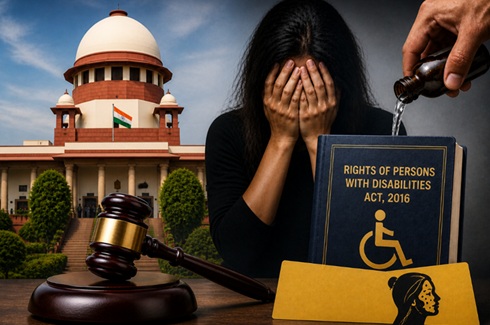
Recently, the Supreme Court delivered an important ruling regarding the rights of acid attack victims. The court stated that not only victims who have had acid thrown on their face or body, but also those who were forced to drink acid and whose internal organs were severely damaged, will receive protection and government assistance under the Disability Act. This ruling was given on a petition filed by acid attack survivor Shaheen Malik.
What was the legal controversy ?
The limited definition of the RPwD Act, 2016
- Under the Rights of Persons with Disabilities Act, 2016, acid attack victims are considered persons with disabilities.
- However, the law's definition primarily focused on those who suffered "external disfigurement" on their body or face due to acid.
- This left victims who were forced to drink acid and whose internal organs were burned outside the scope of the law.
Serious Injuries Caused by Acid Ingestion
- Swallowing acid can seriously affect many vital parts of the body, such as :
- Mouth and throat
- Esophagus
- Stomach and digestive tract
- The effects of these injuries are often permanent. Victims may face lifelong problems with eating, swallowing, and digestion.
Why was this legal change necessary?
- Previously, victims of acid attacks were unable to obtain disability certificates.
- Due to the lack of a disability certificate, they were deprived of many government benefits and rights.
- Such victims were unable to avail of financial assistance, rehabilitation schemes, and medical facilities.
- They also faced difficulty in accessing government compensation and social security schemes.
- The petition stated that treating victims differently based solely on the method of attack is unfair and discriminatory.
Constitutional Issue: Violation of Article 14
- The petition stated that this system violates Article 14 of the Constitution.
- Because acid attack victims, who suffered similar suffering and serious harm, were being treated differently.
- Legal rights were differentiated based solely on the method of attack – acid throwing and acid ingestion.
- According to the petitioner, this was against the constitutional principle of equality.
All acid violence victims are treated as equals.
- The Supreme Court acknowledged that both acid attacks and acid pelting cause severe physical and mental suffering to victims.
- In both cases, victims face long-term health problems and social hardships.
- Therefore, all acid violence victims should be treated as equals.
- The Court stated that all victims should receive equal legal protection and government assistance.
Article 21 and the Right to Dignity
- The Court stated that the lack of rehabilitation, treatment, and compensation violates the victims' right to live with dignity.
- This right is linked to Article 21 of the Constitution.
- Article 21 guarantees every person the right to live with dignity and security.
- Therefore, it is the responsibility of the state to provide necessary assistance and protection to acid attack victims.
Important Observations of the Supreme Court
- The Supreme Court stated that the current sentencing system is not proving to be fully effective in preventing incidents like acid attacks.
- The Court suggested that those selling acid illegally could also be made co-accused in cases.
- The Court also stated that in serious cases, stringent legal measures, such as imposing a burden of proof on the accused, should be considered.
- According to the Court, strict laws and effective enforcement are essential to prevent acid attacks.
- The Supreme Court clarified that this decision will be effective from the date the law comes into force.
Rising acid attacks and pending cases
The Supreme Court also expressed concern over the delay in trials in acid attack cases. It called the lengthy judicial process a "mockery of the system."
States with the Highest Number of Pending Acid Attack Cases
|
State
|
Pending Cases
|
|
Uttar Pradesh
|
198
|
|
West Bengal
|
160
|
|
Gujarat
|
114
|
|
Bihar
|
68
|
Regions with Low Pendency of Acid Attack Cases
|
Region
|
Pending Cases
|
|
Uttarakhand
|
3
|
|
Jammu & Kashmir and Ladakh
|
5
|
Conclusion
This Supreme Court decision is being considered a major step forward in advancing the rights of acid attack victims. It will provide legal recognition and government assistance to victims who were previously denied this due to the limited definition of the law. This decision strengthens the constitutional principles of equality, dignity, and justice.






 Contact Us
  New Batch : 9555124124/ 7428085757
  Tech Support : 9555124124/ 7428085757