Prelims: Typhoon Champi 2026, Taiwan Typhoon, Tropical Cyclone, Super Typhoon, Storm Surge, Coriolis Force, Tropical Cyclone Formation, Western Pacific, Taiwan Central Weather Administration, IMD, Disaster Management
Mains: GS Paper I: Geography, Disaster Management, Climate Change, Tropical Cyclones, Disaster Risk Reduction, Early Warning Systems, Climate Resilience |
Why in news?
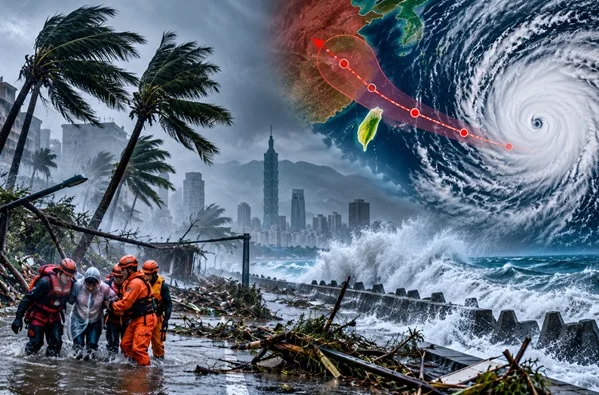
Typhoon Champi swept past Taiwan on 24 October 2026, killing one person and injuring 527 others, as powerful winds and torrential rainfall caused widespread damage and disrupted transportation and electricity supplies.
Key Facts
|
Particulars
|
Details
|
|
Name
|
Typhoon Champi
|
|
Date of major impact on Taiwan
|
23–24 October 2026
|
|
Affected region
|
Taiwan and western Pacific
|
|
Deaths in Taiwan
|
1
|
|
Injuries in Taiwan
|
527
|
|
Wind gusts near storm centre
|
Around 126 km/h on 24 October
|
|
Earlier intensity
|
Super typhoon
|
|
Current movement
|
North towards China's coast
|
|
Landfall in China
|
Not expected at the time of reporting
|
|
Weather agency
|
Taiwan Central Weather Administration
|
|
Major concerns
|
Strong winds, heavy rainfall, coastal waves and power disruption
|
What happened in Taiwan?
- Typhoon Champi passed close to Taiwan's northeastern coast, particularly the Yilan County region. Although the storm weakened from its earlier super typhoon intensity, it continued to produce strong winds and heavy rainfall.
Major impacts
- Human casualties: Taiwan's fire department reported one death after a man was swept away by waves near Liuqiu Island. A total of 527 people were reported injured.
- Electricity disruption: Taiwan Power Company reported that more than 288,000 households had experienced power outages at one point, with electricity restored to most affected homes.
- Transportation: Hundreds of flights were cancelled. The transport ministry reported 242 cancellations on Saturday, following nearly 1,000 cancellations on Friday.
- Schools and offices: Authorities extended closures across parts of northern and central Taiwan, including Taipei.
- Infrastructure damage: Strong winds uprooted trees, damaged buildings, disrupted power lines and created hazardous conditions in urban and coastal areas.
What is a Typhoon?
- A tropical cyclone that develops over the north western Pacific Ocean and reaches the required intensity of a tropical cyclone.
- It is a large rotating weather system characterised by:
- A low-pressure centre.
- Strong winds circulating around the centre.
- Heavy rainfall.
- Thunderstorms.
- Potential storm surges and coastal flooding.
- Tropical cyclones develop over warm ocean waters and draw energy from the heat and moisture available in the atmosphere.
Difference between cyclone, typhoon and hurricane
|
Term
|
Region
|
|
Cyclone
|
Indian Ocean and South Pacific
|
|
Typhoon
|
North-western Pacific Ocean
|
|
Hurricane
|
Atlantic Ocean and north-eastern Pacific Ocean
|
How does a Typhoon form?
- Warm ocean water: Sea surface temperatures of approximately 26.5°C or higher over a sufficient depth provide energy and moisture.
- Evaporation: Warm ocean water evaporates, adding moisture to the atmosphere.
- Condensation: Moist air rises and cools, forming clouds and releasing latent heat.
- Low pressure: The released heat warms the surrounding atmosphere and supports rising air and a developing low-pressure system.
- Rotation: The Coriolis force helps the system develop a rotating circulation.
- Intensification: Under favourable atmospheric conditions, the system strengthens into a tropical cyclone and may reach typhoon or super typhoon intensity.
What is a Super Typhoon?
- An exceptionally intense tropical cyclone in the western North Pacific.
- The term is commonly used by the US Joint Typhoon Warning Center (JTWC) for tropical cyclones reaching maximum sustained winds of at least 130 knots, equivalent to approximately 240 km/h.
- Champi had earlier reached super typhoon intensity before weakening near Taiwan.
Major geographical reasons
- Western Pacific location: Taiwan lies in a major tropical cyclone development and movement region.
- Coastal exposure: Strong winds and waves affect coastal settlements, ports and fishing communities.
- Mountainous terrain: Heavy rainfall can trigger landslides, flash floods and river flooding.
- Urban infrastructure: Dense settlements, electricity networks and transportation infrastructure are exposed to storm damage.
- Seasonal weather: Taiwan's typhoon season generally extends through the warmer months, but tropical cyclones can also affect the island during autumn.
Typhoon Champi's impact on China
- As Champi moved north from Taiwan, Chinese authorities prepared for possible impacts along the eastern coastal province of Zhejiang.
- The storm was not expected to make landfall in China at the time of reporting, but authorities warned of strong winds and heavy rainfall.
Major preparedness measures
- Emergency teams were deployed to Zhejiang.
- Approximately 400 rescue workers and 600 pieces of equipment were readied.
- More than 41,000 firefighters were placed on emergency duty.
- Over 3,800 fishing boats returned to harbour in Taizhou.
- Offshore fish-farm workers were brought ashore.
- More than 2,000 island visitors were evacuated.
- Offshore construction projects and passenger ferry services were suspended.
Why do Typhoons cause heavy rainfall and flooding?
- Typhoons transport large amounts of moisture from the ocean towards land. When moist air rises, it cools and condenses, producing heavy rainfall.
- Flooding can occur because of:
- Intense rainfall over a short period.
- Rivers overflowing their banks.
- Poor drainage in urban areas.
- Rainfall over mountainous terrain.
- Storm surges in coastal regions.
- In mountainous areas, intense rainfall may also trigger landslides and debris flows.
What is a Storm Surge?
- An abnormal rise in sea level caused mainly by a storm's winds pushing seawater towards the coast. It is different from an ordinary ocean tide.
- Strong winds push seawater towards coastal areas. Low atmospheric pressure also contributes to a rise in sea level. When the elevated water reaches the coast, it can cause coastal flooding.
- Storm surge becomes especially dangerous when it coincides with high tide.
Storm surge vs tsunami
|
Storm surge
|
Tsunami
|
|
Mainly caused by storm winds and pressure
|
Mainly caused by underwater earthquakes, landslides or volcanic activity
|
|
Associated with tropical cyclones and severe storms
|
Associated with sudden displacement of water
|
|
Usually linked to storm duration and coastal weather
|
May involve multiple powerful waves
|
Typhoons and Climate Change
- Warmer oceans: Rising ocean temperatures increase the potential energy available to tropical cyclones.
- Intense rainfall: A warmer atmosphere can hold more water vapour, increasing the potential for heavy rainfall.
- Sea-level rise: Rising sea levels increase the baseline from which storm surges occur, potentially worsening coastal flooding.
- Regional changes: Climate change may influence cyclone intensity, rainfall, movement and seasonal patterns, but these changes differ across ocean basins.
Does climate change cause every typhoon?
- No. Tropical cyclones develop through a combination of natural atmospheric and oceanic conditions.
- Climate change can influence the environment in which they form and intensify, but it is not accurate to attribute every individual storm directly to climate change without scientific analysis.
Typhoon Naming System
- Tropical cyclones are assigned names to make communication, forecasting and public warnings easier.
- The naming system in the western North Pacific is coordinated through the World Meteorological Organization's regional arrangements.
- The names are contributed by countries and territories participating in the regional system.
India's Disaster Management Framework
|
Institution
|
Role
|
|
India Meteorological Department (IMD)
|
Weather forecasting and cyclone warnings
|
|
National Disaster Management Authority (NDMA)
|
National disaster management policies and guidelines
|
|
National Disaster Response Force (NDRF)
|
Disaster response and rescue operations
|
|
State Disaster Management Authorities
|
State-level disaster planning and coordination
|
|
Indian National Centre for Ocean Information Services (INCOIS)
|
Ocean information, including tsunami and coastal hazard-related services
|
Major Indian initiatives
- National Cyclone Risk Mitigation Project (NCRMP): Supports cyclone risk reduction through infrastructure, preparedness and capacity-building measures in vulnerable coastal states.
- Early Warning Dissemination Systems: Help communicate alerts to vulnerable communities.
- Cyclone shelters: Provide safe locations for people during severe storms.
- Coastal regulation and planning: Support the management of development and environmental risks along coastlines.
India and the Sendai Framework
- The Sendai Framework for Disaster Risk Reduction 2015-2030 is a global framework adopted to reduce disaster risks and losses.
- Its four priorities are:
- Understanding disaster risk.
- Strengthening disaster risk governance.
- Investing in disaster risk reduction.
- Enhancing preparedness and building back better.
Prelims MCQs
Q. Typhoons are tropical cyclones that occur in which region?
A. Northwestern Pacific
B. Mediterranean Sea
C. Arctic Ocean
D. Southern Atlantic
UPSC Mains Question
Q. How do tropical cyclones affect coastal communities? Discuss measures to reduce their impact.
|
FAQs
What is Typhoon Champi?
A tropical cyclone that swept past Taiwan in October 2026.
When did Champi affect Taiwan?
23–24 October 2026.
How many people died in Taiwan?
One person, according to reports on 24 October.
How many people were injured?
527 people.
Where is Champi moving?
North towards China's coast, with its forecast track potentially extending towards southern Japan.
|





 Contact Us
 New Batch : 9555124124/ 7428085757
 Tech Support : 9555124124/ 7428085757
