Why in News?
- A team of researchers has developed an experimental protein-based pneumococcal vaccine using a technique known as reverse vaccinology.
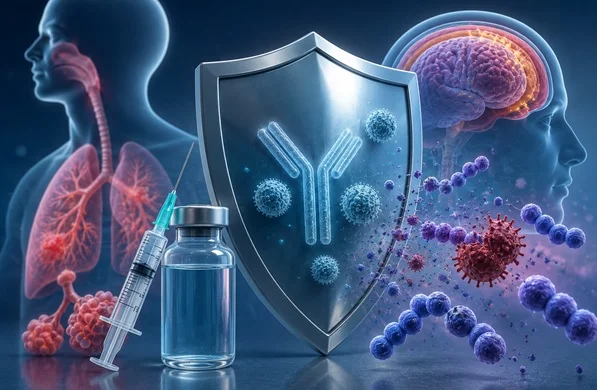
What is Streptococcus pneumoniae?
- Streptococcus pneumoniae, commonly called pneumococcus, is a bacterium that can colonise the human nose and throat without necessarily causing illness. Under certain conditions, however, it can invade other parts of the body and cause serious disease.
- It can cause Pneumonia (Lungs), Meningitis (Meninges), Sepsis (Bloodstream). Collectively, infections caused by this bacterium are known as pneumococcal diseases.
What is Pneumonia?
- An infection affecting the lungs, particularly the tiny air sacs called alveoli. It can be caused by several types of pathogens, including bacteria, viruses and fungi.
- Pneumonia can be particularly dangerous for young children, older adults and people with weakened immune systems.
What is Meningitis?
- Meningitis is inflammation of the meninges, the protective membranes surrounding the brain and spinal cord. It may be caused by bacteria, viruses, fungi and other pathogens.
- WHO notes that survivors of bacterial meningitis can also suffer long-term complications such as hearing loss, seizures, limb weakness and problems with vision, speech or memory.
Why is developing a Universal Pneumococcal Vaccine difficult?
- The central challenge is the enormous diversity of Streptococcus pneumoniae. There are more than 100 known serotypes.
What is a Serotype?
- A serotype is a distinct variation within a species of microorganism that differs in its surface antigens and can therefore be recognised differently by the immune system. Different pneumococcal serotypes have different capsular polysaccharides surrounding the bacterial cell.
How do existing Pneumococcal Vaccines work?
Current pneumococcal vaccines primarily target the bacterium's capsular polysaccharides. The capsule is an outer layer made largely of complex sugars. Because different serotypes possess different capsular structures, vaccines generally need to incorporate antigens from several important serotypes. Two broad approaches are particularly important.
- Pneumococcal Polysaccharide Vaccines: These contain purified capsular polysaccharides from multiple pneumococcal serotypes. A well-known example is PPSV23 (Pneumovax 23). It targets 23 pneumococcal serotypes. Pure polysaccharide vaccines do not generate equally strong immune responses in all age groups, particularly young children.
- Pneumococcal Conjugate Vaccines: Scientists developed Pneumococcal Conjugate Vaccines (PCVs) to produce stronger and more durable immune responses. In these vaccines:
Capsular polysaccharide + Carrier protein → Conjugate vaccine
Attaching the polysaccharide antigen to a carrier protein helps the immune system generate a stronger immune response and immunological memory.
Major Limitation of Existing Vaccines
- Adding more serotype-specific polysaccharides can broaden protection, but the approach becomes increasingly complex and costly as the number of targeted serotypes rises.
- There is another important phenomenon known as serotype replacement. When vaccination reduces disease caused by targeted serotypes, other non-vaccine serotypes can sometimes occupy the ecological space left behind.
What is the new approach?
- Instead of targeting the serotype-specific polysaccharide capsule, researchers searched for proteins shared across pneumococcal serotypes.
- The central idea is: Old approach: Target what differs between serotypes.
New approach: Target what many serotypes have in common
What is Reverse Vaccinology?
- A modern vaccine-development approach in which scientists begin with the genome of a pathogen and use computational and bioinformatics tools to identify genes encoding promising vaccine antigens.
- Traditional vaccine development broadly proceeds as pathogen, culture, identify components, test antigens and vaccine.
- It reverses much of this process genome, bioinformatics analysis, candidate genes, candidate proteins, experimental testing and vaccine candidate.
Why is Reverse Vaccinology important?
- It can help identify proteins that occur across many strains, are exposed on the pathogen's surface, can be recognised by the immune system, generate a strong immune response and are sufficiently different from human proteins.
How did scientists search for a Universal Pneumococcal Target?
- The S. pneumoniae genome contains more than 2,000 genes, with around 1,300 genes shared across serotypes, according to the research summary.
- Researchers analysed genomic information from more than 20,000 pneumococcal isolates spanning nearly 100 serotypes using computational and bioinformatics tools.
- They searched for proteins meeting three broad conditions.
- Accessible to the Immune System: The protein should preferably be located on or exposed near the bacterial surface, allowing antibodies and immune cells to recognise it.
- Different from Human Proteins: The candidate should have little similarity to human proteins, reducing the risk of immune responses against the body's own tissues.
- Strong Immunogenic Potential: It should be capable of triggering a strong and durable immune response against pneumococcus.
The Three Proteins: Z, P and Y
After screening potential targets, the researchers selected three candidate proteins:
- Z (Zinc Metalloprotease B): A bacterial protein identified as a potential target for immune recognition.
- P (Pneumococcal Adherence Virulence Factor A): A protein associated with pneumococcal interaction with the host.
- Y (YfhO-like Protein): A third conserved protein selected through genomic and structural analysis.
The researchers produced these proteins in the laboratory and combined them to construct the experimental vaccine.
What is ZPY-CpG-Ch?
- Z + P + Y = the three selected pneumococcal proteins.
- The formulation also contained two components designed to enhance the immune response:
- CpG: a synthetic DNA-based immune stimulant.
- Chitosan (Ch): a polysaccharide-based polymer used in the formulation.
- Z + P + Y + CpG + Chitosan → ZPY-CpG-Ch experimental vaccine
What did the Mouse Experiments show?
- Researchers vaccinated laboratory mice with the experimental formulation and subsequently exposed those to potentially lethal S. pneumoniae infections.
- Against highly virulent serotype 1, vaccinated mice showed approximately 80–100% survival, whereas the unvaccinated controls succumbed to the challenge. The level of protection was reported to be comparable in the experiment to PCV13.
Did it work against Non-Vaccine Serotypes?
- Researchers also challenged vaccinated mice with pneumococcal serotypes not covered by the comparator vaccine.
- The experimental formulation provided complete protection against serotype 11A, complete protection against serotype 33F, and about 50% protection against serotype 8.
- These results support the idea that targeting conserved proteins could provide broader protection across different pneumococcal serotypes.
- also provided protection against a lethal pneumococcal challenge. This provided evidence that antibody-mediated immunity contributed to the vaccine's protective effect.
Link between Pneumococcal Disease and Antibiotic Resistance
- The search for a broader vaccine also has implications for Antimicrobial Resistance (AMR). Some pneumococcal strains can be resistant to antibiotics. Reducing pneumococcal infections through vaccination can potentially reduce the need for antibiotic treatment and therefore lower one source of selective pressure contributing to AMR. Serotype replacement can further complicate the problem when emerging non-vaccine serotypes possess or acquire antibiotic-resistance genes.
Is a Universal Vaccine Now Available?
- The experimental vaccine has so far been tested primarily in laboratory mice, and researchers examined protection against only a small fraction of the more than 100 pneumococcal serotypes. Results obtained in animals do not automatically translate into safety and effectiveness in humans.
Why is the research significant?
- The study demonstrates an important conceptual shift. Instead of continuously expanding vaccines by adding more serotype-specific polysaccharides, researchers are exploring whether conserved proteins can provide protection across a much wider range of pneumococcal strains.
- If successful, such a strategy could potentially broaden vaccine coverage, reduce serotype replacement, simplify vaccine composition, reduce pneumococcal disease and contribute to controlling antimicrobial resistance.
Importance for India
- The research is particularly relevant for India because pneumonia and other respiratory infections remain important public-health concerns, especially among children.
- India's Universal Immunisation Programme (UIP) includes pneumococcal vaccination for children, making developments in next-generation pneumococcal vaccines relevant to India's broader efforts to reduce vaccine-preventable childhood morbidity and mortality.
- A future broadly protective pneumococcal vaccine could potentially simplify protection against multiple serotypes and improve long-term disease control, although the present experimental formulation is still far from routine human use.
Challenges Ahead
- Human effectiveness: Protection observed in mice may not translate directly to humans.
- Serotype coverage: The vaccine has been experimentally tested against only a handful of pneumococcal serotypes.
- Colonisation: It protected against disease but did not eliminate upper respiratory bacterial carriage.
- Duration of immunity: Researchers need to determine how long protection lasts.
- Manufacturing and affordability: Any eventual universal vaccine must be scalable and affordable, especially for low- and middle-income countries.
Prelims MCQ
Q. What is ‘Reverse Vaccinology’?
A. Using antibiotics to develop vaccines
B. Using genomic and computational analysis to identify potential vaccine antigens
C. Developing vaccines only from weakened pathogens
D. Producing vaccines without identifying antigens
Mains Practice Question
Q. “Next-generation vaccines can play an important role in addressing antimicrobial resistance.” Examine the statement with reference to pneumococcal disease.
|
FAQs
What is a universal pneumococcal vaccine?
A vaccine designed to protect against multiple serotypes of Streptococcus pneumoniae.
What is Streptococcus pneumoniae?
A bacterium that can cause pneumonia, meningitis and sepsis.
Is this a universal vaccine for all pneumonia and meningitis?
No. It specifically targets diseases caused by S. pneumoniae.
Why is a universal pneumococcal vaccine needed?
Because S. pneumoniae has more than 100 serotypes, while current vaccines cover only selected ones.
What is ZPY-CpG-Ch?
It is an experimental protein-based pneumococcal vaccine candidate.
|





 Contact Us
  New Batch : 9555124124/ 7428085757
  Tech Support : 9555124124/ 7428085757