
- UPSC Exam
- State PCS
- One Day Exam
- Current Affairs
- PT Quiz
- Downlaods
- About Coaching
- Blog
- Videos

| Prelims: (Economics + CA) Mains: (GS 2: India–US Relations; GS 3: Infrastructure, Energy Security, Industrial Policy, External Sector) |
The United States has imposed preliminary countervailing duties (CVD) of 126% on crystalline silicon photovoltaic (CSPV) cells and modules imported from India, following an investigation into alleged unfair government subsidies. The decision could significantly affect India’s rapidly expanding solar manufacturing sector, which has relied heavily on exports to the US market.
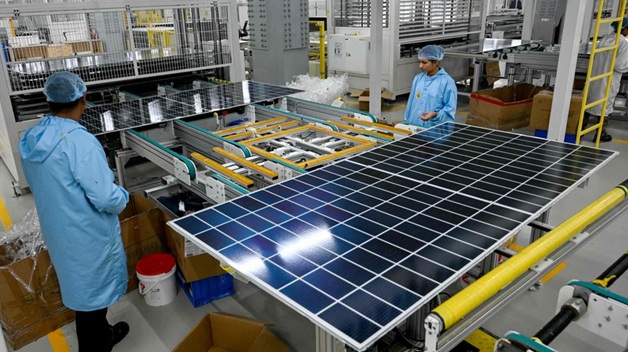
The duties were announced by the United States Department of Commerce after a subsidy probe into Indian solar manufacturers. The investigation also covered imports from Indonesia and Laos, assigning varying duty rates.
Countervailing duties are imposed to offset subsidies provided by exporting countries that allegedly distort fair trade. These measures are distinct from anti-dumping duties and are consistent with global trade rules under the World Trade Organization framework.
The move comes amid rising trade tensions in the clean energy sector, where governments are increasingly promoting domestic manufacturing through subsidies and industrial policies.
The final determination on the duties is expected later this year.
India has significantly scaled up its solar module production capacity:
This indicates a structural supply-demand imbalance, making exports crucial for sustaining capacity utilisation.
Between 2021 and 2024:
Thus, the US market has been central to India’s solar export strategy.
A 126% duty significantly increases the landed cost of Indian modules in the US, potentially making the market commercially unviable for many exporters.
If export-bound modules are redirected to India:
Tariff disruptions may affect:
India’s renewable sector is already facing:
Further disruptions could impact renewable capacity addition targets.
Not all manufacturers are equally exposed.
Thus, impact may vary depending on company-specific export strategies.
The investigation reportedly stems from allegations that Chinese manufacturers, facing US tariffs, shifted production to countries such as India, Indonesia, and Laos to retain access to the American market.
In the first half of 2025:
The duties are aimed at protecting US domestic solar manufacturing under broader industrial policy measures.
However, higher import duties may:
This reflects the growing intersection of climate policy and trade protectionism.
India has committed to achieving 500 GW of non-fossil fuel capacity by 2030 and net-zero emissions by 2070.
A strong domestic solar manufacturing ecosystem is essential for:
The US duties may compel India to:
1. Diversify Export Markets
Explore opportunities in Europe, Africa, Middle East, and Latin America.
2. Strengthen Domestic Demand
Enhance policy incentives such as Production-Linked Incentive (PLI) schemes and domestic procurement mandates.
3. Encourage Overseas Manufacturing
Shift from exporting products to exporting capital — establishing manufacturing bases abroad to bypass trade barriers.
4. Improve Competitiveness
Invest in technology upgrades, efficiency improvements, and cost reductions.
Trade Policy Implications
Highlights increasing use of trade remedies in the renewable energy sector.
Strategic India–US Economic Dimension
Adds complexity to clean energy cooperation between India and the US.
Industrial Policy Test
Challenges India’s ambition to become a global solar manufacturing hub.
Energy Transition Risks
Excess capacity and pricing pressure could destabilise domestic manufacturers.
Global Climate Paradox
Protectionist measures may conflict with global climate cooperation goals.
FAQsQ1. What are countervailing duties (CVD) ? They are tariffs imposed to offset subsidies provided by exporting countries that allegedly give unfair price advantages to their manufacturers. Q2. Why is the US imposing duties on Indian solar panels ? Following an investigation, the US determined that Indian manufacturers benefited from government subsidies that distorted market competition. Q3. How dependent is India on the US solar market ? Between 2021 and 2024, over 90% of India’s solar module exports were shipped to the US, making it a critical export destination. Q4. Will this affect India’s renewable energy targets ? Indirectly, yes. Oversupply and pricing pressure may strain domestic manufacturers, potentially impacting long-term capacity expansion plans. Q5. What strategic options does India have ? India can diversify export markets, enhance domestic demand, strengthen industrial competitiveness, and consider overseas manufacturing investments. |



Our support team will be happy to assist you!

 Contact Us
  New Batch : 9555124124/ 7428085757
  Tech Support : 9555124124/ 7428085757