|
Prelims : International Relations + Geography + CA
Mains : GS Paper 2 – India and its Neighbourhood; GS Paper 3 – Security; Internal Security & Defence
|
Why in News ?
Israel’s evolving concept of the “Yellow Line” has emerged as a significant development in contemporary conflict strategy, particularly in the context of its operations in Gaza and its extension into southern Lebanon in 2026.
- Israel has reportedly established a militarised buffer zone extending several kilometres inside southern Lebanon, marking a shift from border defence to forward territorial control
- The move has been criticised by Lebanon and non-state actors like Hezbollah, who view it as a violation of sovereignty and ceasefire arrangements
- The development reflects a broader transformation in Israel’s military doctrine, emphasising pre-emptive defence, spatial control, and long-term security dominance beyond its recognised borders
This concept is increasingly important as it represents a new model of warfare where physical control of territory is used as a preventive security mechanism.
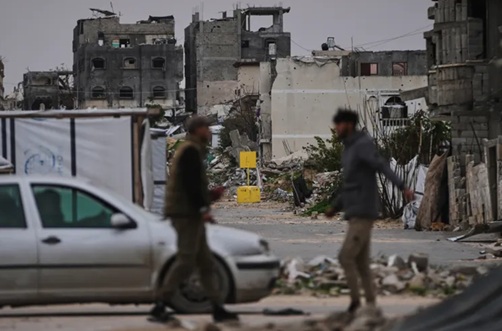
What is the ‘Yellow Line’ ?
The “Yellow Line” is a military-imposed demarcation or buffer zone created by Israeli forces inside conflict territories to establish a controlled security perimeter.
- It is not a legally recognised international boundary but rather a tactical and operational line defined by military presence and control
- It demarcates :
- Areas under direct Israeli military control and surveillance
- Areas beyond which perceived threats are expected to originate
Unlike conventional borders, the Yellow Line is :
- Flexible and expandable, depending on the intensity of conflict
- Enforced through military means rather than diplomatic agreements
- Often treated as a high-risk exclusion zone, where civilian movement is heavily restricted or prohibited
In essence, it represents a shift from territorial defence to territorial domination as a means of ensuring security.
Origin and Evolution of the Yellow Line
1. Emergence During the Gaza Conflict (2025)
- The concept first gained prominence during Israel’s military operations in Gaza in 2025
- Israeli forces established a visible demarcation line, often marked by barriers and painted structures, dividing the region into zones of control
This division effectively :
- Segregated Israeli-controlled areas from those outside its immediate authority
- Enabled systematic surveillance and monitoring of movement
- Restricted civilian access to large parts of the territory
This marked a transition toward physically enforced spatial control within densely populated conflict zones.
2. Expansion into Southern Lebanon (2026)
- In 2026, Israel extended the Yellow Line concept into southern Lebanon, creating a buffer zone inside foreign territory
- The zone is designed to act as a protective barrier between Israeli borders and hostile groups operating in the region
This expansion is significant because :
- It represents the externalisation of Israel’s defence perimeter beyond its borders
- It introduces a similar control model in multiple theatres of conflict
Key Features of the Yellow Line Strategy
1. Shift to Forward Defence Doctrine
- Traditional defence strategies rely on protecting national borders from within
- The Yellow Line reflects a shift toward forward defence, where threats are neutralised before reaching the border
This approach:
- Pushes the conflict zone away from civilian areas within Israel
- Allows early detection and interception of threats
- Reduces response time in case of hostile activity
2. Creation of a Militarised Buffer Zone
- The area along the Yellow Line is heavily militarised, featuring :
- Continuous troop deployment
- Advanced surveillance systems such as drones and sensors
- Fortified positions and checkpoints
- Civilians are often :
- Displaced from these zones
- Restricted from returning due to security concerns
This transforms the buffer zone into a controlled security corridor with minimal civilian presence.
3. Establishment of High-Control or “Free-Fire” Zones
- Areas near the Yellow Line are frequently treated as high-threat zones
- Any unauthorised movement may be considered hostile, leading to strict enforcement measures
This creates :
- A deterrence effect against militant infiltration
- Significant risks for civilians due to the blurred distinction between combatants and non-combatants
4. Permanent or Semi-Permanent Infrastructure
- Unlike temporary military deployments, the Yellow Line involves :
- Construction of defensive infrastructure
- Establishment of observation posts and logistical bases
This indicates an intention for long-term presence rather than short-term tactical deployment.
5. Spatial Segmentation of Conflict Zones
- The Yellow Line divides territories into :
- Controlled zones under Israeli influence
- Uncontrolled or contested zones beyond
This segmentation allows :
- Better monitoring and regulation of movement
- Strategic dominance over key geographical areas
Strategic Objectives Behind the Yellow Line
1. Preventing Militant Regrouping and Infiltration
- By maintaining control over buffer zones, Israel aims to :
- Prevent militant groups such as Hamas and Hezbollah from reorganising near its borders
- Disrupt supply lines and communication networks
2. Creating Strategic Depth
- Strategic depth refers to the distance between the frontline and critical population centres
The Yellow Line :
- Expands this distance
- Provides additional reaction time during attacks
- Enhances defensive resilience
3. Establishing De Facto Territorial Control
- Although not officially annexed, areas within the Yellow Line come under effective Israeli control
- Over time, such zones may evolve into informal boundaries influencing political negotiations
4. Enhancing Deterrence Capability
- Demonstrates Israel’s willingness to :
- Maintain aggressive forward positions
- Impose costs on adversaries
This psychological dimension strengthens deterrence.
Implications for West Asian Geopolitics
1. Sovereignty Concerns
- The presence of Israeli forces inside Lebanese territory is viewed as a violation of national sovereignty
- It raises questions about the legitimacy of unilateral security measures
2. Strain on Ceasefire Agreements
- The creation of buffer zones may :
- Undermine existing ceasefire arrangements
- Trigger retaliatory actions by non-state actors
3. Humanitarian Impact
- Displacement of civilian populations
- Loss of access to homes, agricultural land, and livelihoods
- Increased vulnerability due to proximity to militarised zones
4. Risk of Escalation
- High militarisation increases the likelihood of :
- Accidental clashes
- Rapid escalation into larger conflicts
5. Evolution of Modern Warfare
- The Yellow Line reflects a broader trend where :
- Territorial control is used as a preventive strategy
- Conflicts are managed through controlled spatial dominance rather than clear frontlines
Comparison with Other Demarcation Lines
- Unlike traditional ceasefire lines or borders, such as the Green Line, which are politically negotiated,
- The Yellow Line is :
- Unilateral
- Militarily enforced
- Flexible and subject to change
This highlights a shift from legal boundaries to operational control zones.
Criticism and Concerns
1. Questions of Legality
- Critics argue that such actions may violate :
- International law
- Principles of territorial sovereignty
2. Civilian Displacement and Hardship
- Large populations may be displaced
- Restricted access to basic resources affects livelihoods
3. Ambiguity and Uncertainty
- Lack of clearly defined boundaries creates confusion
- Civilians may unknowingly enter high-risk zones
4. Sustainability Challenges
- Maintaining buffer zones requires :
- Continuous military deployment
- Significant financial and logistical resources
Way Forward
1. Diplomatic Engagement
- Encourage dialogue between Israel and neighbouring countries
- Strengthen mechanisms for conflict resolution
2. International Monitoring
- Increase role of global institutions in monitoring compliance with international law
3. Protection of Civilians
- Ensure humanitarian safeguards in conflict zones
- Facilitate safe return and rehabilitation of displaced populations
4. De-escalation Strategies
- Promote confidence-building measures
- Reduce dependence on militarised buffer zones
Practice Questions
Prelims
Q. The “Yellow Line” refers to :
(a) An internationally recognised boundary
(b) A military buffer zone established by Israel
(c) A maritime trade route
(d) A UN peacekeeping corridor
Mains
“Emerging military doctrines such as Israel’s ‘Yellow Line’ indicate a shift towards spatial control and pre-emptive defence in modern warfare.” Critically analyse.
FAQs
Q1. What is the Yellow Line ?
It is a military demarcation line marking areas under Israeli control.
Q2. Why was it created ?
To establish a buffer zone and prevent militant threats.
Q3. Where is it used ?
Initially in Gaza and later extended to southern Lebanon.
Q4. Why is it controversial ?
It raises issues of sovereignty, legality, and humanitarian impact.
Q5. Why is it important for UPSC ?
It reflects evolving conflict strategies and geopolitical dynamics in West Asia.
|






 Contact Us
  New Batch : 9555124124/ 7428085757
  Tech Support : 9555124124/ 7428085757