Prelims : (Polity & Constitution + Defence + CA)
Mains : (GS 2 – Governance, Equality, Women Empowerment; GS 3 – Security, Armed Forces) |
Why in News ?
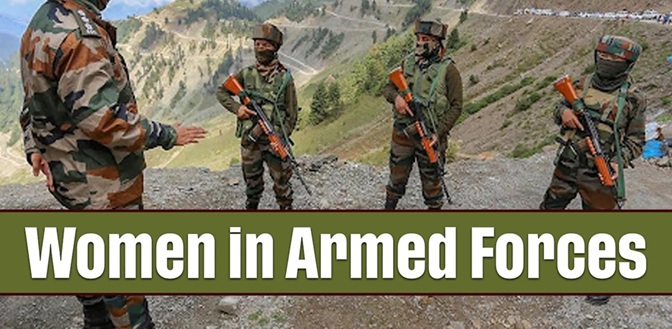
The Supreme Court of India has upheld the grant of Permanent Commission (PC) and pensionary benefits for women officers in the Armed Forces, emphasising the need to eliminate systemic gender bias and ensure substantive equality.
Background and Context
Women in the Armed Forces
Women have historically been inducted into the Indian Armed Forces mainly through :
- Short Service Commission (SSC)
Key Features of SSC :
- Limited tenure :
- No assured long-term career
- Restricted access to :
Permanent Commission (PC)
- Allows :
- Full-length career till retirement
- Pension and post-retirement benefits
- Essential for :
- Leadership roles
- Career progression
Issues Faced by Women Officers
- Limited access to Permanent Commission
- Restricted career advancement
- Lack of command opportunities
- Institutional bias in :
- Performance evaluation
- Promotions
Impact :
- Created structural inequality between male and female officers
Supreme Court’s Key Directions
1. Grant of Permanent Commission
- Women officers meeting eligibility criteria :
- Must be considered for PC
- Court held :
- Inclusion is a constitutional obligation, not discretion
2. Pensionary Benefits
- Women officers denied PC but released :
- Deemed to have completed 20 years of service
- Entitled to :
- Pension
- All consequential benefits
3. No Vacancy Cap Barrier
- Court rejected :
- Argument of limited vacancies
- Held :
- Administrative constraints cannot override equality principles
4. Uniform Relief Across Forces
- Applies to :
- Ensures :
- Consistency across all branches
Constitutional and Legal Principles
1. Equality Before Law
- Under Article 14 :
- Prohibits arbitrary discrimination
2. Equal Opportunity in Public Employment
- Under Article 16 :
- Guarantees equal access to public jobs
3. Substantive Equality
- Court emphasised :
- Real equality requires addressing structural disadvantages
- Goes beyond :
Significance of the Judgment
1. Gender Justice
- Recognises and addresses systemic bias
2. Institutional Reform
- Forces changes in :
- Evaluation systems (ACRs)
- Promotion processes
3. Career Stability for Women
- Ensures :
- Long-term service
- Financial security
4. Strengthening Armed Forces
- Promotes :
- Merit-based system
- Diversity and inclusion
5. Precedential Value
- Builds on earlier rulings on gender equality
- Sets benchmark for :
Broader Implications
1. Expanding Roles for Women
- Opens pathways for :
- Leadership positions
- Combat and command roles (gradually)
2. Policy Reforms
- Necessitates review of :
- Service rules
- Training access
3. Social Impact
- Reinforces :
- Gender equality in public institutions
Challenges
- Resistance within institutional structures
- Need for infrastructure and policy adjustments
- Ensuring uniform implementation across services
Way Forward
- Reform internal evaluation and promotion systems
- Ensure equal access to :
- Build gender-sensitive institutional culture
- Monitor implementation of court directives
FAQs
1. What is Permanent Commission (PC) ?
It allows officers to serve a full career in the Armed Forces with pension benefits.
2. What was the issue with women officers ?
They were largely restricted to Short Service Commission, limiting career growth and benefits.
3. What did the Supreme Court rule ?
Women officers must be considered for PC and given pension benefits if eligible.
4. Which constitutional provisions are involved ?
Articles 14 and 16 ensuring equality and equal opportunity.
5. What is the significance of the judgment ?
It promotes gender equality, institutional reform, and strengthens the Armed Forces.
|






 Contact Us
  New Batch : 9555124124/ 7428085757
  Tech Support : 9555124124/ 7428085757