
- UPSC Exam
- State PCS
- One Day Exam
- Current Affairs
- PT Quiz
- Downlaods
- About Coaching
- Blog
- Videos

| Prelims : Polity + Constitution + CA Mains : GS Paper 2 – Governance; Representation of Women; Constitutional Amendments |
The Union Government has formally brought into force the Women’s Quota Act, 2023, also known as the Nari Shakti Vandan Adhiniyam, marking a historic step toward institutionalising gender-based political representation in India.
Although the Act has now been notified, its operationalisation in terms of actual seat reservation in the Lok Sabha and State Legislative Assemblies will take place only after the completion of the next Census and the subsequent delimitation exercise. This means that while the legal framework is now in place, its tangible impact on electoral politics is expected to be visible only from the 2029 general elections onward.
This development assumes significance in the context of India’s relatively low representation of women in legislative bodies, despite being the world’s largest democracy, and highlights the state’s commitment to improving inclusivity in governance.
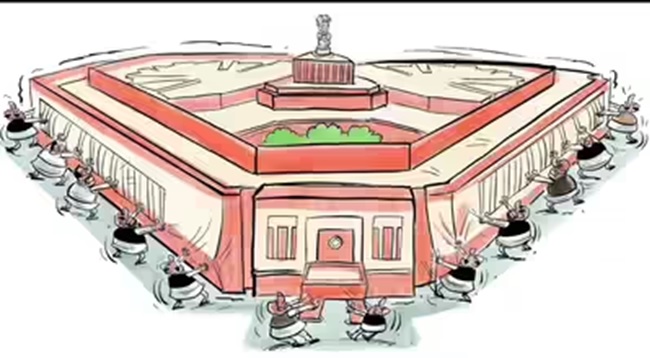
The Women’s Quota Act, formally enacted as the Constitution (106th Amendment) Act, 2023, introduces a structural reform aimed at correcting gender imbalances in political representation.
Overall, the Act represents a shift from voluntary political inclusion to a legally enforceable framework for gender representation.
The demand for reservation of seats for women in legislatures has been a persistent feature of India’s political discourse since the early 1990s. Multiple attempts were made to pass similar legislation, but these efforts were repeatedly stalled due to lack of political consensus, disagreements over sub-quotas, and concerns regarding the impact on existing power structures.
The passage of the 2023 Act, therefore, marks the culmination of decades of advocacy by women’s groups, civil society organisations, and policymakers who have argued that structural barriers prevent women from entering politics on equal footing with men.
The Act was passed by both Houses of Parliament with an overwhelming majority, reflecting a rare moment of political consensus on a significant reform measure. As a constitutional amendment, it required ratification by at least half of the state legislatures, which was subsequently achieved.
The amendment introduced new constitutional provisions to institutionalise the reservation framework, thereby giving it a strong legal and structural foundation that cannot be easily altered without further constitutional changes.
A key feature of the Act is that its implementation is contingent upon the completion of the next Census and the delimitation of constituencies. Delimitation refers to the process of redrawing electoral boundaries to reflect population changes.
This condition has resulted in a time lag between the enactment of the law and its actual implementation. While this approach is intended to ensure fairness and proportional representation, it has also attracted criticism for potentially delaying the benefits of the reform.
The Act provides for reservation of seats for women in both national and state-level legislatures, thereby ensuring a comprehensive impact across different tiers of governance. This is significant because it goes beyond local bodies, where reservation for women already exists, and extends it to higher levels of political decision-making.
By incorporating reservation within SC and ST quotas, the Act acknowledges the intersectionality of gender and caste-based disadvantage. This ensures that women from historically oppressed communities are not excluded from the benefits of political reservation.
The Act предусматривает rotation of reserved constituencies after each delimitation exercise. While this is intended to distribute opportunities across different regions, it also introduces complexities in terms of continuity of representation and political accountability.
The introduction of specific constitutional provisions ensures that the reservation framework is not merely a policy decision but a legally enforceable right. This enhances the durability and legitimacy of the reform.
Women remain significantly underrepresented in India’s legislatures, often due to socio-cultural barriers, lack of resources, and limited access to political networks. The Act directly addresses this imbalance by guaranteeing a minimum level of representation.
A representative democracy must reflect the diversity of its population. By ensuring greater participation of women, the Act enhances the inclusivity and legitimacy of democratic institutions, making them more responsive to the needs of all sections of society.
Empirical evidence from local governance suggests that increased participation of women leads to greater emphasis on issues such as health, education, nutrition, and social welfare. Extending this representation to higher levels of governance could result in more balanced and inclusive policymaking.
The Act aligns with the fundamental principles of equality and social justice enshrined in the Constitution. It operationalises the idea that formal equality must be complemented by substantive measures to address structural disadvantages.
The requirement of linking implementation to Census and delimitation has raised concerns that the actual benefits of the Act may be deferred for several years, thereby diluting its immediate impact.
There is a possibility that reservation alone may not ensure meaningful participation if women representatives are not given real decision-making authority within political parties and legislative bodies.
Frequent rotation of reserved constituencies may discourage representatives from investing in long-term development of their constituencies, as they may not have the opportunity to contest from the same seat again.
Some stakeholders have raised concerns about the absence of specific provisions for Other Backward Classes (OBCs), arguing that without such measures, the benefits may not be equitably distributed.
The Act has the potential to significantly alter the composition of legislative bodies, leading to a more gender-balanced political system and creating new opportunities for leadership.
Political parties will need to adapt their strategies, including candidate selection, leadership development, and organisational structures, to accommodate increased participation of women.
Greater visibility of women in positions of power can challenge traditional gender norms and inspire more women to participate in public life, thereby creating a virtuous cycle of empowerment.
The implementation of such a large-scale reservation policy enhances India’s standing in global discussions on gender equality and democratic governance.
The government should ensure timely completion of these processes to avoid unnecessary delays in implementing the reservation provisions.
Efforts must be made to equip women with the necessary skills, resources, and institutional support to effectively participate in legislative processes.
Political parties and institutions must go beyond formal reservation to ensure that women have meaningful roles in decision-making and leadership positions.
Further reforms may be required to ensure that the benefits of reservation reach all sections of women, including those from backward and marginalised communities.
Prelims
Q. The Women’s Reservation Act, 2023 provides for reservation in:
(a) Panchayats only
(b) Lok Sabha only
(c) Lok Sabha and State Assemblies
(d) Judiciary
Mains
“While the Women’s Reservation Act is a landmark step towards gender equality, its effectiveness will depend on addressing structural and institutional challenges.” Discuss.
FAQsQ1. What does the Women’s Quota Act provide ? It provides 33% reservation for women in legislatures. Q2. When will it be implemented ? After the next Census and delimitation exercise, likely from 2029. Q3. Does it include SC/ST women ? Yes, through horizontal reservation within existing quotas. Q4. What is the key challenge ? Delay in implementation and concerns over effective participation. Q5. Why is it important ? It promotes gender equality and strengthens democratic representation. |

Our support team will be happy to assist you!

 Contact Us
  New Batch : 9555124124/ 7428085757
  Tech Support : 9555124124/ 7428085757