Why in the News ?
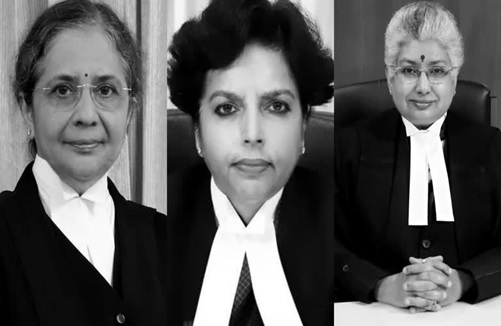
- The recent appointment of Justice V. Mohana to the Supreme Court of India marks a significant milestone in Indian judicial history. She is only the second woman advocate to be appointed directly from the Bar to the Supreme Court. The previous appointment was in 2018, when Justice Indu Malhotra received this opportunity.
- While this achievement signals increasing participation of women, their representation in the Indian higher judiciary remains extremely limited. Therefore, it is natural to question whether this appointment will truly prove to be a decisive step towards breaking the "last glass ceiling" of the judiciary.
Limited Participation of Women in the Higher Judiciary
- Women's participation in the Indian judiciary has historically been low. Of the nine male judges directly appointed from the bar to the Supreme Court, many served for long terms, and some, such as Justice S.M. Sikri and Justice U.U. Lalit, even became Chief Justices of India (CJIs).
- Currently serving Justices P.S. Narasimha and K.V. Vishwanathan are also likely to become Chief Justices in the future. In contrast, the first female direct appointment, Justice Indu Malhotra, served for less than three years and never became a member of the collegium.
- This situation demonstrates that women have had relatively limited opportunities to reach leadership roles in the judiciary.
Global Experience and Best Practices
The Belgian Model
- In 2014, Belgium amended its Constitutional Court legislation to mandate at least one-third representation of each gender on the court.
- Until this goal is achieved, for every two male appointments, the third will be a woman.
South Africa's Experience
- Article 174(2) of the South African Constitution requires the judiciary to reflect the country's racial and gender composition.
- Currently, six out of 11 judges on the Constitutional Court are women, and the court is headed by a female Chief Justice.
- It is one of the first female-majority constitutional courts in the world.
Are representation-based appointments a new concept ?
- The principle of representation is not a new idea in the Indian judiciary. There is already a tradition of representing various High Courts and regions in appointments to the Supreme Court. In recent years, geographical diversity has also been given importance in judicial appointments.
- In such a situation, if regional representation is considered a legitimate criterion, it seems logical to institutionalize gender representation as well.
India's position: Far behind global standards
Current Status
- Total sanctioned strength of the Supreme Court : 37 judges
- Women judges : 2
- Total representation : approximately 5.4 percent
International Comparison: Women’s Representation in Apex Courts
|
Country
|
Percentage of Women Judges
|
|
South Africa
|
54.5%
|
|
Canada
|
50%
|
|
Belgium
|
50%
|
|
Germany
|
50%
|
|
United States
|
44.4%
|
|
Australia
|
42.85%
|
|
France
|
33.33%
|
|
Singapore
|
Approximately 24%
|
|
Nepal
|
Approximately 17%
|
|
United Kingdom
|
Approximately 17%
|
|
India
|
5.4%
|
Necessary Reforms
1. Constitutional Amendment
-
Article 124 (Appointment of Judges of the Supreme Court) and Article 217 (Appointment of Judges of the High Courts) can be amended to ensure adequate representation of women, Scheduled Castes, Scheduled Tribes, Other Backward Classes, and minorities in the judiciary.
2. Formulation of Judicial Policy
3. Targeted Appointment System
Conclusion
The appointment of Justice V. Mohana is an important symbol of the increasing participation of women in the Indian judiciary, but a few individual appointments cannot eliminate structural inequalities. The mere 5.4 percent representation of women in the Supreme Court indicates that there is still a long way to go towards gender equality.






 Contact Us
  New Batch : 9555124124/ 7428085757
  Tech Support : 9555124124/ 7428085757