Prelims: (Polity & Constitution + CA)
Mains: (GS 2 – Governance, Representation, Constitutional Provisions) |
Why in News ?
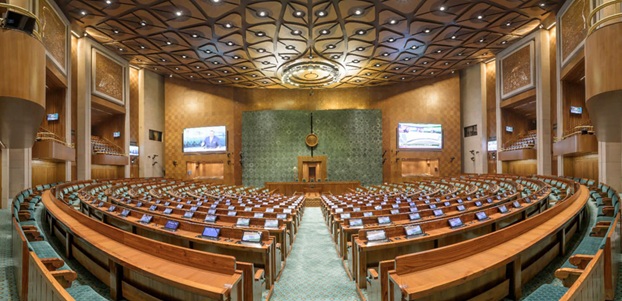
The government is considering increasing Lok Sabha seats from 543 to 816 (a 50% rise) to facilitate the implementation of the Nari Shakti Vandan Adhiniyam (Women’s Reservation Act), 2023. The proposal, however, faces significant constitutional and legal hurdles.
Background and Context
India’s electoral system is based on the principle of equal representation, where population determines the allocation of seats. Over time, demographic changes and regional disparities have made delimitation a politically sensitive issue.
The Women’s Reservation Act links the implementation of 33% reservation for women to delimitation, which in turn requires updated Census data—creating a policy and constitutional challenge.
What Is Being Proposed
- Increase Lok Sabha seats from 543 to 816
- Reserve 33% seats (273 seats) for women
- Conduct delimitation using the 2011 Census instead of a fresh Census
- Maintain proportional representation among states
- Extend similar expansion to State Assemblies
Why the 2011 Census ?
- The next Census has been delayed, delaying delimitation
- The government aims to fast-track women’s reservation
- Avoids political conflict between northern and southern states
- Prevents immediate redistribution that could reduce southern states’ representation
Constitutional Provisions Governing Seat Allocation
Article 81
- Ensures equal representation across states
- Mandates “one person, one vote, one value”
- Requires uniform population-to-seat ratio
Article 82
- Mandates delimitation after every Census
- Covers seat allocation and constituency boundaries
Exception :
- Smaller states (population < 6 million) may have disproportionate representation
The Delimitation Freeze
- 1976 Amendment : Froze seat allocation based on 1971 Census
- 2001 Amendment : Extended freeze until first Census after 2026
- Result : Inter-state seat distribution unchanged since 1971
Why Was the Freeze Introduced?
- Southern states achieved population control
- Northern states continued high population growth
- Redistribution would penalise southern states
- Freeze ensured political balance and fairness
The Road Ahead: Delimitation Process
If the freeze ends :
- Census conducted and data published
- Parliament enacts Delimitation Act
- Delimitation Commission is constituted
- Constituencies are redrawn accordingly
Last major exercise :
- Delimitation Act, 2002 (based on 2001 Census)
- Only intra-state boundary changes, not inter-state seat redistribution
Key Constitutional Roadblocks
- Article 81 Constraint
- Any expansion must maintain equal population representation
- Violation of Equality (Article 14)
- Distorting representation may violate the Basic Structure
- Delimitation-Census Link (Article 82)
- Using outdated Census data is constitutionally questionable
- Federal Imbalance
- Southern states may resist loss of political weight
- Judicial Review
- Any deviation can be challenged in courts
Possible Legal Routes
Route 1 : Amend Women’s Reservation Act
- • Delink reservation from delimitation
- • Faster and less controversial
Route 2 : Amend Articles 81 & 82
- • Allow delimitation using 2011 Census
- • Higher legal and political risks
A Possible Solution: Compensatory Principle
- Provide safeguards for southern states
- Balance population-based representation with equity
- Maintain federal harmony
Significance of the Issue
- Democratic Representation Impacts fairness in Parliament
- Women’s Empowerment : Key to implementing 33% reservation
- Federal Balance : Affects Centre-State political dynamics
- Constitutional Integrity : Tests Basic Structure doctrine
- Long-Term Political Impact : Shapes India’s parliamentary structure for decades
Challenges
- Achieving political consensus
- Balancing equity vs population-based representation
- Legal scrutiny by judiciary
- Managing regional disparities
- Timing of Census and reforms
Way Forward
- Build consensus among states
- Consider phased delimitation reforms
- Ensure constitutional safeguards
- Protect interests of population-stabilised states
- Align reforms with democratic and federal principles
FAQs
1. Why is Lok Sabha seat expansion proposed ?
To improve representation and implement women’s reservation.
2. What is the main constitutional issue ?
Delimitation must be based on the latest Census, not 2011 data.
3. Why has seat allocation been frozen since 1971 ?
To avoid penalising states that controlled population growth.
4. What are the legal risks ?
Violation of equality and Basic Structure principles.
5. What is the possible solution ?
Amend laws carefully and adopt a compensatory approach to balance interests.
|






 Contact Us
  New Batch : 9555124124/ 7428085757
  Tech Support : 9555124124/ 7428085757