Why in news?
World Animal Day is observed every year on 4 October across the world to raise awareness about animal welfare, animal rights and the protection of animals and their habitats.
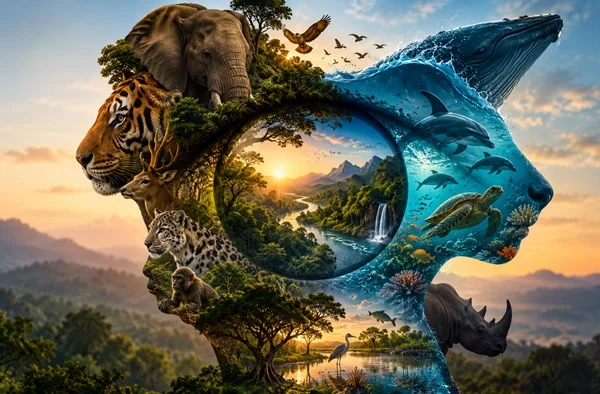
Key Facts
|
Particular
|
Details
|
|
Observed on
|
4 October every year
|
|
2026 Theme
|
See the World Through Their Eyes
|
|
First celebration
|
1925
|
|
Founder
|
Heinrich Zimmermann
|
|
Original venue
|
Berlin, Germany
|
|
Main objective
|
Improving the status and welfare of animals worldwide
|
|
Nature
|
Global animal-welfare movement
|
History
- The origins of World Animal Day can be traced to Heinrich Zimmermann, a German writer and animal-welfare advocate.
- The first World Animal Day was organised on 24 March 1925 in Berlin, Germany. It was subsequently shifted to 4 October in 1929. The date coincides with the feast day of St. Francis of Assisi, traditionally regarded as the patron saint of animals and nature.
- Over time, the observance developed into a worldwide movement involving animal-welfare organisations, conservation groups, schools, communities and individuals.
Objectives
- Aims to create a world in which animals receive greater protection and humane treatment. Its broader objectives include:
- Raising awareness about animal welfare and protection.
- Preventing cruelty and exploitation of animals.
- Protecting wildlife and natural habitats.
- Encouraging responsible treatment of domestic, farm and working animals.
- Drawing attention to threatened and endangered species.
- Encouraging governments and communities to strengthen animal-protection measures.
- Building a stronger relationship between animal welfare, biodiversity and sustainable development.
Why is Animal Protection important?
- Pollinators support plant reproduction, predators regulate prey populations, herbivores influence vegetation, and countless organisms contribute to nutrient cycling and ecosystem functioning.
- Animals increasingly face pressures from habitat destruction, climate change, pollution, poaching, illegal wildlife trade, infrastructure expansion and human-wildlife conflict.
- Protecting animals goes beyond protecting individual species. It involves preserving the ecological systems upon which both wildlife and human societies depend.
Animal Conservation and the One Health Approach
- Animal welfare also has an important connection with the One Health approach which recognises that the health of humans, animals, plants and ecosystems is closely interconnected.
- Changes in habitats and increasing human-animal interaction can affect disease dynamics, while healthy ecosystems can contribute to broader environmental and public-health resilience.
World Animal Day and Climate Change
- Climate change has emerged as an important challenge for animals across terrestrial, freshwater and marine ecosystems.
- Rising temperatures, changing rainfall patterns, extreme weather events and ocean warming can alter habitats, food availability, breeding cycles and migration patterns.
- The 2026 theme specifically encourages people to recognise that animals also experience the consequences of a changing climate and human activity.
- The Coral Triangle-inspired 2026 artwork particularly highlights coral bleaching and the vulnerability of marine ecosystems.
Animal and Wildlife Protection in India
- Wild Life (Protection) Act, 1972: It is India's principal legislation for wildlife conservation. It provides for the protection and management of wildlife, regulation of hunting, creation of protected areas and penalties for violations. Protected areas under the framework include National Parks, Wildlife Sanctuaries, Conservation Reserves and Community Reserves.
- Project Tiger: Launched in 1973, it is one of India's flagship wildlife-conservation programmes. India currently has 58 Tiger Reserves, covering roughly 85,000 sq. km. The latest national tiger assessment cited by the government estimates 3,682 tigers in 2022.
- Project Elephant: It supports the conservation of elephants, their habitats and corridors and measures to address human-elephant conflict. By 2025, India had 33 Elephant Reserves, while 150 elephant corridors across 15 states had been identified.
- Species-Specific Conservation: India also implements programmes focusing on species such as tiger, elephant, lion, snow leopard, dolphin and cheetah. The government also supports recovery programmes for identified critically endangered species and habitats.
India’s Recent Wildlife Conservation Push
- India's protected-area network expanded from 745 protected areas in 2014 to 1,134 in 2025.
- Technology is increasingly being integrated into conservation through camera traps, drones, e-surveillance, early-warning systems and wildlife monitoring. These tools support anti-poaching operations, wildlife monitoring and management of human-wildlife conflict.
- A particularly recent development came on 2 October 2026, when a tigress was released in Buxa Tiger Reserve, West Bengal, beginning a phased tiger reintroduction programme aimed at restoring a viable tiger population there.
Major Challenges to Animal Conservation
- Habitat Loss and Fragmentation: Urbanisation, agriculture and infrastructure can fragment natural habitats and wildlife corridors.
- Human-Wildlife Conflict: Expansion of human settlements and activities into wildlife landscapes can increase encounters involving elephants, leopards, tigers and other species.
- Illegal Wildlife Trade and Poaching: Commercial demand for wildlife and wildlife products continues to threaten vulnerable species.
- Animal Cruelty and Neglect: Domestic, working, stray and captive animals can face inadequate food, shelter, veterinary care and humane treatment.
Prelims MCQ
Q. With reference to wildlife conservation in India, consider the following statements:
- Conservation Reserves and Community Reserves are provided for under the Wild Life (Protection) Act, 1972.
- A Community Reserve may involve private or community-owned land.
- Project Tiger was launched in India in 1973.
Which of the statements given above are correct?
(a) 1 and 2 only
(b) 2 and 3 only
(c) 1 and 3 only
(d) 1, 2 and 3
Mains Practice Question
Q. “Wildlife conservation requires habitat conservation.” Discuss.
|
FAQs
When is World Animal Day observed?
4 October.
What is the theme of World Animal Day 2026?
See the World through Their Eyes
Who started World Animal Day?
German animal-welfare advocate Heinrich Zimmermann initiated it in 1925.
Which is the principal legislation for wildlife protection in India?
The Wild Life (Protection) Act, 1972.
When was Project Tiger launched?
In 1973.
|






 Contact Us
  New Batch : 9555124124/ 7428085757
  Tech Support : 9555124124/ 7428085757