In 1940, American scientists Martin Kamen and Samuel Ruben discovered a special radioactive isotope of carbon known as Carbon-14 (C-14).
This discovery revolutionized archaeology and history, as it made it possible to determine the age of ancient artifacts and civilizations with scientific accuracy.
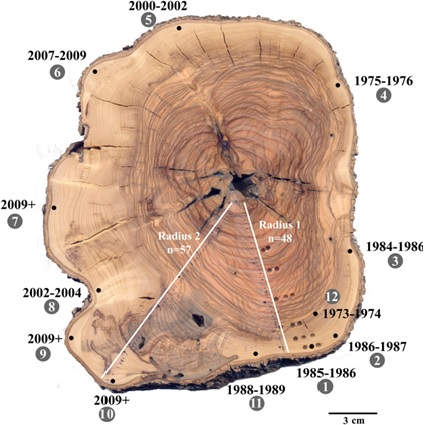
About Carbon-14
Carbon has three main isotopes:
- Carbon-12 (C-12) – Stable
- Carbon-13 (C-13) – Stable
- Carbon-14 (C-14) – Radioactive
Key Features of Carbon-14
- It is a radioactive isotope of carbon.
- Its nucleus contains 6 protons and 8 neutrons.
- It is formed in the Earth’s atmosphere when cosmic rays collide with nitrogen atoms.
- It undergoes beta decay, gradually transforming back into nitrogen.
- Its half-life is about 5,730 years, meaning half of any given amount decays in that time.
What is Radiocarbon Dating (Carbon-14 Dating)?
Radiocarbon dating is a scientific method used to determine the age of carbon-based materials that come from living organisms.
How It Works
- Living organisms (plants, animals, and humans) continuously absorb carbon-14 from the atmosphere during their lifetime.
- When the organism dies, it stops absorbing carbon-14.
- The carbon-14 present in its body begins to decay over time.
- Scientists measure the remaining amount of carbon-14 to estimate when the organism died.
Since carbon-14 decays at a constant and predictable rate, this method provides reliable age estimates for organic materials.
Uses of Carbon-14 Dating
Radiocarbon dating is widely used in several scientific fields:
- Archaeology – Determining the age of ancient artifacts and human remains
- Geology – Studying sediments and recent geological formations
- Oceanography – Understanding the age and circulation of ocean waters
- Atmospheric Science – Studying the carbon cycle in the atmosphere
- Paleoclimatology – Analyzing past climate changes
- Biomedical Research – Tracing biological and metabolic processes.






 Contact Us
  New Batch : 9555124124/ 7428085757
  Tech Support : 9555124124/ 7428085757