
- UPSC Exam
- State PCS
- One Day Exam
- Current Affairs
- PT Quiz
- Downlaods
- About Coaching
- Blog
- Videos

| Prelims: (Environment & Ecology + CA)) Mains: (GS 3: Environment & Climate Change; Science & Technology; Infrastructure & Industrial Development) |
Carbon Capture and Utilisation (CCU) technologies are gaining policy and industry attention in India as the country explores pathways to decarbonise hard-to-abate sectors such as cement, steel, power, and chemicals. Unlike Carbon Capture and Storage (CCS), which stores CO₂ underground, CCU converts captured carbon dioxide into useful products like fuels, chemicals, polymers, and construction materials — integrating emissions back into the economic cycle.
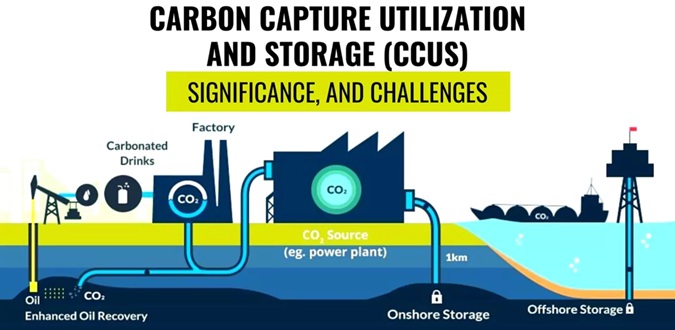
India is currently the world’s third-largest CO₂ emitter, with emissions largely driven by coal-based power generation and energy-intensive industries. While renewable energy expansion is progressing rapidly, several industrial processes inherently release CO₂ due to chemical reactions (e.g., clinker production in cement, blast furnaces in steel).
Globally, CCU has emerged as a complementary strategy to renewable energy, energy efficiency, and green hydrogen. International climate frameworks under the United Nations Framework Convention on Climate Change increasingly recognise carbon management technologies as part of long-term decarbonisation pathways.
For India, which has pledged to achieve net-zero emissions by 2070, CCU offers a bridge technology — reducing emissions while creating new industrial value chains and promoting a circular carbon economy.
CCU involves three key steps:
Unlike CCS, which focuses on permanent geological storage, CCU reintegrates carbon into productive economic uses.
1. Addressing Hard-to-Abate Sectors
Sectors such as cement, steel, fertilisers, and refining account for significant industrial emissions. Renewable electricity alone cannot eliminate process emissions in these industries.
2. Supporting Net Zero 2070
CCU complements renewable expansion and green hydrogen strategies, aligning with India’s long-term climate commitments.
3. Promoting a Circular Carbon Economy
By converting waste CO₂ into value-added products, CCU reduces dependence on virgin fossil feedstocks.
4. Energy Security & Industrial Competitiveness
CO₂-derived fuels and chemicals can reduce import dependency and create new manufacturing opportunities.
These initiatives indicate early-stage experimentation but remain limited in scale.
1. European Union – Circular Economy Integration
The European Union integrates CCU into its Circular Economy Action Plan and Bioeconomy Strategy, promoting CO₂-derived fuels and materials.
2. United States – Incentive-Based Scaling
The United States promotes CCU through tax credits and funding support for industrial carbon conversion projects.
3. United Arab Emirates – Hydrogen Integration
The United Arab Emirates integrates CCU with green hydrogen in projects like Al Reyadah to decarbonise heavy industry.
4. China – Industrial-Scale Deployment
China is expanding CCUS projects in coal-based power and chemical sectors, focusing on converting CO₂ into fuels and building materials.
CO₂ capture and conversion are energy-intensive. Without carbon pricing or incentives, CCU products struggle against cheaper fossil-based alternatives.
Effective deployment requires:
Such infrastructure remains underdeveloped.
Over-reliance on CCU without parallel renewable deployment may slow the clean energy transition.
Climate Mitigation Tool
Reduces industrial emissions where electrification is difficult.
Industrial Innovation Driver
Encourages advanced materials science and green chemistry innovation.
Strategic Autonomy
Supports domestic fuel and chemical production.
Economic Diversification
Creates new value chains and green employment opportunities.
Global Climate Leadership
Enhances India’s role in emerging carbon management technologies.
A balanced approach combining renewable expansion, green hydrogen, energy efficiency, and CCU will be essential for India’s low-carbon transition.
FAQsQ1. How is CCU different from CCS ? CCS stores captured CO₂ underground permanently, while CCU converts it into useful products, reintegrating carbon into economic cycles. Q2. Can CCU alone solve India’s emission problem ? No. CCU is a complementary strategy. Renewable energy, energy efficiency, and green hydrogen remain essential pillars. Q3. Which sectors benefit most from CCU ? Cement, steel, fertilisers, refining, and chemical industries — sectors with unavoidable process emissions. Q4. Is CCU commercially viable today ? Currently, it remains costly and requires policy incentives, technological innovation, and market support. Q5. Why is CCU important for India’s net-zero target ? It helps decarbonise hard-to-abate sectors and promotes a circular carbon economy, supporting India’s 2070 net-zero commitment. |



Our support team will be happy to assist you!

 Contact Us
  New Batch : 9555124124/ 7428085757
  Tech Support : 9555124124/ 7428085757