China recently publicly demonstrated the CJ-1000 ground-launched scramjet-powered hypersonic missile during a military parade in Beijing.
About the CJ-1000 Missile
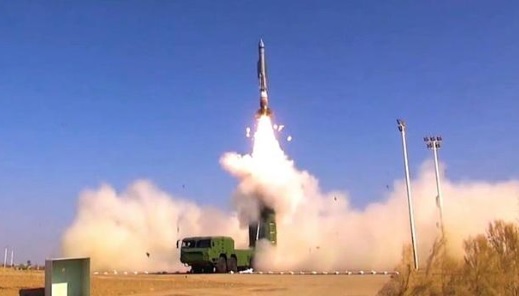
- The CJ-1000 is a road-mobile hypersonic cruise missile indigenously developed by China. It is believed to be the first and only operational land-based scramjet-powered hypersonic missile to date.
- The missile is deployed on a 10-wheel diesel-electric hybrid transporter-erector-launcher (TEL) vehicle, enhancing its mobility and rapid deployment capability.
- Its range is estimated to be at least 2,500 kilometers, enabling it to strike long-range strategic targets.
Scramjet vs. Hypersonic Glide Vehicle
- Scramjet technology is considered highly advanced but technically complex in the field of hypersonic weapons.
- Comparatively, systems like China's DF-17 and Russia's Avangard are based on hypersonic glide vehicles (HGVs).
Reasons for the danger of scramjet missiles
- Low flight altitude: Scramjet missiles typically fly at altitudes of 20 to 30 km, while glide vehicles operate at altitudes of 60 to 80 km. Flying at low altitudes makes them difficult for enemy radar to detect.
- Radar evasion capability: It is more challenging for any air defense system to detect and respond in time to a missile flying at low altitudes.
- Continuous engine operation: The scramjet engine remains active throughout the cruise and terminal phases. This gives the missile the ability to change direction during flight, maintain greater maneuverability, and strike the target with higher accuracy.
- Limitations of Glide Vehicles: In contrast, hypersonic glide vehicles rely primarily on inertia in the final stages, which can limit their maneuverability.






 Contact Us
  New Batch : 9555124124/ 7428085757
  Tech Support : 9555124124/ 7428085757