New
Hindi Medium: (Delhi) - GS Foundation (P+M) : 10th Aug 2026, 3:00 PM Hindi Medium: (Prayagraj) - GS Foundation (P+M) : 18th Aug 2026, 8:00 AM English Medium: (Delhi) - GS Foundation (P+M) : 6th Aug 2026 English Medium: (Prayagraj) - GS Foundation (P+M) : 15th July 2026, 8:00 AM Hindi Medium: (Delhi) - GS Foundation (P+M) : 10th Aug 2026, 3:00 PM Hindi Medium: (Prayagraj) - GS Foundation (P+M) : 18th Aug 2026, 8:00 AM English Medium: (Delhi) - GS Foundation (P+M) : 6th Aug 2026 English Medium: (Prayagraj) - GS Foundation (P+M) : 15th July 2026, 8:00 AM

Current Affairs for 06 August 2026

Marine Microbes Beneath Antarctica's Blood Falls Reveal Ancient Seawater Origin

Why in News?

A new study published in Nature Geoscience has found that the salty water emerging from Antarctica's Blood Falls contains marine-specific microorganisms, providing strong evidence that the subglacial brine originated from ancient seawater trapped beneath the glacier thousands of years ago.

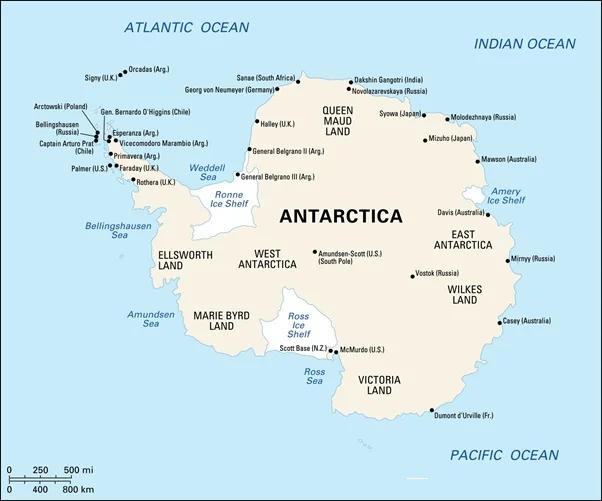
What is Blood Falls?

  • Blood Falls is a striking red-colored waterfall located at the terminus of Taylor Glacier in the McMurdo Dry Valleys, Antarctica. 
  • It flows into Lake Bonney, one of Antarctica's ice-covered lakes. 
  • The waterfall's crimson color is caused by iron-rich brine. When the iron-rich saline water reaches the surface, it reacts with oxygen and forms iron oxides (rust), giving the water its blood-red appearance. 
  • The feature was first discovered in 1911 by Australian geologist Griffith Taylor. 

Key Findings of the Study

  • Researchers analyzed 167 samples of water, sediment, ice, mud, and air collected from the McMurdo Dry Valleys. 
  • Advanced genetic sequencing identified both prokaryotic (bacteria and archaea) and eukaryotic microorganisms. 
  • The microbial community at Blood Falls was found to be predominantly marine in origin, unlike surrounding areas that were dominated by freshwater and terrestrial microorganisms. 
  • Around 9.34% of eukaryotic microorganisms at the glacier terminus matched nearby marine communities, compared to only 1.15% at other Dry Valleys locations. 
  • The findings suggest that the subglacial brine originated from ancient seawater that became trapped beneath Taylor Glacier after sea levels fell and the glacier advanced. 

How Did the Ancient Seawater Become Trapped?

Scientists believe that:

  1. During earlier warm climatic periods, seawater flooded Taylor Valley
  2. As global temperatures declined, sea levels fell
  3. Taylor Glacier advanced and sealed off the seawater beneath thick layers of ice. 
  4. The isolated seawater gradually evolved into a highly saline subglacial brine while preserving ancient marine microorganisms. 

Scientific Significance

The study provides important evidence that:

  • Ancient microbial ecosystems can survive for thousands of years beneath glaciers. 
  • Subglacial environments preserve biological records of Earth's climatic history. 
  • Marine microorganisms can remain isolated despite major environmental changes. 
  • Modern wind transport alone cannot explain the presence of these marine microbes. 

Why is this Important?

The findings help scientists:

  • Reconstruct Antarctica's past climate and sea-level changes. 
  • Understand how life survives in extreme environments. 
  • Study long-term microbial evolution under isolated conditions. 
  • Develop models for potential life in icy extraterrestrial environments such as Mars and Europa.

UPSC Prelims Questions

Q1. Blood Falls, recently seen in the news, is located in:
A. Greenland Ice Sheet
B. Taylor Glacier, Antarctica
C. Siachen Glacier, India
D. Vatnajökull Glacier, Iceland

UPSC Mains Questions

Q1. Discuss the significance of Antarctica's Blood Falls in understanding past climate change, sea-level fluctuations, and glacial evolution.

FAQs: Antarctica's Blood Falls 

Q1. What is Blood Falls?

Answer: Blood Falls is a red-colored outflow of iron-rich saline water emerging from beneath Taylor Glacier in the McMurdo Dry Valleys, Antarctica, flowing into Lake Bonney.

Q2. Why is it called "Blood Falls"?

Answer: It is called Blood Falls because the water appears blood-red due to the oxidation (rusting) of iron-rich brine when it comes into contact with oxygen.

Q3. Where is Blood Falls located?

Answer: It is located at the terminus of Taylor Glacier in the McMurdo Dry Valleys, one of the coldest and driest regions of Antarctica.

Q4. What did the recent Nature Geoscience study discover?

Answer: The study found that the microorganisms in Blood Falls are predominantly marine-specific, indicating that the subglacial brine originated from ancient seawater trapped beneath Taylor Glacier.

Meghalaya Launches Mission to Protect Clouded Leopards: Key Objectives, Features and Significance

Why in News?

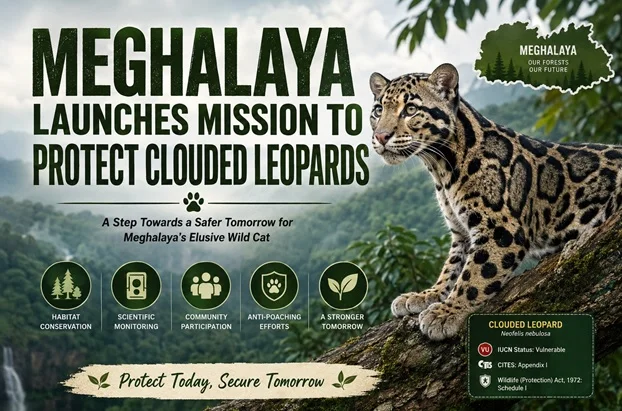
  • Meghalaya Chief Minister Conrad K. Sangma launched Mission Clouded Leopard, a flagship conservation programme dedicated to safeguarding the Clouded Leopard (Neofelis nebulosa), the official State Animal of Meghalaya. 
  • The mission is intended to provide a comprehensive, long-term framework for the protection of the species and its habitat, and positions Meghalaya among the few Indian states to roll out a species-specific conservation programme of this kind.


What is the Clouded Leopard Mission?

The initiative focuses on:

  • Conserving critical forest ecosystems.
  • Conducting scientific population monitoring.
  • Reducing human-wildlife conflict.
  • Strengthening anti-poaching surveillance.
  • Promoting community-based conservation.
  • Enhancing public awareness about wildlife protection.

What Is the Clouded Leopard?

  • Scientific Name: Neofelis nebulosa 
  • Family: Felidae (Cat family) 
  • Common Name: Clouded Leopard (It is known for its distinctive cloud-shaped markings, from which it derives its name.)
  • Habitat: Dense tropical and subtropical forests. 
  • Distribution: India (Northeast), Nepal, Bhutan, Bangladesh, Myanmar, Thailand, Malaysia, Southern China and other parts of Southeast Asia. 
  • It is an excellent tree climber and spends much of its time in the forest canopy. It hunts deer, monkeys, birds, wild pigs and other small mammals. 
  • It is considered one of the most elusive and least-studied big cats in Asia. 
  • Locally, the species is known by different names among Meghalaya's communities — Maccha Pheng in Garo, Lakrong in Khasi, and Khla in Jaintia. 
  • The species is classified as Vulnerable on the IUCN Red List, is included in Appendix I of CITES, and enjoys the highest level of legal protection in India under Schedule I of the Wild Life (Protection) Act, 1972.

What Does Mission Clouded Leopard Involve?

  • The mission will be guided by the Meghalaya Clouded Leopard Action Plan, currently being prepared by the state's Forest and Environment Department, which will serve as the strategic roadmap for the species' long-term conservation. 
  • As part of the programme, an ongoing scientific assessment in the Balpakram landscape has already identified 21 individual Clouded Leopards. 
  • Officials have described these as preliminary findings, and the survey is now being extended to other major habitats across the state to produce Meghalaya's first comprehensive population estimate of its State Animal.

Objectives of the Mission

  • It aims to protect and restore the natural habitat of the Clouded Leopard across the state's forest landscapes.
  • It seeks to strengthen scientific research and long-term population monitoring of the species.
  • It will reinforce anti-poaching and protection measures to curb illegal hunting and habitat loss.
  • It aims to improve landscape connectivity between fragmented forest patches to support the species' movement.
  • It focuses on building the capacity of frontline forest staff involved in conservation work.
  • It encourages community participation and public awareness, given that the species is found in community-managed forests as well.
  • It promotes collaboration with neighbouring north-eastern states for landscape-level conservation.

Why Is This Mission Important for Meghalaya?

  • As Meghalaya is home to some of India's richest and most biodiverse forest landscapes, protecting an apex predator like the Clouded Leopard has a cascading effect on the health of the wider ecosystem.
  • Since the species depends on healthy, connected forest cover, its conservation indirectly protects watersheds, other wildlife, and the livelihoods of communities dependent on these forests. 
  • The mission also strengthens the scientific understanding of the species, since reliable population data on the Clouded Leopard has so far been extremely limited across its range due to its elusive and nocturnal nature.

Major Components of the Mission

  • Habitat Conservation
  • Protection and restoration of degraded forests. 
  • Conservation of wildlife corridors connecting fragmented habitats.
  • Scientific Monitoring
  • Camera trap surveys. 
  • GPS mapping. 
  • Population estimation. 
  • Behavioural research.
  • Community Participation
  • Involvement of local communities in forest conservation.
  • Awareness campaigns in villages and schools. 
  • Promotion of sustainable livelihoods to reduce dependence on forests.
  • Anti-Poaching Measures
  • Increased forest patrols.
  • Better surveillance.
  • Intelligence-based wildlife crime monitoring.
  • Coordination among enforcement agencies.

Ecological and Strategic Importance

  • As an apex predator, the Clouded Leopard helps regulate prey populations and maintain ecological balance within forest ecosystems.
  • The mission strengthens India's compliance with international commitments under CITES and supports the broader national agenda on wildlife conservation.
  • It encourages coordinated, landscape-level conservation with neighbouring north-eastern states, since wildlife corridors do not respect administrative boundaries.
  • It supports Meghalaya's identity and heritage, as the Clouded Leopard is the state's official animal and holds cultural significance among local communities.

Why is the Clouded Leopard Threatened?

Major threats include:

  • Habitat loss due to deforestation.
  • Infrastructure development.
  • Shifting cultivation in some regions.
  • Illegal hunting.
  • Wildlife trafficking.
  • Decline in prey population.
  • Human-wildlife conflict.

Significance of the Mission

  • Strengthens conservation efforts in Northeast India.
  • Protects one of Asia's rarest wild cats.
  • Enhances biodiversity conservation.
  • Supports India's commitments under the Convention on Biological Diversity (CBD).
  • Encourages community-led wildlife conservation.
  • Improves scientific knowledge of an elusive species.

Dedicated Conservation Action Plan for the Wild Cat

  • On the occasion of International Clouded Leopard Day (4 August), India launched the Clouded Leopard Conservation Action Plan (CAP) under the Government of India–GEF–UNDP initiative. 
  • Released during the 91st SCNBWL meeting in Coimbatore, the plan identifies 14 priority conservation landscapes across Northeast India and focuses on habitat restoration, wildlife corridors, scientific monitoring (camera traps, genetics, eDNA), anti-poaching, community participation, M-STrIPES-based monitoring, climate resilience, and transboundary cooperation for long-term conservation.

Challenges to Clouded Leopard Conservation

  • Habitat loss and fragmentation due to shifting cultivation, logging, and infrastructure development threaten the species' forest corridors.
  • The elusive, nocturnal and arboreal nature of the Clouded Leopard makes population monitoring and scientific study extremely difficult.
  • Poaching and illegal wildlife trade remain concerns for a species valued for its pelt and body parts in some illegal markets.
  • Much of the species' habitat lies in community-managed forests outside formal protected areas, requiring sustained cooperation with traditional institutions.

Way Forward

  • Expand habitat restoration programmes.
  • Strengthen wildlife corridors.
  • Increase use of drones, camera traps and GIS mapping.
  • Improve coordination between forest departments and research institutions.
  • Enhance community incentives for conservation.
  • Promote long-term ecological monitoring and awareness campaigns.

PRELIMS MCQ

Q. With reference to the Clouded Leopard (Neofelis nebulosa), consider the following statements:

  1. It is listed as Vulnerable on the IUCN Red List.
  2. It is included in CITES Appendix I.
  3. It is protected under Schedule I of the Wildlife (Protection) Act, 1972.

Which of the statements given above is/are correct?

A. 1 and 2 only

B. 2 and 3 only

C. 1 and 3 only

D. 1, 2 and 3

MAINS PRACTICE QUESTION

Q. The conservation of apex predators is essential for maintaining ecological balance. Discuss the significance of Meghalaya's Clouded Leopard Mission in protecting biodiversity and strengthening community-based wildlife conservation.

FAQs

What is the Clouded Leopard Mission?

It is a wildlife conservation initiative launched by the Meghalaya Government to protect clouded leopards through habitat conservation, scientific research, anti-poaching measures, and community participation.

What is the scientific name of the Clouded Leopard?

The scientific name of the Clouded Leopard is Neofelis nebulosa.

Why is Meghalaya important for clouded leopard conservation?

Meghalaya has extensive evergreen and subtropical forests that   provide ideal habitat for clouded leopards, making it one of India's key strongholds for the species.

What are the major threats faced by clouded leopards?

The major threats include habitat loss, deforestation, illegal hunting, wildlife trafficking, declining prey populations, infrastructure development, and human-wildlife conflict.          

What is the conservation status of the Clouded Leopard?

  • IUCN Red List: Vulnerable
  • CITES: Appendix I
  • Wildlife (Protection) Act, 1972: Schedule I 

National Centre for Cell Science (NCCS): Discovery of New Gut Bacteria and the Need for an India-Specific Microbiome Map

Why in News?

  • Scientists at the National Centre for Cell Science (NCCS), Pune, have discovered 14 previously unknown bacterial species and nearly 200 undocumented microbial strains while studying the gut microbiomes of India's tribal communities. 
  • The study, published in the journal Gut Microbes, highlights the immense unexplored microbial diversity in India and emphasizes the need for an India-specific microbiome database to improve healthcare, nutrition, and personalized medicine.


National Centre for Cell Science (NCCS)

  • The National Centre for Cell Science (NCCS) is an autonomous research institution under the Department of Biotechnology (DBT), Ministry of Science and Technology, Government of India
  • It was established to promote advanced research in cell biology and related life sciences and has emerged as one of India's premier biotechnology research institutes.
  • Located on the campus of Savitribai Phule Pune University, Pune, NCCS conducts cutting-edge research in cell biology, microbiology, cancer biology, immunology, stem cell biology, neurobiology, structural biology, bioinformatics, and omics sciences.

Origin and Evolution

The institute has evolved through several stages:

  • 1986: Established as the National Tissue Culture Facility (NTCF)
  • 1988: Upgraded to the National Facility for Animal Tissue and Cell Culture Collection (NFATCC)
  • 1996: Renamed as the National Centre for Cell Science (NCCS)

Today, NCCS is recognized as one of India's leading biotechnology research institutions.

Mandate of NCCS

NCCS has a three-fold national mandate:

1. National Cell Repository

  • Maintains authenticated animal cell lines. 
  • Supplies quality-tested cell cultures to universities, research institutions, hospitals, and industries. 
  • Ensures standardized biological materials for scientific research. 

2. Basic Research in Cell Biology

Conducts frontier research in:

  • Cell Biology ,Cancer Biology,Stem Cell Biology, Neurobiology , Structural Biology , Bioinformatics , Omics Sciences , Immunology ,Infectious Diseases ,Microbiology ,

Its research addresses major health challenges such as:

  • Cancer ,Infectious diseases ,Metabolic disorders ,Regenerative medicine ,Precision medicine .

3. Human Resource Development

NCCS trains researchers, students, and professionals through:

  • PhD programmes 
  • Research fellowships 
  • Specialized workshops 
  • Skill development programmes 
  • National and international collaborations 

National Cell Repository

One of NCCS's major national responsibilities is maintaining the National Cell Repository, which:

  • Preserves authenticated animal cell lines. 
  • Ensures quality control and genetic stability. 
  • Provides affordable cell cultures to Indian research institutions. 
  • Supports biomedical, pharmaceutical, and industrial research. 

National Centre for Microbial Resource (NCMR)

NCCS also hosts the DBT-funded National Centre for Microbial Resource (NCMR).

Its major functions include:

  • Collection of microbial cultures. 
  • Identification and characterization. 
  • Preservation of microorganisms. 
  • Distribution to researchers. 
  • Conservation of microbial biodiversity. 

The microbial cultures are collected from various ecological regions of India, including forests, deserts, mountains, oceans, and agricultural ecosystems. Notably, NCCS possesses the third-largest microbial culture collection in the world, making it a globally significant repository for microbial biodiversity.

The NCCS Gut Microbiome Study

Background

Researchers from BRIC–National Centre for Cell Science carried out one of India's most comprehensive studies on indigenous gut microbiomes. The objective was to understand how geography, food habits, ethnicity, and traditional lifestyles influence the human gut microbiome.

Major Findings

The study discovered:

  • 14 entirely new bacterial species 
  • Nearly 200 previously undocumented microbial strains 

These microbes had never been described in global microbiome databases.

The findings demonstrate that India possesses enormous unexplored microbial diversity.

Communities Studied

The study examined gut microbiomes from eight tribal communities representing diverse ecological zones.

These include:

  • Western Coast :-Warli 
  • Deccan Plateau :-Gond  ,Madia .
  • North-East Hills :-Kabui (Rongmei Naga) 
  • Trans-Himalayan Region :-Boto, Balti ,Brokpa ,Purigpa .

These communities differ significantly in terms of: Geography ,Climate ,Food habits ,Lifestyle ,Cultural traditions  making them ideal for studying microbial diversity.

What is the Gut Microbiome?

The gut microbiome refers to the collection of microorganisms—including bacteria, fungi, viruses, and archaea—that inhabit the human digestive tract.

These microorganisms perform several essential functions:

  • Digest complex food. 
  • Produce vitamins. 
  • Regulate metabolism. 
  • Strengthen immunity. 
  • Protect against disease-causing microbes. 
  • Maintain intestinal health. 
  • Influence brain function through the gut-brain axis. 

Every individual's microbiome is unique. Its composition depends upon:

  • Diet,Geography ,Medicines ,Environment ,Lifestyle ,Cultural practices ,Genetics .

Key Scientific Observations

No Universal Healthy Gut Microbiome

One of the most important conclusions of the study is that there is no universal blueprint for a healthy gut microbiome.

Instead, healthy gut microbes vary across populations depending upon:

  • Food habits 
  • Local environment 
  • Geography 
  • Evolutionary adaptation 
  • Traditional lifestyles 

This challenges the long-held assumption that Western microbiome profiles represent the global standard.

Shared Core Microbial Groups

Despite regional diversity, all eight tribal communities possessed three dominant bacterial genera:

  • Segatella 
  • Agathobacter 
  • Faecalibacterium 

These bacteria appear to form the core of a healthy Indian gut microbiome.

Distinct Indian Genetic Lineages

Although Segatella was common across all communities, Indian strains belonged to unique genetic lineages absent from most European and North American microbiome databases.

This indicates that Indian microbial populations have evolved independently under local ecological conditions.

Diet Shapes the Gut Microbiome

The study found that diet leaves a strong microbial signature. The greatest microbial diversity was observed among the Trans-Himalayan communities, whose traditional diets include:

  • Milk ,Homemade butter ,Wheat ,Barley ,Rice ,Leafy vegetables ,Tubers ,Fruits ,Wild berries .

These populations showed:

  • Greater microbial diversity. 
  • Higher abundance of Bifidobacterium
  • Enhanced genes involved in digesting: 
    • Lactose 
    • Galactose 
    • Grain-derived carbohydrates 

These findings suggest that gut microbes gradually adapt to traditional diets over generations. However, researchers emphasize that the study establishes strong associations rather than proving direct causation.

Implications for Probiotics

A significant finding relates to Bifidobacterium adolescentis, one of the most widely used probiotic bacteria. Researchers found that Indian strains differ genetically from strains commonly used in industrialized countries.

These Indian strains possess:

  • Different carbohydrate-processing enzymes. 
  • Adaptations to Indian dietary patterns. 

The findings suggest:

  • Imported probiotics may not always be equally effective for Indian populations. 
  • Future probiotic development should consider local microbial diversity. 
  • Population-specific clinical evaluation is essential before recommending probiotics. 

Importantly, the study does not conclude that imported probiotics are ineffective or that Indian strains are inherently superior.

Why India Needs Its Own Microbiome Map

The study strongly advocates creating a National Indian Microbiome Database.

Such a database would:

  • Document India's microbial diversity. 
  • Establish population-specific healthy microbiome references. 
  • Improve nutrition research. 
  • Support personalized medicine. 
  • Help understand metabolic diseases. 
  • Enable development of indigenous probiotics. 
  • Improve dietary recommendations. 
  • Strengthen precision healthcare. 
  • Reduce dependence on Western microbiome databases. 

Significance for Public Health

An India-specific microbiome map could contribute to:

  • Better management of obesity. 
  • Diabetes prevention. 
  • Gastrointestinal disease treatment. 
  • Improved immune health. 
  • Personalized nutrition. 
  • Precision medicine. 
  • Indigenous probiotic development. 
  • Public health policy formulation. 

Challenges

Several challenges remain:

  • Large portions of India's microbial diversity remain unexplored. 
  • Limited microbiome data from rural and tribal populations. 
  • Lack of long-term cohort studies. 
  • Need for standardized microbial sequencing protocols. 
  • High cost of advanced genomic technologies. 
  • Limited awareness regarding microbiome-based healthcare. 

Way Forward

India should:

  • Develop a National Microbiome Mission
  • Build a comprehensive Indian microbiome database. 
  • Increase research on tribal and rural populations. 
  • Promote indigenous probiotic development. 
  • Encourage interdisciplinary collaboration among microbiologists, clinicians, nutritionists, and bioinformaticians. 
  • Integrate microbiome research with precision medicine initiatives. 
  • Expand genomic and metagenomic research infrastructure. 
  • Promote public awareness regarding gut health. 

Conclusion

  • The NCCS study represents a landmark achievement in Indian microbiome research by uncovering 14 new bacterial species and nearly 200 previously undocumented microbial strains
  • It demonstrates that the composition of a healthy gut microbiome is profoundly influenced by geography, diet, lifestyle, and cultural practices rather than following a universal standard. 
  • The findings underscore the urgent need for an India-specific microbiome map, which can transform nutrition science, personalized medicine, disease prevention, and the development of indigenous probiotics. For India, this research opens a new frontier in biotechnology, public health, and precision healthcare while reinforcing the importance of conserving the country's unique microbial biodiversity.

Frequently Asked Questions (FAQs)

Q1. What is the National Centre for Cell Science (NCCS)?

Answer: The National Centre for Cell Science (NCCS) is an autonomous institute under the Department of Biotechnology (DBT), Ministry of Science and Technology, Government of India. Located in Pune, it conducts advanced research in cell biology, microbiology, cancer biology, stem cell biology, immunology, and bioinformatics.

Q2. Why was NCCS in the news?

Answer: NCCS scientists discovered 14 previously unknown bacterial species and nearly 200 undocumented microbial strains while studying the gut microbiomes of India's tribal communities. The study highlighted the need for an India-specific microbiome database.

Q3. What is the gut microbiome?

Answer: The gut microbiome is the community of bacteria, fungi, viruses, and other microorganisms living in the human intestine. These microbes help digest food, regulate the immune system, produce essential nutrients, and protect against harmful pathogens.

India’s First Indigenous ASF Vaccine for Pigs: Features, Significance, and Challenges

Prelims: Science & Technology | Animal Husbandry | Biotechnology | Current Affairs
Mains: GS Paper III – Science & Technology; Agriculture; Animal Husbandry; Food Security

Why in News

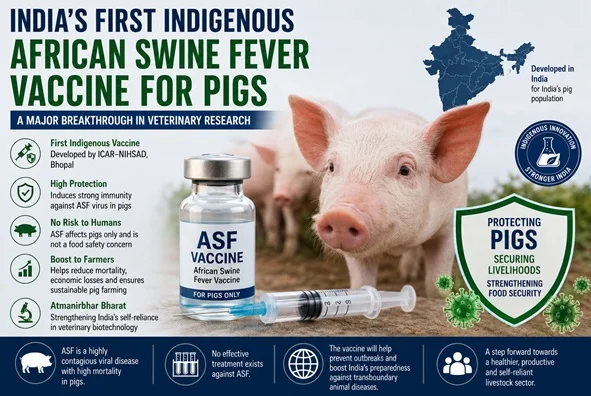
The Indian Council of Agricultural Research (ICAR) dedicated India’s first indigenous African Swine Fever (ASF) vaccine for pigs. Developed by scientists at the ICAR–National Institute of High Security Animal Diseases (ICAR-NIHSAD) in Bhopal, this MA-104 Cell Line-Based Live Attenuated Vaccine represents a landmark breakthrough in veterinary science and animal biosecurity.
What is African Swine Fever (ASF)?

  • African Swine Fever (ASF) is a highly contagious viral disease that affects domestic and wild pigs. It is caused by the African Swine Fever Virus (ASFV), a large DNA virus belonging to the Asfarviridae family.
  • The disease has an extremely high mortality rate, often approaching 100% in susceptible pig populations. ASF does not infect humans and is not considered a food safety risk, but it causes severe economic damage to the pig farming industry.

Why is ASF a Serious Concern?

  • There is no effective treatment once pigs are infected.
  • Large-scale outbreaks often require mass culling of pigs to prevent further spread.
  • Pig farmers suffer huge financial losses due to mortality, trade restrictions and movement bans.
  • The disease threatens food security and the livelihood of millions dependent on pig farming.

Key Features of India's Indigenous ASF Vaccine

  • Indigenous Development: Developed entirely by Indian scientists under ICAR. Represents a major step towards self-reliance in veterinary vaccine technology.
  • High Protection: Provides effective immunity against circulating ASF virus strains. Significantly reduces mortality among vaccinated pigs.
  • Disease Control: Helps prevent large-scale outbreaks. Reduces dependence on imported vaccines and diagnostic technologies.
  • Support for Farmers: Expected to minimise economic losses. Strengthens confidence among pig farmers and promotes sustainable pig production.

Significance of the Vaccine

  • Strengthening Animal Health: Enhances India's preparedness against transboundary animal diseases. Improves disease surveillance and livestock protection.
  • Boost to Veterinary Research: Demonstrates India's growing capabilities in advanced veterinary biotechnology. Encourages further research into vaccines for emerging livestock diseases.
  • Economic Benefits: Protects the pig farming sector, especially in the North-Eastern states where pig rearing is an important livelihood. Reduces losses caused by recurring ASF outbreaks.
  • Food Security: Ensures a stable supply of pork and supports nutritional security in regions where pork is a major source of protein.
  • Atmanirbhar Bharat: Reduces dependence on foreign technologies. Promotes indigenous innovation in the livestock sector.

Challenges Ahead

  • Large-scale vaccine production and distribution.
  • Ensuring affordability for small and marginal farmers.
  • Maintaining cold-chain infrastructure for vaccine storage.
  • Continuous surveillance against new virus variants.
  • Creating awareness among pig farmers regarding vaccination.

Way Forward

  • Expand vaccination programmes in ASF-prone regions.
  • Strengthen disease surveillance and rapid diagnostic systems.
  • Promote collaboration between research institutions, veterinary departments and state governments.
  • Improve farmer awareness through extension services.
  • Continue research for broader and longer-lasting protection against emerging ASF strains.

PRELIMS MCQ

Q. With reference to African Swine Fever (ASF), consider the following statements:

  1. African Swine Fever affects both domestic and wild pigs.
  2. The disease can be transmitted from pigs to humans.
  3. India has recently developed its first indigenous vaccine against ASF.

Which of the statements given above is/are correct?

(a) 1 only

(b) 1 and 3 only

(c) 2 and 3 only

(d) 1, 2 and 3

MAINS PRACTICE QUESTION

Q. Discuss the significance of India's first indigenous African Swine Fever vaccine in strengthening animal health, livestock productivity and veterinary research. Also examine the challenges associated with controlling transboundary animal diseases in India.

FAQs

What is African Swine Fever (ASF)?

It is a highly contagious viral disease affecting domestic and wild pigs, causing very high mortality but posing no risk to human health.

Which organisation developed India's first indigenous ASF vaccine?

The vaccine has been developed by the ICAR–National Institute of High Security Animal Diseases (NIHSAD), Bhopal, under the Indian Council of Agricultural Research (ICAR).

Does ASF infect humans?

No. African Swine Fever affects only pigs and does not spread to humans.

Why is the vaccine important?

It helps prevent large-scale pig deaths, protects farmers' livelihoods, strengthens India's veterinary research capabilities and reduces dependence on imported technologies.

Which regions of India are expected to benefit the most?

The North-Eastern states and other pig-rearing regions, where pork production is an important source of livelihood and nutrition.

MoRTH Issues Draft Notification for Mandatory Vehicle-to-Vehicle (V2V) Communication Systems from 2028

  • The Ministry of Road Transport and Highways (MoRTH) has released a draft notification proposing the mandatory adoption of Vehicle-to-Vehicle (V2V) communication systems in newly manufactured motor vehicles from 1 October 2028
  • The proposal is based on the newly developed AIS-230 standard and is currently in the draft stage, meaning it has not yet become law and will take effect only after final approval and notification.
  • The initiative aims to enhance road safety by enabling vehicles to communicate with each other in real time, forming a key component of India's Intelligent Transportation System (ITS).


Why is it in the News?

  • MoRTH has issued a draft amendment to the AIS-230 automotive standard. 
  • The draft proposes making V2V communication mandatory for all newly manufactured L, M and N category vehicles from 1 October 2028
  • Vehicles voluntarily equipped with V2V systems from 1 October 2027 must comply with the AIS-230 standard. 
  • The notification is currently open for stakeholder feedback and has not yet been enacted

What is Vehicle-to-Vehicle (V2V) Communication?

Vehicle-to-Vehicle (V2V) communication is a wireless technology that enables nearby vehicles to exchange real-time information without human intervention.

The system continuously shares information such as:

  • Vehicle speed 
  • Position 
  • Direction of movement 
  • Acceleration 
  • Braking status 
  • Hazard warnings 

This allows vehicles to warn each other about potential dangers before they become visible to the driver.

How Does V2V Work?

Every vehicle fitted with a V2V system contains an On-Board Unit (OBU) that continuously broadcasts and receives safety messages from nearby vehicles. Using Cellular Vehicle-to-Everything (C-V2X) technology, vehicles exchange data several times every second.

The information is processed instantly to generate warnings regarding:

  • Sudden braking ahead 
  • Possible forward collisions 
  • Unsafe lane changes 
  • Wrong-way driving 
  • Hazardous road conditions 
  • Approaching emergency vehicles 

Unlike traditional driver assistance systems, V2V works even when the hazard is outside the driver's line of sight.

Difference Between V2V and ADAS

Vehicle-to-Vehicle (V2V)

Advanced Driver Assistance Systems (ADAS)

Communicates with nearby vehicles

Uses onboard sensors

Uses wireless communication

Uses cameras, radar and LiDAR

Can detect hidden hazards

Limited by sensor visibility

Provides information beyond line of sight

Detects only visible surroundings

Complements ADAS

Works independently using sensors

MoRTH has clarified that V2V is not a replacement for ADAS but a complementary technology that significantly improves road safety.

AIS-230 Standard

AIS-230 is the new Indian automotive standard developed specifically for factory-installed V2V communication systems.

The standard specifies minimum requirements for:

Technical Requirements

  • Radio performance 
  • Frequency stability 
  • Receiver sensitivity 
  • Output power 

Navigation Requirements

  • Global Navigation Satellite System (GNSS) positioning 

Electrical Requirements

  • Electrical performance 
  • Electromagnetic Compatibility (EMC) 
  • Electromagnetic interference protection 

Cybersecurity Requirements

  • Communication security 
  • Cybersecurity protocols 
  • Data integrity 
  • Secure message exchange 

Functional Requirements

  • Road safety applications 
  • System reliability 
  • Environmental performance 

Vehicles Covered Under the Draft

The proposal applies to the following categories:

Category L

  • Motor vehicles with fewer than four wheels 
  • Motorcycles 
  • Scooters 

Category M

  • Passenger vehicles with four or more wheels 
  • Cars 
  • SUVs 
  • Buses 

Category N

  • Goods-carrying vehicles 
  • Mini trucks 
  • Trucks 
  • Commercial cargo vehicles 

Frequency Band Allocated

The V2V communication system will operate in the: 5.875 GHz – 5.925 GHz frequency band

Important points:

  • Dedicated for Intelligent Transportation System (ITS) applications. 
  • Exempted from licensing requirements. 
  • License exemption notified by the Department of Telecommunications (DoT) on 10 June 2026
  • Supports reliable low-latency communication between vehicles. 

Safety Features Supported Under AIS-230

  • The standard provides for the phased introduction of several advanced safety applications, including:
    • Emergency Brake Alert (EBA) :-Warns following vehicles when a vehicle ahead brakes suddenly.
    • Forward Collision Warning (FCW) :-Alerts drivers about an imminent collision with a vehicle in front.
    • Wrong-Way Driving Alert :-Detects vehicles moving in the wrong direction and issues warnings.
    • Emergency Vehicle Alert :-Notifies nearby drivers about approaching ambulances, police vehicles and fire engines.

Additional future applications may include:

  • Hazardous road warnings 
  • Lane-change assistance 
  • Traffic congestion alerts 
  • Intersection collision warnings 

Rollout Timeline

From 1 October 2027

  • Vehicles voluntarily equipped with V2V communication systems must comply with AIS-230. 

From 1 October 2028

  • All newly manufactured vehicles in Categories L, M and N must be equipped with AIS-230-compliant V2V communication systems. 

The phased implementation is intended to provide manufacturers, suppliers and testing agencies adequate time to prepare.

Benefits of V2V Communication

The proposed system is expected to provide several advantages:

Improved Road Safety

  • Reduces accidents by providing early hazard warnings. 

Better Situational Awareness

  • Drivers receive information about hazards beyond their field of vision. 

Faster Emergency Response

  • Vehicles can make way for ambulances and emergency responders more efficiently. 

Reduced Traffic Congestion

  • Better coordination among connected vehicles can improve traffic flow. 

Support for Autonomous Driving

  • Provides essential communication infrastructure for future connected and autonomous vehicles. 

Complements ADAS

  • Enhances the effectiveness of existing Advanced Driver Assistance Systems. 

Intelligent Transportation System (ITS)

V2V communication forms an important part of the broader Intelligent Transportation System (ITS).

ITS integrates:

  • Smart vehicles 
  • Digital communication networks 
  • Navigation systems 
  • Traffic management 
  • Road infrastructure 

The objective is to improve:

  • Road safety 
  • Traffic efficiency 
  • Mobility 
  • Environmental sustainability 

Challenges

Despite its benefits, implementation may face certain challenges:

  • Increased manufacturing costs 
  • Cybersecurity and data privacy concerns 
  • Need for nationwide communication infrastructure 
  • Standardisation among different automobile manufacturers 
  • Public awareness and acceptance 
  • Compatibility with older vehicles not equipped with V2V systems 

Significance for India

  • India records one of the highest numbers of road accident fatalities globally. 
  • The proposed V2V framework represents a significant step toward creating a connected mobility ecosystem capable of preventing accidents before they occur.
  • By enabling vehicles to exchange real-time safety information, the AIS-230 standard is expected to improve situational awareness, strengthen intelligent transportation systems, support future autonomous mobility, and contribute to reducing road accidents across the country.

Frequently Asked Questions (FAQs): MoRTH Draft on Vehicle-to-Vehicle (V2V) Communication

1. Why is the MoRTH V2V proposal in the news?

Answer :-The Ministry of Road Transport and Highways (MoRTH) has issued a draft notification proposing mandatory Vehicle-to-Vehicle (V2V) communication systems for all newly manufactured L, M and N category vehicles from 1 October 2028 under the AIS-230 standard.

2. Is the V2V communication system mandatory in India now?

Answer :-No. The proposal is currently a draft notification. It will become mandatory only after the government finalizes and officially notifies the rules.

3. What is Vehicle-to-Vehicle (V2V) communication?

Answer :-Vehicle-to-Vehicle (V2V) communication is a wireless technology that enables nearby vehicles to exchange real-time information such as speed, location, direction, braking status and hazard warnings to improve road safety.

upsc english
« »
  • SUN
  • MON
  • TUE
  • WED
  • THU
  • FRI
  • SAT
Have any Query?

Our support team will be happy to assist you!

OR