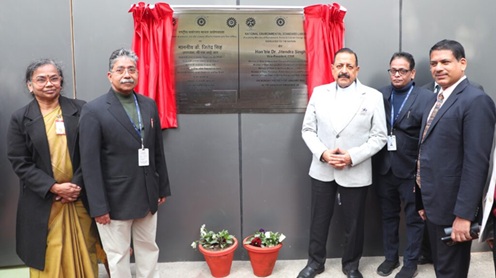
Recently, the world's second National Environmental Standards Laboratory (NESL) and the world's fifth National Primary Standards Facility for solar cell calibration was inaugurated at CSIR-National Physical Laboratory (CSIR-NPL).
| (Prelims: Current Events of National Importance, General Science) (Mains, General Studies Paper 3: Achievements of Indians in Science and Technology; Indigenous Technology Development and Development of New Technologies) |

| Prelims: (Temple Architecture + CA) Mains: (GS Paper 1: Indian Art & Architecture, Culture, History) |
The Prime Minister has highlighted the thousand-year survival of the Somnath Temple as a symbol of India’s indomitable civilisational spirit, as the country commemorates Somnath Swabhiman Parv (1026–2026) — marking one millennium since the first documented destruction of the shrine and its repeated resurgence thereafter. The year-long observance celebrates unbroken faith, cultural continuity, and national self-respect (Swabhiman) rooted in India’s civilisational consciousness.

Somnath occupies a unique place in Indian history—not merely as a religious shrine but as a civilisational marker reflecting the continuity of Indian culture despite repeated political upheavals.
Located on India’s western coast, Somnath stood at the intersection of religion, maritime trade, geography, and political power. Its repeated destruction and reconstruction over centuries transformed it into a powerful metaphor for India’s resilience.
Post-Independence, the rebuilding of Somnath was consciously framed as a symbol of national regeneration, separate from sectarian narratives, reinforcing India’s commitment to cultural revival within a constitutional framework.
According to tradition, the temple was rebuilt multiple times:
Somnath Swabhiman Parv (1026–2026) is not merely commemorative but civilisational in intent. It underscores:
|
Jyotirlinga |
Location |
State |
|---|---|---|
|
Somnath |
Prabhas Patan |
Gujarat |
|
Mallikarjuna |
Srisailam |
Andhra Pradesh |
|
Mahakaleshwar |
Ujjain |
Madhya Pradesh |
|
Omkareshwar |
Mandhata |
Madhya Pradesh |
|
Kedarnath |
Kedarnath |
Uttarakhand |
|
Bhimashankar |
Khed (Pune) |
Maharashtra |
|
Kashi Vishwanath |
Varanasi |
Uttar Pradesh |
|
Trimbakeshwar |
Trimbak |
Maharashtra |
|
Baidyanath |
Deoghar |
Jharkhand |
|
Nageshwar |
Dwarka |
Gujarat |
|
Rameshwaram |
Rameshwaram |
Tamil Nadu |
|
Grishneshwar |
Ellora |
Maharashtra |
FAQsQ1. Why is Somnath called the first Jyotirlinga ? Because it is traditionally regarded as the earliest manifestation of Shiva’s Jyotirlinga form. Q2. What is the significance of Somnath Swabhiman Parv ? It marks 1,000 years of civilisational resilience since the first destruction of the temple in 1026 CE. Q3. Who led the post-Independence reconstruction of Somnath ? Sardar Vallabhbhai Patel, with intellectual support from K.M. Munshi. Q4. What architectural style is Somnath built in ? Kailas Mahameru Prasad style, part of the Nagara tradition with Māru-Gurjara elements. Q5. Why is Somnath important beyond religion ? It symbolises cultural continuity, resilience, and national self-respect. |
| Prelims: (Economy + CA) Mains: (GS 2: Governance, Social Sector Policies; GS 3: Employment, Human Capital, Economic Development) |
Over the last decade, India has created one of the world’s largest skilling infrastructures, with the Pradhan Mantri Kaushal Vikas Yojana (PMKVY) alone training about 1.40 crore candidates between 2015 and 2025.
However, despite this scale, skilling has not emerged as an aspirational or rewarding career pathway. Data from the Periodic Labour Force Survey (PLFS) show limited and inconsistent wage gains from vocational training—particularly in the informal sector, where most certified trainees eventually find employment.
India’s skilling strategy emerged against the backdrop of:
To harness the demographic dividend, successive governments invested heavily in short-term vocational training, ITI reforms, apprenticeship promotion, and institutional mechanisms such as Sector Skill Councils (SSCs).
Yet, the gap between training outputs and labour-market outcomes has persisted, raising concerns about whether skilling has become a numbers-driven welfare intervention rather than an economic transformation tool.
FAQsQ1. Why has large-scale skilling not improved employability significantly ? Because certifications are weakly linked to wages, industry demand, and accountability for outcomes. Q2. What is the main weakness of Sector Skill Councils ? Lack of ownership over employment and wage outcomes. Q3. How can skilling be made aspirational in India ? By integrating it with degrees, ensuring wage premiums, and creating clear career progression pathways. Q4. Why is industry participation crucial in skilling ? Industry best understands skill requirements and can align training with productivity and wages. Q5. What role do apprenticeships play in skilling reform ? They embed learning in real workplaces, improve job readiness, and reduce hiring risks. |
| Prelims: (Geography + CA) Mains: (GS 3 - Cropping Patterns, Sustainable Agriculture, Environmental Pollution & Degradation) |
In 2025, India overtook China to become the world’s largest rice producer and now accounts for around 40% of global rice exports, with shipments crossing 20 million metric tonnes.
While this underscores India’s central role in global food security, it has also renewed concerns over rice being a highly water-intensive crop, leading to groundwater depletion, environmental degradation, and the phenomenon of “virtual water exports”, especially from water-stressed regions.
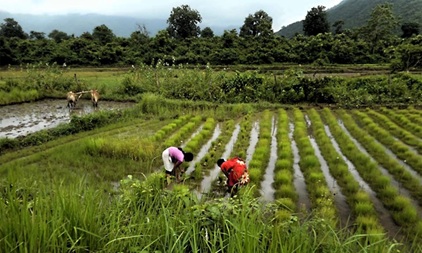
Rice has been at the heart of India’s food security strategy since the Green Revolution. Supported by:
rice cultivation expanded rapidly, particularly in north-western India (Punjab, Haryana, western Uttar Pradesh).
While this model ensured food self-sufficiency and price stability, it has also created structural distortions, locking farmers into water-intensive monocropping systems ill-suited to local agro-ecological conditions. With climate change intensifying water stress, this rice-centric model is increasingly seen as ecologically unsustainable.
FAQsQ1. Why is rice considered environmentally unsustainable in India ? Because it is highly water-intensive and contributes to groundwater depletion and methane emissions. Q2. What is virtual water export in rice trade ? Exporting rice effectively exports the large quantities of water used to produce it. Q3. How does Direct Seeded Rice help sustainability ? It reduces water use, labour costs, and methane emissions. Q4. Why is diversification away from rice necessary ? To reduce water stress, improve soil health, and enhance climate resilience. Q5. What role can genome-edited crops play ? They can deliver drought- and heat-tolerant varieties without yield loss. |
| Prelims: (Polity & Governance + CA) Mains: (GS 2 - Governance, Fundamental Rights, Police Reforms; GS 3: Internal Security, Cyber Security, Technology in Policing) |
Indian States have significantly expanded dedicated police social media monitoring cells over the last five years, reflecting a shift in policing strategies to address emerging digital-era crimes, misinformation, and public order challenges.

Over the past decade, India has witnessed an explosive growth in social media usage, with hundreds of millions of users active on platforms such as Facebook, X (formerly Twitter), WhatsApp, Instagram, Telegram, and Snapchat.
This digital transformation has:
However, it has also created new vulnerabilities, including:
As a result, law enforcement agencies have been compelled to adapt, integrating digital surveillance and online intelligence into routine policing and internal security management.
Social media monitoring has emerged as a critical component of modern policing, aimed at:
Unlike traditional reactive policing, social media monitoring focuses on early warning, trend analysis, and preventive intervention.
Earlier, such functions were handled informally within cybercrime units; their separation into standalone cells marks institutional maturity in digital policing.
The expansion has been uneven across States, influenced by population size, digital penetration, and internal security challenges.
Police authorities cite changing crime patterns as the primary driver. Social media platforms are increasingly used for:
The emphasis is largely preventive, enabling early detection of threats and timely intervention.
The growth of social media monitoring cells parallels broader police modernisation efforts:
However, these advances coexist with structural challenges:
This highlights the technology–manpower mismatch in Indian policing.
The expansion of social media monitoring raises serious constitutional questions:
Balancing security imperatives with civil liberties remains a central governance challenge.
FAQsQ1. What are police social media monitoring cells ? Dedicated units that track online platforms for crime prevention, misinformation, and public order management. Q2. Why has their number increased rapidly ? Due to rising cybercrime, misinformation, and digital coordination of unlawful activities. Q3. Which States have the highest number of such cells ? Bihar, Maharashtra, Punjab, West Bengal, and Assam. Q4. What data source tracks these monitoring cells ? The Data on Police Organisations (DoPO) reports by BPR&D. Q5. What are the main concerns with increased monitoring ? Privacy violations, free speech restrictions, and lack of clear legal oversight. |
| Prelims: (International Relations + CA) Mains: (GS 2 - International Relations; GS 3 – Security, Military Doctrine, Strategic Affairs) |
China recently conducted large-scale military exercises around Taiwan under the banner of “Justice Mission 2025”, involving coordinated deployment of army, navy, air force, and missile units.
The drills come amid heightened tensions in the Taiwan Strait, following major US arms sales to Taiwan, and reflect Beijing’s increasing use of military signalling and coercive deterrence to assert its sovereignty claims over the island.
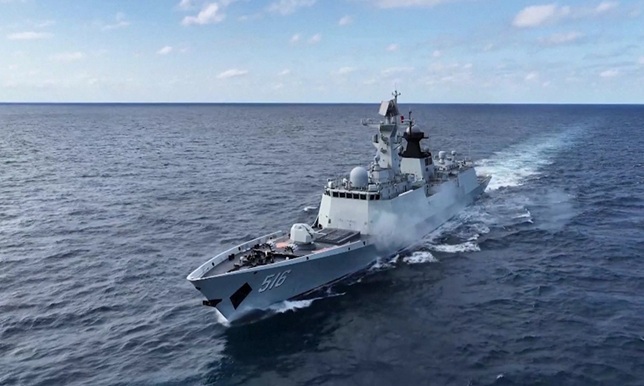
The Taiwan issue is one of the most sensitive and enduring flashpoints in East Asian geopolitics.
In recent years, China has grown increasingly impatient with what it perceives as:
This has led to a sharp escalation in military pressure around the Taiwan Strait.
Justice Mission 2025 is a large-scale inter-service military exercise conducted by China’s People’s Liberation Army (PLA) in and around the Taiwan Strait.
According to Chinese military statements, the exercises focused on:
These elements mirror a full-spectrum coercive campaign, short of invasion, aimed at isolating Taiwan economically, militarily, and psychologically.
Beijing has described the drills as a direct warning to:
China reiterates that Taiwan is an inalienable part of its sovereign territory and has refused to rule out the use of force for reunification.
The timing of Justice Mission 2025 is significant:
For countries like India, such developments highlight the interconnected nature of Asian security dynamics and the importance of maritime stability.
Justice Mission 2025 reflects China’s evolving strategy of:
Rather than an immediate precursor to invasion, the exercise represents a coercive tool to shape behaviour, test responses, and assert dominance in the Taiwan Strait.
FAQsQ1. What is Justice Mission 2025 ? A large-scale joint military exercise conducted by China around Taiwan. Q2. What forces are involved in the drills ? Army, navy, air force, and missile units of the PLA. Q3. Why did China conduct these exercises now ? Amid rising cross-strait tensions and recent US arms sales to Taiwan. Q4. Does this mean China is about to invade Taiwan ? Not necessarily; the drills are primarily coercive signalling and readiness testing. Q5. Why is this important for regional security ? It increases tensions in the Indo-Pacific and raises risks of escalation in a vital global trade corridor. |

Our support team will be happy to assist you!

 Contact Us
  New Batch : 9555124124/ 7428085757
  Tech Support : 9555124124/ 7428085757