- UPSC Exam
- State PCS
- One Day Exam
- Current Affairs
- PT Quiz
- Downlaods
- About Coaching
- Blog
- Videos

| Prelims: Special Campaign 6.0, E-Waste (Management) Rules, 2022, Ministry of Steel, Swachhata, Administrative Reforms Mains: GS Paper II Governance, Administrative Reforms, Accountability and Citizen-Centric Administration GS Paper III Environmental Conservation, E-Waste Management and Sustainable Development Keywords: Special Campaign 6.0, Ministry of Steel, E-Waste Management, E-Waste (Management) Rules 2022, Mechanised Cleaning, Swachhata, Pendency Clearance, Administrative Reforms, Circular Economy, Citizen-Centric Governance, Sustainable Governance |
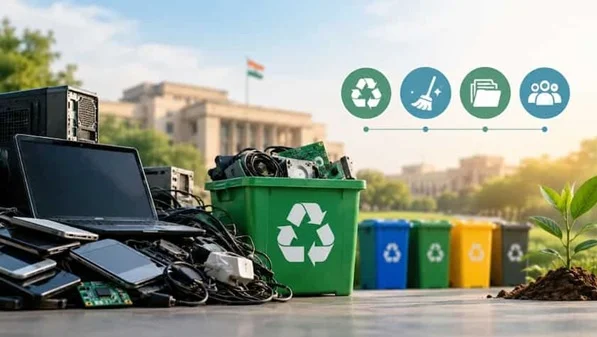
The Ministry of Steel, along with its Public Sector Undertakings (PSUs), will participate in Special Campaign 6.0, which will be implemented from October 2 to October 31, 2026.
This year, the campaign will place special emphasis on the collection, segregation and proper disposal of e-waste in accordance with the E-Waste (Management) Rules, 2022.
Prelims MCQsQ. Consider the following statements regarding Special Campaign 6.0:
Which of the statements given above are correct? (a) 1 only Mains Question“Special Campaign 6.0 goes beyond cleanliness by integrating environmental sustainability with administrative efficiency.” Discuss in the context of e-waste management and good governance. |
What is Special Campaign 6.0?Special Campaign 6.0 is an initiative aimed at improving cleanliness, administrative efficiency, record management, pendency clearance and sustainable practices in government institutions. When will Special Campaign 6.0 be conducted?Its Preparatory Phase will run from September 15 to September 30, 2026, while the Implementation Phase will take place from October 2 to October 31, 2026. Why has e-waste management been included in the campaign?The increasing use of electronic equipment in government institutions generates obsolete electronic devices that require proper collection, segregation and environmentally safe disposal. Who will participate in the campaign?The Ministry of Steel and its Public Sector Undertakings (PSUs) will participate in Special Campaign 6.0. What are the major focus areas of Special Campaign 6.0?The four major focus areas are e-waste management, mechanised cleaning, disposal of pending matters, and awareness and public engagement. |
| Prelims: World Ozone Day, Montreal Protocol, Kigali Amendment, Net Zero Portal, National Action Plan on Climate Change (NAPCC), greenhouse gas emissions, Net Zero, National Missions, Ministry of Environment, Forest and Climate Change. Mains Relevance: GS Paper III: Environment and Ecology, Climate Change, Conservation, Environmental Governance, International Environmental Agreements and India’s Climate Commitments. |
Participating entities can:
Entities successfully declaring their Net Zero targets will receive an acknowledgement from the Ministry of Environment, Forest and Climate Change (MoEFCC).
Public access to declarations will also help create a consolidated national repository of voluntary Net Zero actions by industries and organisations.
The NAPCC framework currently covers the following nine missions:
The original NAPCC, released on 30 June 2008, contained eight core missions. Climate and health has subsequently become part of the expanded framework.
India’s climate policies involve several ministries, industries, state governments and private entities. A common digital reporting system can improve accessibility and transparency of climate-related information.
Many companies announce Net Zero targets, but differences in reporting standards can make their progress difficult to assess. The Net Zero Portal provides a common national platform where voluntary commitments and subsequent progress can be disclosed.
The NAPCC Dashboard can integrate information from different ministries, helping the government evaluate whether climate programmes are producing the intended results.
Reliable indicators can help policymakers identify gaps, revise programmes and allocate resources more effectively.
India has committed to achieving Net Zero emissions by 2070. Monitoring the contribution of different sectors, industries and government missions will therefore become increasingly important.
Prelims MCQsQ. India’s Net Zero Portal was launched by which ministry? A. Ministry of Power Mains Question“Digital monitoring and transparent climate disclosures can significantly strengthen environmental governance in India.” Discuss in the context of the Net Zero Portal and NAPCC Dashboard. |
What is India’s Net Zero Portal?It is a centralised digital platform where Indian entities can voluntarily register their Net Zero commitments, disclose greenhouse gas emissions, specify their targets and provide annual progress updates. What is the purpose of the NAPCC Dashboard?The dashboard provides consolidated monitoring of National Missions under the National Action Plan on Climate Change and helps track sector-wise progress and implementation gaps. Is registration on the Net Zero Portal compulsory?The platform has been designed for voluntary registration and disclosure of Net Zero commitments. What is India’s Net Zero target?India has committed to achieving Net Zero emissions by 2070. What was the theme of World Ozone Day 2026?The theme was “Global Action for a Cooler Planet”, marking ten years of sustainable cooling efforts under the Kigali Amendment. What is the relationship between the Montreal Protocol and the Kigali Amendment?The Montreal Protocol was created to phase out ozone-depleting substances, while the Kigali Amendment added a global phasedown of HFCs to generate significant climate benefits. |
|
Prelims: Vasundhara Doraswamy, Bharatanatyam, Ashtanga Vinyasa Yoga, Sangeet Natak Akademi Award, Vysakhi Nrithyotsav, Nataraj Music & Dance Academy, UNESCO |

Bharatanatyam is one of India’s major classical dance forms, originating in Tamil Nadu.
Dr. Vasundhara Doraswamy's recognition celebrates her five decades of contribution to Bharatanatyam and her efforts to promote Indian classical dance in India and abroad.
Prelims Practice QuestionQ. Dr. Vasundhara Doraswamy is associated with which classical dance form? Mains Practice QuestionQ. Discuss the role of Indian classical dance forms such as Bharatanatyam in preserving India's cultural heritage and promoting Indian culture globally. |
1. Who is Dr. Vasundhara Doraswamy?Dr. Vasundhara Doraswamy is a renowned Bharatanatyam artist, choreographer and scholar based in Mysore. 2. Which award will Dr. Vasundhara Doraswamy receive in 2026?She will receive the Padmabhushan Guru Dr. Saroja Vaidyanathan Excellence Award 2026. 3. What is Bharatanatyam? Bharatanatyam is a major Indian classical dance form that originated in Tamil Nadu. 4. What is special about Dr. Doraswamy's work?She is known for combining Bharatanatyam with Ashtanga Vinyasa Yoga. 5. Where will the award be presented?The award will be presented during the Vysakhi Nrithyotsav Indian Dance Festival in Visakhapatnam. |
|
Prelims: India-New Zealand FTA, Free Trade Agreement, Tariff Reduction, Duty-Free Trade, Bilateral Trade, Market Access, Investment, MFN, Non-Tariff Barriers, Ratification, Trade Liberalisation. |
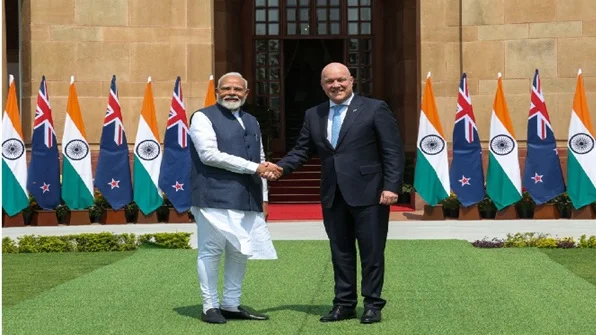
The India-New Zealand Free Trade Agreement is aimed at reducing trade barriers and expanding economic cooperation between the two countries. With most New Zealand exports expected to receive lower or zero tariffs in India and all Indian goods receiving duty-free access to New Zealand, the agreement could provide new opportunities for exporters, investors and service providers in both countries.
Prelims Practice QuestionQ. Consider the following statements regarding the India-New Zealand Free Trade Agreement:
Which of the statements given above are correct? (a) 1 and 2 only Mains Practice QuestionQ. The India-New Zealand Free Trade Agreement can deepen economic cooperation between the two countries. Discuss its potential benefits for India and examine the challenges associated with its implementation. |
1. What is the India-New Zealand Free Trade Agreement?The India-New Zealand FTA is a trade agreement aimed at reducing tariffs and other trade barriers and improving market access between the two countries. 2. What is the major feature of the FTA?Around 95% of New Zealand’s exports to India will receive tariff elimination or significant tariff reductions, while all Indian goods will receive duty-free access to New Zealand. 3. How much will New Zealand invest in India?New Zealand has committed to investing $20 billion in India over the next 15 years. 4. When will the FTA come into effect?The FTA will come into effect after both India and New Zealand complete their respective ratification procedures. 5. What was the bilateral trade between India and New Zealand?Two-way trade stood at approximately NZ$3.99 billion in the year ending June 2026. |
World Ozone Day, officially known as the International Day for the Preservation of the Ozone Layer, is observed every year on 16 September.

|
Fact |
Detail |
|
World Ozone Day |
16 September |
|
Official Name |
International Day for the Preservation of the Ozone Layer |
|
2026 Theme |
Global Action for a Cooler Planet |
|
Special Focus in 2026 |
10 years of the Kigali Amendment |
|
Vienna Convention |
1985 |
|
Montreal Protocol |
1987 |
|
Kigali Amendment |
2016 |
|
Kigali Amendment targets |
HFC phase-down |
|
Ozone formula |
O₃ |
|
Ozone-depleting chemicals |
CFCs, halons and other ODS |
When is World Ozone Day observed?World Ozone Day is observed every year on 16 September. What is the official name of World Ozone Day?Its official name is the International Day for the Preservation of the Ozone Layer. What is the theme of World Ozone Day 2026?The 2026 theme is “Global Action for a Cooler Planet.” Why is World Ozone Day celebrated on 16 September?It commemorates the adoption of the Montreal Protocol on 16 September 1987. What is the ozone layer?It is an ozone-rich region of the stratosphere that absorbs much of the Sun’s harmful ultraviolet radiation. |
| Prelims: Environment & Ecology, Biodiversity, Fisheries, Indian Geography, Current Affairs Mains: GS Paper II: India-Bangladesh Relations GS Paper III: Fisheries, Blue Economy, Biodiversity, Food Processing & River Conservation |
A striking reversal has emerged in the traditional Hilsa (Ilish) trade between India and Bangladesh. India, which is better known for importing the prized fish from Bangladesh particularly to meet festive demand in West Bengal has begun exporting substantial quantities of Hilsa to its eastern neighbour.

|
Fish |
Hilsa/Ilish |
|
Scientific name |
Tenualosa ilisha |
|
Family |
Clupeidae |
|
Nature |
Anadromous migratory fish |
|
Migration |
Marine/estuarine waters → freshwater rivers for breeding |
|
Important Indian river system |
Ganga-Bhagirathi-Hooghly |
|
Barrier discussed in Ganga context |
Farakka Barrage |
|
Farakka Barrage commissioned |
1975 |
|
Major Indian research institute |
ICAR-CIFRI |
|
Conservation programme |
National Mission for Clean Ganga |
|
Major 2026 Indian export source |
Gujarat |
|
2026 trade development |
India exporting Hilsa to Bangladesh |
|
Reported exports |
Around 500 tonnes in about two months |
|
Additional expected exports |
Around 150–200 tonnes |
|
Special demand factor |
High roe content of Gujarat Hilsa |
|
Important Bangladeshi markets mentioned |
Chattogram and Sylhet |
Gujarat Hilsa → High Roe Content → Demand in Bangladesh
Marine waters - Estuaries - River channels - spawning habitats
Marine fisheries, Coastal livelihoods, Food processing, Exports, Biodiversity conservation and Scientific management.
Prelims MCQQ. With reference to Hilsa (Tenualosa ilisha), consider the following statements:
Which of the statements given above are correct? A. 1 and 2 only B. 1, 2 and 3 only C. 2, 3 and 4 only D. 1, 2, 3 and 4 Mains Practice QuestionQ. The recent reversal in India-Bangladesh Hilsa trade highlights the interconnection between ecology, livelihoods and international trade.” Discuss. |
What is the scientific name of Hilsa?Tenualosa ilisha. What type of fish is Hilsa?An anadromous migratory fish. Which sea is strongly associated with Hilsa in South Asia?The Bay of Bengal. Which mission supports Hilsa restoration in the Ganga?The National Mission for Clean Ganga (NMCG). Why is Hilsa important to India’s Blue Economy?It supports fisheries, livelihoods, processing and trade. |
| Prelims Relevance: Science & Technology, Defence Technology, Semiconductors, DRDO, Electronic Warfare, Radar Systems, Gallium Nitride, MMIC Mains: GS Paper III Indigenisation of Technology, Defence Technology, Semiconductor Ecosystem, Science and Technology Developments, National Security Keywords: GaN, Gallium Nitride, MMIC, DRDO, SSPL, Semiconductor, GaAs, SiC, AESA Radar, Electronic Warfare, S-Band, X-Band, Microwave Technology, Defence Indigenisation, Strategic Autonomy |
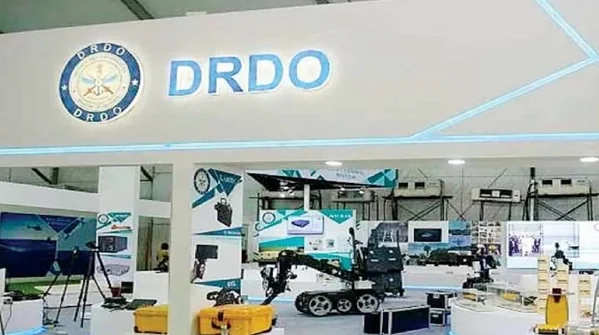
This can contribute to:
GaN technology is especially relevant for Active Electronically Scanned Array (AESA) radars, where hundreds or thousands of small transmit-receive modules operate together.
Prelims MCQsQ. With reference to Gallium Nitride (GaN), consider the following statements:
Which of the statements given above are correct? (a) 1 and 2 only Mains Question“Indigenous Gallium Nitride semiconductor technology can become a critical enabler of India's future radar, electronic warfare and strategic communication capabilities.” Discuss its technological and strategic significance for India. |
What is GaN MMIC?GaN MMIC is a microwave integrated circuit manufactured using Gallium Nitride semiconductor technology. It integrates radio-frequency components onto a single chip and is particularly suitable for high-power and high-frequency applications. Why is GaN important for defence?GaN provides high power density, thermal tolerance and high-frequency performance, making it suitable for advanced radar, electronic warfare, missile and communication systems. Which DRDO laboratory developed the technology?DRDO's Solid State Physics Laboratory (SSPL) has played a major role in developing India's indigenous GaN and other compound semiconductor technologies. What is the importance of X-band capability?X-band frequencies are widely used in high-resolution surveillance radar, fire-control systems, missile guidance and several other defence applications. Can GaN technology be used outside defence?Yes. GaN technology also has applications in telecommunications, satellite systems, electric vehicles, renewable energy and high-efficiency power electronics. |
|
Prelims: Dronathon-2026, Indian Air Force, Pokhran Field Firing Range, Unmanned Aircraft Systems (UAS), Swarm Technology, Autonomous Operations, Electronic Warfare, Counter-Unmanned Aircraft Systems (CUAS), Vayu UTtaM, IAF UAS Roadmap, Atmanirbharta in Defence. |
The Indian Air Force (IAF) has launched its first Dronathon-2026 at the Pokhran Field Firing Range in Jaisalmer, Rajasthan. The three-day event is being held from September 14 to 16, 2026, with participation from more than 20 defence companies, start-ups, MSMEs, DPSUs and innovators.
The event aims to test advanced unmanned systems under realistic operational conditions and strengthen cooperation between the IAF and India’s growing unmanned systems industry.
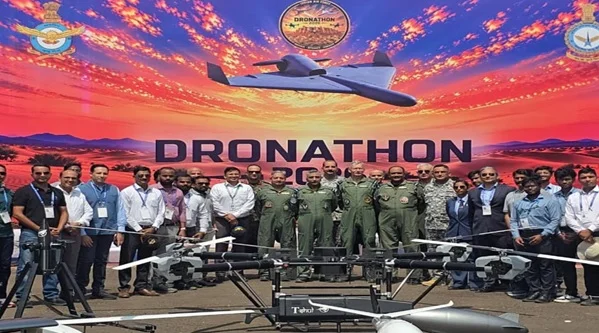
The demonstrations at Dronathon-2026 cover several important unmanned technologies, including:
These technologies can provide military commanders with additional options to improve the reach, persistence, responsiveness and flexibility of air operations.
A major objective of Dronathon-2026 is to assess the real-world operational effectiveness of unmanned systems.
Participating technologies are being evaluated on the basis of:
This approach can help the IAF identify technologies that can move from the development stage towards actual operational deployment.
The technology can have applications in areas such as:
The increasing use of unmanned systems is changing modern warfare. Drones can perform surveillance, reconnaissance and other missions while reducing risks to human personnel.
Dronathon-2026 provides an opportunity for the IAF to:
IAF Dronathon-2026 represents an important step towards integrating advanced unmanned technologies into India’s future air operations. By testing systems under realistic conditions and providing industry with a clear roadmap, the initiative can support innovation, operational preparedness and Atmanirbharta in defence technology
Prelims Practice QuestionQ1. With reference to IAF Dronathon-2026, consider the following statements:
Which of the statements given above is/are correct? A. 1 only Mains Practice QuestionQ. Unmanned systems are emerging as an important component of modern warfare and national security. Discuss the opportunities and challenges associated with the growing use of drone technology in India. |
1. What is IAF Dronathon-2026?IAF Dronathon-2026 is an Indian Air Force initiative to test and evaluate advanced unmanned systems under realistic operational conditions. 2. Where is Dronathon-2026 being held?The event is being held at the Pokhran Field Firing Range in Jaisalmer, Rajasthan. 3. What technologies are being tested?The event covers surveillance, reconnaissance, autonomous operations, swarm technology, electronic warfare and Counter-Unmanned Aircraft Systems (CUAS). 4. What is Vayu UTtaM?Vayu UTtaM is an indigenous multi-mode Unmanned Traffic Management System designed to detect and track military and civilian unmanned aircraft systems. 5. How does Dronathon-2026 support Atmanirbharta?It encourages the development of indigenous capabilities in drone platforms, sensors, propulsion, communications, autonomy, electronic warfare and counter-drone systems. |
The Department of Financial Services (DFS) has received the First Prize under the Rajbhasha Kirti Award for 2025–26 in the category of ministries/departments with fewer than 300 personnel. The award recognises its effective implementation and innovative use of Official Language Hindi in official work.
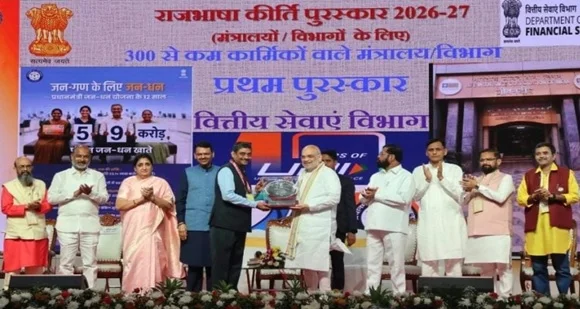
The Rajbhasha Kirti Award highlights the importance of promoting Hindi in official work while respecting India’s rich linguistic diversity. It also encourages government departments to adopt innovative and effective approaches to improve official communication.
Prelims Practice QuestionQ. Who received the First Rajbhasha Kirti Award for 2025–26? A. Department of Financial Services Mains practice QuestionQ. Discuss the significance of promoting Hindi in official work while maintaining India’s linguistic diversity and multilingual character. |
1. What is the Rajbhasha Kirti Award?The Rajbhasha Kirti Award recognises outstanding efforts in the promotion and implementation of Hindi in official work. 2. Who received the First Rajbhasha Kirti Award for 2025–26?The Department of Financial Services (DFS) received the First Prize. 3. In which category did DFS receive the award?DFS received the award in the category of Ministries/Departments with less than 300 personnel. 4. Which organisation presents the Rajbhasha Kirti Award?The award is presented by the Department of Official Language, Ministry of Home Affairs. 5. When was the award presented?The award was presented during the 6th All India Official Language Conference and Hindi Diwas 2026. 6. Why did DFS receive the award?DFS was recognised for the effective implementation and innovative use of Hindi in official work. |

Our support team will be happy to assist you!

 Contact Us
  New Batch : 9555124124/ 7428085757
  Tech Support : 9555124124/ 7428085757