
- UPSC Exam
- State PCS
- One Day Exam
- Current Affairs
- PT Quiz
- Downlaods
- About Coaching
- Blog
- Videos

| Prelims: (Defence + CA) Mains: (GS 2: International Relations; GS 3: Security, Defence Preparedness, Joint Military Exercises) |
The 7th edition of Exercise Dharma Guardian, the annual joint military exercise between the Indian Army and the Japan Ground Self-Defense Force (JGSDF), has commenced at the Foreign Training Node, Chaubattia in Uttarakhand. The exercise aims to enhance interoperability and joint operational capabilities in semi-urban combat environments.
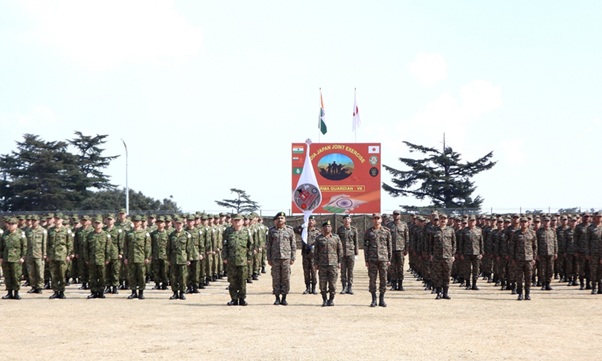
India and Japan have steadily deepened defence and strategic cooperation over the past decade, particularly under their “Special Strategic and Global Partnership.” The annual Dharma Guardian exercise serves as a cornerstone of this growing military engagement.
The strengthening of India–Japan defence ties aligns with:
Defence cooperation between the two countries has expanded to include logistics agreements, high-level military dialogues, and participation in multilateral naval exercises.
The exercise remains a key pillar of India–Japan defence engagement and reflects growing military trust and operational coordination.
The primary objective of Exercise Dharma Guardian is to:
The exercise focuses on realistic, scenario-based operations, including:
1. Establishment of Temporary Operating Base (TOB)
Simulating deployment and operational readiness in hostile environments.
2. Intelligence, Surveillance & Reconnaissance (ISR) Grid Development
Coordinated surveillance planning to detect and neutralise threats.
3. Mobile Vehicle Check Posts
Simulating urban security operations to detect infiltration or contraband.
4. Cordon and Search Operations
Joint drills in hostile and semi-urban terrain to neutralise simulated insurgents.
5. Heliborne Operations
Rapid insertion of troops using helicopters to secure strategic locations.
6. House Intervention Drills
Room-clearing and close-quarter battle techniques for urban warfare scenarios.
These exercises enhance tactical synchronisation and operational compatibility.
1. Malabar (Naval Exercise)
The multilateral naval exercise Malabar involves India, Japan, the United States, and Australia. It enhances maritime interoperability and Indo-Pacific naval coordination.
Participants include the United States and Australia.
2. JIMEX (Japan-India Maritime Exercise)
A bilateral naval exercise focusing on maritime security, anti-submarine warfare, and tactical manoeuvres.
3. SHINYUU Maitri
An air force exercise between the Indian Air Force and the Japan Air Self-Defense Force, focusing on air mobility and disaster relief cooperation.
Together, these exercises indicate expanding tri-service defence cooperation.
1. Strengthening India–Japan Strategic Partnership
The exercise reinforces defence ties within the broader framework of their special strategic relationship.
2. Enhancing Indo-Pacific Security Architecture
Improves preparedness to respond to regional contingencies, including terrorism and maritime threats.
3. Improving Interoperability
Standardising operational procedures ensures seamless coordination during joint missions.
4. Confidence Building & Trust
Regular bilateral exercises build mutual understanding, trust, and strategic alignment.
5. Expanding India’s Defence Diplomacy
Positions India as a reliable security partner in the Indo-Pacific region.
India and Japan are both active members of the Quad grouping, alongside the United States and Australia, which promotes a free and open Indo-Pacific.
Military cooperation through exercises like Dharma Guardian reflects:
FAQsQ1. What is Exercise Dharma Guardian ? It is an annual joint military exercise conducted between the Indian Army and the Japan Ground Self-Defense Force. Q2. Where is the current edition being held ? The 7th edition is being conducted at the Foreign Training Node, Chaubattia, Uttarakhand. Q3. What is the primary objective of the exercise ? To enhance interoperability and strengthen joint operational capabilities in semi-urban combat scenarios. Q4. How often is the exercise conducted ? It is held annually and alternates between India and Japan. Q5. How does it contribute to Indo-Pacific security ? By improving military coordination and operational readiness between two major Indo-Pacific democracies, it strengthens regional stability and collective deterrence. |

Our support team will be happy to assist you!

 Contact Us
  New Batch : 9555124124/ 7428085757
  Tech Support : 9555124124/ 7428085757