Prelims: NABARD, NABKISAN Finance Limited, Social Bonds, WASH, National Stock Exchange (NSE), Sustainable Finance, ESG, SDG 6, NBFC.
Mains: GS Paper III: Indian Economy, Mobilisation of Resources, Infrastructure, Inclusive Growth and Sustainable Development. |
Why in news?
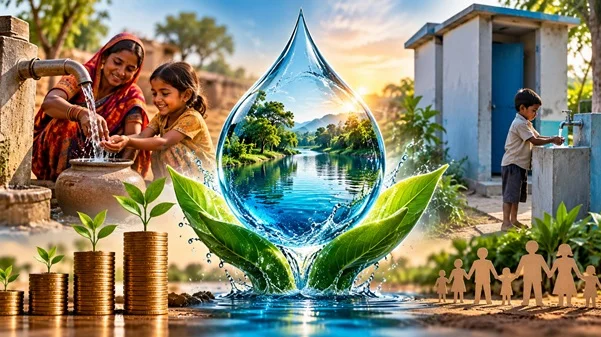
NABKISAN Finance Limited, a subsidiary of the National Bank for Agriculture and Rural Development (NABARD), listed India’s first Social Bond dedicated exclusively to the Water, Sanitation and Hygiene (WASH) sector on the National Stock Exchange (NSE), Mumbai, on 2 October 2026.
Key Facts
|
Particular
|
Details
|
|
Issuer
|
NABKISAN Finance Limited
|
|
Parent institution
|
NABARD
|
|
Type
|
WASH-focused Social Bond
|
|
Significance
|
India's first Social Bond exclusively dedicated to WASH
|
|
Amount raised
|
₹180 crore
|
|
Listing platform
|
National Stock Exchange (NSE), Mumbai
|
|
Tenure
|
5 years
|
|
Coupon rate
|
8.10%
|
|
Maturity
|
September 2031
|
|
Subscription
|
1.8 times
|
|
CRISIL rating
|
AAA (Stable)
|
|
CARE rating
|
AAA (Stable)
|
|
Purpose
|
Financing access to safe water, sanitation and hygiene
|
What is WASH?
- WASH stands for WA (Water), S (Sanitation) and H (Hygiene).
- It refers broadly to access to safe drinking water, adequate sanitation facilities and appropriate hygiene practices and services.
- WASH is closely connected with public health because inadequate water, sanitation and hygiene conditions can increase exposure to preventable diseases and impose social and economic costs on households.
What is Bond?
- It is a debt instrument used to raise money from investors.
- It may be used for general purposes, depending on the bond terms.
What is a Social Bond?
- A debt instrument through which an issuer raises money from investors and uses the proceeds for projects intended to produce positive social outcomes.
- According to the International Capital Market Association's Social Bond Principles, the proceeds or an equivalent amount of a social bond are exclusively applied towards financing or refinancing eligible social projects.
- Eligible areas can include affordable basic infrastructure (clean drinking water and sanitation), essential services (healthcare, education and financial services), affordable housing, employment generation and food security.
How does a Social Bond work?
- Issuer identifies eligible social projects → Social Bond issued to investors → Investors provide capital→ Issuer pays agreed interest/coupon → Bond proceeds allocated to eligible social projects → Social outcomes are monitored/reported → Principal repaid at maturity
What makes the NABKISAN bond different?
- The important feature of this issue is its exclusive WASH focus. The ₹180 crore raised is intended to expand financing for solutions involving safe water, sanitation, hygiene, rural & underserved communities, health, livelihood and quality of life.
- This makes the instrument an example of using the capital market for social infrastructure financing, rather than relying solely on traditional public expenditure or grants.
What is NABKISAN Finance Limited?
- A NABARD subsidiary and an RBI-notified Non-Banking Financial Company (NBFC). It was originally incorporated in 1997 as Agri Development Finance (Tamil Nadu) Limited.
- NABKISAN has developed a major presence in financing the Farmer Producer Organisation (FPO) ecosystem.
- Its financing activities currently extend across areas such as:
- Farmer Producer Organisations
- Primary Agricultural Credit Societies
- Agricultural value chains
- NBFCs and MFIs
- Agri-tech enterprises
- MSMEs and Climate initiatives
- WASH and Rural livelihoods
- NABKISAN states that it operates across 24 states and 5 Union Territories.
NABKISAN-NABSAMRUDDHI Merger: Important Background
- An important development behind NABKISAN's expanded WASH role was its merger with another NABARD subsidiary, NABSAMRUDDHI Finance Limited.
- According to NABKISAN, the merger took effect on 16 December 2025.
- Before the merger: NABKISAN (Strong presence in FPO and agricultural financing) and NABSAMRUDDHI (Significant focus on WASH and development-sector financing)
- After merger: Agriculture Finance, WASH Finance, Social Infrastructure, Climate Finance
Role of Water.org
- Water.org acted as the technical adviser and knowledge partner for the transaction.
- Its involvement is relevant because WASH financing requires more than simply raising capital. It also involves identifying appropriate financing models and connecting financial mechanisms with water and sanitation outcomes.
- NABKISAN and Water.org had already organised a forum on “Scaling WASH Finance in India”, where NABKISAN had announced plans for a proposed Social Bond.
Social Bond vs Green Bond vs Sustainability Bond
|
Instrument
|
Main Purpose
|
|
Green Bond
|
Environmental projects
|
|
Social Bond
|
Projects producing positive social outcomes
|
|
Sustainability Bond
|
Combination of eligible green and social projects
|
|
Sustainability-linked Bond
|
Financial characteristics linked to achievement of predefined sustainability/KPI targets
|
Significance
- New Source of WASH Financing: Social Bonds can complement Government spending, Institutional finance, Development finance and Private capital.
- Mobilising Capital for Rural Development: The bond links capital-market financing with rural and underserved communities, consistent with NABARD and NABKISAN's development-oriented mandate.
- Strengthens India's Sustainable Finance Market: India's sustainable-finance ecosystem has gradually expanded beyond conventional Green Bonds towards instruments targeting social and broader sustainability outcomes.
- Investor Participation: The issue was reportedly 1.8 times oversubscribed, showing substantial demand relative to the amount offered.
- Linking Finance with Development Outcomes: Traditional financing often measures success primarily in terms of financial repayment. Impact-oriented finance adds another dimension capital raised, social project, beneficiaries and measurable social outcome. This can encourage greater focus on the developmental impact of deployed capital.
Why WASH Financing Matters
- Access to water and sanitation is not merely an infrastructure issue.
- It has links with Public Health (Lower exposure to water- and sanitation-related health risks), Education (Improved sanitation facilities can support school attendance and dignity), Women and Girls (Safe and accessible WASH facilities have particular implications for safety, dignity and unpaid care burdens), Productivity (Better health and reliable services can reduce time and economic losses) and Rural Development (Improved basic infrastructure strengthens quality of life).
Challenges
- Impact Measurement: Social outcomes may be more difficult to quantify than financial returns.
- Use-of-Proceeds Monitoring: Funds must actually reach eligible projects.
- Social-washing Risk: Social labels should correspond to genuine and measurable benefits.
- Project Identification: Suitable and financially viable social projects must be developed.
- Reporting Requirements: Investors need credible information on allocation and impact.
- Scalability: Individual successful issuances must translate into a deeper sustainable-finance market.
Prelims MCQ
Q. With reference to Social Bonds, consider the following statements:
- Their proceeds are used to finance or refinance eligible projects intended to generate positive social outcomes.
- Affordable basic infrastructure such as clean drinking water and sanitation can qualify as a social project.
- NABKISAN Finance Limited is a subsidiary of NABARD.
Which of the statements given above are correct?
(a) 1 and 2 only
(b) 2 and 3 only
(c) 1 and 3 only
(d) 1, 2 and 3
Mains Practice Question
Q. How can Social Bonds support sustainable and inclusive development in India?
|
FAQs
What does WASH stand for?
Water, Sanitation and Hygiene.
Which institution issued India's first WASH-focused Social Bond?
NABKISAN Finance Limited. LinkedIn
How much did NABKISAN raise through the bond?
₹180 crore. Ruralvoice
Where was the bond listed?
On the National Stock Exchange (NSE), Mumbai. Ruralvoice
What is the coupon rate of the bond?
8.10%
|






 Contact Us
  New Batch : 9555124124/ 7428085757
  Tech Support : 9555124124/ 7428085757