Why is it in the News ?
- The West Bengal Health Department has launched a Mass Drug Administration (MDA) campaign against Lymphatic Filariasis (LF).
- The campaign is being conducted across 59 blocks and urban local bodies in 10 districts of the state.
- Its objective is to eliminate filariasis by 2030. During the campaign, health workers are visiting households to provide free preventive medicines to eligible people and encouraging them to consume the medicines under Directly Observed Treatment (DOT).
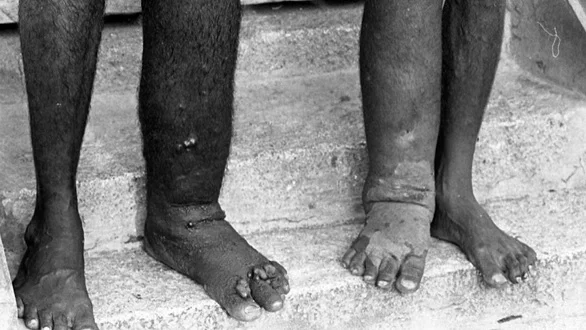
What is Lymphatic Filariasis?
- Lymphatic Filariasis (LF), commonly known as Elephantiasis, is a parasitic infection.
- It is classified by the World Health Organization (WHO) as a Neglected Tropical Disease (NTD).
- The disease affects the lymphatic system, leading to abnormal swelling of various body parts, especially the legs, arms, breasts, and genital organs.
- If left untreated for a long period, it can cause permanent disability and serious social and economic problems.
What is the Lymphatic System ?
The lymphatic system is an important network in the human body consisting of lymph vessels, lymph nodes, and lymph fluid.
Its major functions include :
- Removing excess fluid from body tissues.
- Strengthening the body's immune system.
- Protecting the body against infections.
- Helping in the transport of fats and nutrients.
The filarial parasites damage this system, causing lymph fluid to accumulate and resulting in swelling.
What Causes Lymphatic Filariasis ?
The disease is caused by infection with thread-like parasitic roundworms (nematodes) belonging to the Filarioidea family.
The three main parasites are :
1. Wuchereria bancrofti
- Responsible for about 90% of global cases.
- Causes the majority of infections in India.
2. Brugia malayi
- Responsible for most of the remaining cases.
- Found in some states of India.
3. Brugia timori
- Comparatively rare.
- Mainly found in certain parts of Indonesia.
Transmission
- Lymphatic Filariasis is a vector-borne disease.
- In India, the principal vector is the female Culex mosquito.
- In some parts of the world, Anopheles, Aedes, and Mansonia mosquitoes can also transmit the disease.
How Does Filariasis Spread ?
- The blood of an infected person contains microfilariae (immature larvae).
- When a female mosquito bites the infected person, it ingests these microfilariae.
- Inside the mosquito, the larvae develop into the infective stage.
- When the infected mosquito later bites a healthy person, the larvae enter the body.
- The larvae migrate to the lymphatic vessels, where they develop into adult worms.
- Adult worms can survive for years and produce millions of microfilariae.
Can a Single Mosquito Bite Cause Filariasis ?
- Generally, a single mosquito bite does not cause the disease.
- Infection usually occurs after repeated bites by infected mosquitoes over several months or even years.
Symptoms of Lymphatic Filariasis
In the early stages, most infected individuals do not show any symptoms.
Over time, the following complications may develop :
- Severe swelling of the legs (Elephantiasis)
- Swelling of the arms
- Hydrocele (swelling of the scrotum)
- Swelling of the breasts
- Thickening and hardening of the skin
- Recurrent fever
- Inflammation of the lymphatic vessels
- Pain and difficulty in movement
Why Does Elephantiasis Occur ?
Adult worms block the lymphatic vessels.
As a result :
- The normal flow of lymph fluid is obstructed.
- Lymph fluid accumulates in the affected tissues.
- The affected body parts gradually become enlarged, swollen, and thickened.
This condition is known as Elephantiasis.
Situation in India
- India is among the countries with the highest burden of Lymphatic Filariasis.
- The disease is endemic in many districts of Uttar Pradesh, Bihar, Jharkhand, West Bengal, Odisha, Assam, Tamil Nadu, Kerala, Andhra Pradesh, and Telangana.
- The Government of India aims to eliminate Lymphatic Filariasis by 2030.
Treatment of Lymphatic Filariasis
Treatment is carried out at two levels :
1. Preventing Transmission
2. Management of Patients
- Regular care of swollen limbs
- Prevention of secondary infections
- Surgery for Hydrocele
- Proper skin hygiene
- Exercise and physiotherapy
What is Mass Drug Administration (MDA)?
Mass Drug Administration (MDA) is a public health intervention in which all eligible people living in endemic areas receive anti-filarial medicines once every year, regardless of whether they have symptoms.
Its objectives are :
- To eliminate microfilariae circulating in the blood.
- To break the cycle of transmission through mosquitoes.
- To prevent new infections.
- To ultimately eliminate the disease.
Which Medicines are Used in MDA ?
According to WHO recommendations, the following medicines are used in different countries :
- Diethylcarbamazine (DEC)
- Albendazole
- Ivermectin (in selected regions)
In India, the standard MDA regimen generally consists of DEC + Albendazole.
West Bengal's New Campaign
Recently, the Government of West Bengal has :
- Launched the campaign in 10 districts.
- Covered 59 blocks and urban local bodies.
- Deployed health workers for door-to-door drug distribution.
- Urged people to consume the medicines in the presence of health workers.
- Set the target of eliminating filariasis from the state by 2030.
Preventive Measures Against Filariasis
- Protect yourself from mosquito bites.
- Prevent water stagnation around homes.
- Use mosquito nets.
- Wear full-sleeved clothing.
- Take medicines provided during the MDA campaign.
- Ensure timely treatment of infected individuals.
FAQ (Frequently Asked Questions)
1. What is lymphatic filariasis ?
Answer:- It is a parasitic neglected tropical disease, commonly known as elephantiasis. It affects the body's lymphatic system.
2. Which mosquito is transmitted by this disease in India ?
Answer:- Primarily through the bite of the female Culex mosquito.
3. Which system of the body does filariasis affect ?
Answer:- It affects the lymphatic system.
|






 Contact Us
  New Batch : 9555124124/ 7428085757
  Tech Support : 9555124124/ 7428085757