
- UPSC Exam
- State PCS
- One Day Exam
- Current Affairs
- PT Quiz
- Downlaods
- About Coaching
- Blog
- Videos

KeywordsMH-60R Seahawk, Lockheed Martin, Sikorsky Aircraft, Indian Navy, Anti-Submarine Warfare (ASW), Anti-Surface Warfare (ASuW), Maritime Domain Awareness (MDA), Foreign Military Sales (FMS), Indo-Pacific, Indian Ocean Region (IOR) Focus AreaMains GS II (International Relations) India–US Strategic Partnership, Defence Cooperation, Indo-Pacific Strategy, Quad Mains GS III (Internal Security & Defence) Maritime Security, Naval Modernisation, Defence Technology, Anti-Submarine Warfare |
The Indian Navy has received another MH-60R Seahawk multi-role naval helicopter from the United States, which arrived at INS Garuda, Kochi.
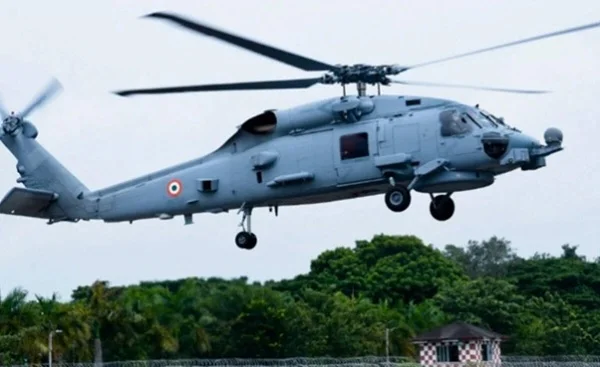
Anti-Submarine Warfare refers to military operations conducted to detect, track, monitor, deter, and destroy enemy submarines. With the growing presence of conventional and nuclear submarines in the Indian Ocean, ASW has become one of the Indian Navy's highest operational priorities. The MH-60R significantly strengthens India's underwater warfare capability through its advanced sonar systems, sonobuoys, and lightweight torpedoes.
Anti-Surface Warfare involves detecting and neutralising enemy warships, patrol vessels, and other surface combatants. The MH-60R carries AGM-114 Hellfire missiles and advanced targeting systems, enabling precision engagement of hostile vessels while supporting naval task forces.
Foreign Military Sales (FMS) is a US government-to-government defence export programme under which friendly countries procure military equipment, weapons, training, logistics, and support directly from the United States Government. India's purchase of the MH-60R helicopters was concluded through this route, ensuring long-term maintenance, training, and operational support.
Over the last decade, India and the United States have transformed their defence relationship into one of the most comprehensive strategic partnerships in the Indo-Pacific. The two countries regularly conduct joint military exercises such as Malabar, Yudh Abhyas, Tiger Triumph, and Cope India, while foundational agreements including LEMOA (2016), COMCASA (2018), BECA (2020), and GSOMIA have enabled greater logistics sharing, secure communications, geospatial intelligence sharing, and defence technology cooperation.
The induction of the MH-60R further enhances interoperability between the Indian Navy and the US Navy during joint operations and humanitarian assistance missions.
|
Particular |
Details |
|---|---|
|
Manufacturer |
Lockheed Martin (Sikorsky Aircraft) |
|
Country of Origin |
United States |
|
Type |
Multi-role Naval Helicopter |
|
Operators |
US Navy, Indian Navy and several allied countries |
|
Engines |
Twin General Electric T700 Turboshaft Engines |
|
Crew |
4 |
|
Maximum Speed |
Around 270 km/h |
|
Operational Range |
Approximately 830 km |
|
Maximum Endurance |
About 4 hours |
|
Platform |
Aircraft Carriers, Destroyers, Frigates and Naval Air Stations |
|
Particular |
Details |
|---|---|
|
Contract Signed |
2020 |
|
Total Helicopters Ordered |
24 |
|
Procurement Route |
Foreign Military Sales (FMS) |
|
Estimated Cost |
Approximately US$2.6 Billion |
|
Delivery Status |
Deliveries underway |
|
Primary Purpose |
Replace ageing Sea King helicopters |
China has significantly expanded the deployment of both conventional and nuclear-powered submarines in the Indian Ocean Region. The MH-60R provides India with a modern airborne ASW platform capable of detecting and neutralising underwater threats before they approach Indian naval assets.
The helicopter's advanced radar and surveillance systems enable continuous monitoring of India's vast Exclusive Economic Zone (EEZ), critical Sea Lines of Communication (SLOCs), offshore energy infrastructure, and strategic maritime chokepoints.
The MH-60R serves as the "eyes and ears" of naval fleets by extending the surveillance range of aircraft carriers and destroyers. It protects carrier strike groups from submarine attacks and enhances fleet air defence.
China's increasing naval deployments, including research vessels, intelligence ships, and submarines, have made underwater surveillance a strategic necessity. The Seahawk strengthens India's capability to maintain maritime superiority across the Indian Ocean Region.
The helicopter integrates seamlessly with modern Indian warships through secure communication links, enabling real-time intelligence sharing and coordinated maritime operations.
Apart from combat missions, the MH-60R can undertake medical evacuation, disaster relief, search and rescue operations, and evacuation of civilians during natural disasters.
Prelims MCQQ. With reference to the MH-60R Seahawk helicopter, consider the following statements:
Which of the statements given above are correct? (a) 1 and 2 only Mains Practice Question"The induction of advanced naval aviation platforms like the MH-60R Seahawk represents a paradigm shift in India's maritime security architecture." Discuss the strategic significance of the MH-60R helicopters in strengthening India's naval capabilities and examine their role in deepening India-US defence cooperation. |
FAQs1. What is the MH-60R Seahawk ?The MH-60R Seahawk is an advanced multi-role naval helicopter developed by Lockheed Martin (Sikorsky) for missions such as anti-submarine warfare, anti-surface warfare, maritime surveillance, search and rescue, and special operations support. 2. Why is the MH-60R important for the Indian Navy ?It significantly enhances India's ability to detect enemy submarines, protect naval fleets, improve maritime domain awareness, and safeguard strategic interests in the Indian Ocean Region. 3. How many MH-60R helicopters has India ordered ?India signed a US$2.6 billion contract in 2020 to procure 24 MH-60R Seahawk helicopters from the United States under the Foreign Military Sales (FMS) programme. 4. Which Indian naval platforms will operate the MH-60R ?The helicopter can operate from INS Vikrant, INS Vikramaditya, Kolkata-class destroyers, Visakhapatnam-class destroyers, Nilgiri-class frigates, and other modern frontline warships equipped with helicopter facilities. 5. How does the MH-60R strengthen India-US defence cooperation ?Its induction enhances interoperability between the Indian and US Navies, supports joint exercises like Malabar, promotes advanced defence technology collaboration, and reinforces the shared vision of a free, open, and rules-based Indo-Pacific. |



Our support team will be happy to assist you!

 Contact Us
  New Batch : 9555124124/ 7428085757
  Tech Support : 9555124124/ 7428085757