
- UPSC Exam
- State PCS
- One Day Exam
- Current Affairs
- PT Quiz
- Downlaods
- About Coaching
- Blog
- Videos

KeywordsDrug Demand Reduction • Community Participation • Jan Andolan • Social Reintegration • Harm Reduction • Whole-of-Government Approach • Public Health • Youth Empowerment • Evidence-Based Policy • Rehabilitation • Behavioural Change Communication • Internal Security • Preventive Healthcare Focus AreaGS-I : Social Issues, Youth, Substance Abuse GS-II : Welfare Schemes, Health Governance, Vulnerable Sections GS-III : Internal Security, Drug Trafficking, Border Management, Organized Crime. |
The Ministry of Social Justice and Empowerment has announced that the Nasha Mukt Bharat Abhiyaan (NMBA) has reached over 29.32 crore citizens across India through awareness campaigns and community participation. Since its launch in 2020, the campaign has expanded from 272 vulnerable districts to all districts of the country, making it one of India's largest social awareness initiatives against substance abuse.
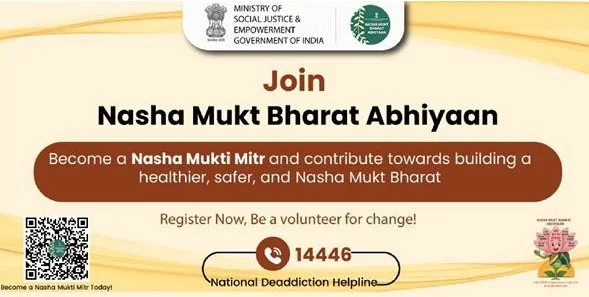
Nasha Mukt Bharat Abhiyaan (NMBA) is the flagship anti-drug awareness and rehabilitation campaign of the Ministry of Social Justice and Empowerment.
The campaign adopts an evidence-based approach, focusing equally on prevention, treatment and rehabilitation instead of relying solely on law enforcement.
|
Indicator |
Achievement |
|---|---|
|
Citizens Reached |
29.32 crore+ |
|
Youth Covered |
11.20 crore+ |
|
Women Covered |
7.92 crore+ |
|
Awareness Activities |
21 lakh+ |
|
Educational Institutions Covered |
Schools, Colleges & Universities nationwide |
|
Drug De-addiction Helpline Calls (14446) |
4.60 lakh+ |
|
People Benefitted through Rehabilitation Services |
28.29 lakh+ |
|
Treatment Centres Supported |
768 |
|
Increase in Persons Seeking Treatment |
294% growth (2020-2025) |
The Ministry has significantly expanded treatment and rehabilitation services across the country.
Together, these facilities have benefited over 28.29 lakh individuals.
A notable achievement is the 294% increase in treatment seekers, from 2.08 lakh in 2020 to over 8.20 lakh in 2025, indicating greater awareness and trust in rehabilitation services.
To strengthen implementation, the Government launched NMBA App 2.0.
The Ministry operates the National Drug De-Addiction Helpline (14446).
The helpline has received over 4.60 lakh calls, becoming the first point of assistance for people affected by substance abuse.
Citizens can voluntarily become Nasha Mukti Mitras after taking the Nasha Mukt Bharat Pledge.
This initiative aims to transform every citizen into an anti-drug ambassador.
|
Feature |
Importance |
|---|---|
|
Community Participation |
Converts anti-drug efforts into a Jan Andolan |
|
Awareness Campaigns |
Prevents first-time drug use through education |
|
Youth-Centric Approach |
Targets the most vulnerable age group |
|
Women Participation |
Strengthens family and community resilience |
|
Rehabilitation Services |
Provides treatment and recovery support |
|
Inter-Ministerial Coordination |
Ensures integrated governance |
|
NMBA App 2.0 |
Enables digital monitoring and transparency |
|
Drug Helpline (14446) |
Provides accessible counselling and referral services |
Drug trafficking finances organised crime, terrorism and illegal arms trade. Therefore, reducing drug demand also strengthens India's internal security.
Prelims MCQQ. With reference to the Nasha Mukt Bharat Abhiyaan (NMBA), consider the following statements:
Which of the statements given above is/are correct? A. 1 and 2 only Mains Practice Question"Drug abuse is not merely a law-and-order issue but a multidimensional public health and social challenge." Discuss the role of the Nasha Mukt Bharat Abhiyaan in addressing drug demand reduction in India. Also examine the challenges and suggest measures for making India drug-free. |
FAQs1. What is the Nasha Mukt Bharat Abhiyaan (NMBA) ?It is a flagship campaign of the Ministry of Social Justice and Empowerment, launched on 15 August 2020 under NAPDDR to prevent substance abuse through awareness, treatment, rehabilitation and community participation. 2. Which ministry implements the Nasha Mukt Bharat Abhiyaan ?The Ministry of Social Justice and Empowerment is the nodal ministry responsible for implementing the campaign in coordination with States, the Narcotics Control Bureau, NGOs and educational institutions. 3. What is the Drug De-addiction Helpline 14446 ?It is a national toll-free helpline that provides counselling, information and referral services to individuals and families affected by substance abuse. 4. What is the Nasha Mukti Mitra Initiative?It is a volunteer initiative under NMBA where citizens take the Nasha Mukt Bharat Pledge and work as Nasha Mukti Mitras to spread awareness and encourage a drug-free society. 5. Under which programme was NMBA launched ?The campaign was launched under the National Action Plan for Drug Demand Reduction (NAPDDR), which focuses on prevention, treatment, rehabilitation and social reintegration of persons affected by substance abuse. |

Our support team will be happy to assist you!

 Contact Us
  New Batch : 9555124124/ 7428085757
  Tech Support : 9555124124/ 7428085757