
- UPSC Exam
- State PCS
- One Day Exam
- Current Affairs
- PT Quiz
- Downlaods
- About Coaching
- Blog
- Videos

| Prelims: Article 263, Inter-State Council, Article 356, Article 239AB, President's Rule, Governor, Lieutenant Governor, Sarkaria Commission, Centre-State Relations. Mains: GS Paper II: Indian Constitution, Federalism, Centre-State Relations, Constitutional Bodies and Inter-Governmental Coordination. |
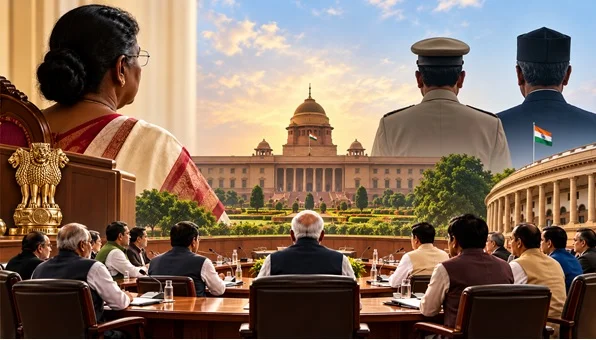
President Droupadi Murmu has issued the Inter-State Council (Amendment) Order, 2026, modifying the Inter-State Council Order, 1990.
|
Particular |
Details |
|
Amendment |
Inter-State Council (Amendment) Order, 2026 |
|
Issuing authority |
President of India |
|
Constitutional basis |
Article 263 |
|
Ministry |
Ministry of Home Affairs |
|
Gazette publication |
18 September 2026 |
|
Original order |
Inter-State Council Order, 1990 |
|
Original establishment |
28 May 1990 |
|
Provision amended |
Proviso to Clause 2 |
|
Territories covered |
States, NCT of Delhi, Puducherry and Jammu & Kashmir |
|
Nature of change |
Attendance of Governors/LGs in specified circumstances |
|
Member |
Position |
|
Prime Minister |
Chairperson |
|
Chief Ministers of all States |
Members |
|
Chief Ministers of UTs having Legislative Assemblies |
Members |
|
Administrators of UTs without Legislative Assemblies |
Members |
|
Six Union Cabinet Ministers nominated by the Prime Minister |
Members |
|
Provision |
Earlier Position |
Current Position |
|
Article 356 |
During President’s Rule, the President may assume specified State government functions. The Governor ordinarily continues as the constitutional head. |
The Governor of a State under President’s Rule shall be invited to the Inter-State Council. |
|
Article 239AB |
Allows suspension of specified provisions of Article 239AA or laws made under it when Delhi’s administration cannot be carried on under the constitutional framework. |
Delhi’s Lieutenant Governor shall be invited to the Council when an order under Article 239AB is in force. |
|
Section 51 |
Allows the President to suspend relevant statutory provisions and make consequential arrangements during a failure of constitutional machinery. |
Puducherry’s Lieutenant Governor shall be invited to the Council when an order under Section 51 is in force. |
|
Section 73 |
Provides for presidential action when the administration of the UT of Jammu & Kashmir cannot be carried on under the applicable statutory framework. |
Jammu & Kashmir’s Lieutenant Governor shall be invited to the Council when an order under Section 73 is in force. |
|
Basis |
Inter-State Council |
Zonal Council |
|
Nature |
Constitutional mechanism |
Statutory bodies |
|
Legal Basis |
Article 263 |
States Reorganisation Act, 1956 |
|
Chairperson |
Prime Minister |
Union Home Minister |
|
Scope |
National-level Centre-State and inter-State coordination |
Regional inter-State coordination |
|
Number |
One |
Five |
|
Main function |
Discussion and recommendations on matters of common interest |
Regional cooperation and resolution of common issues |
Prelims MCQQ. With reference to the Inter-State Council, consider the following statements:
Which of the statements given above are correct? (a) 1 and 2 only (b) 2 and 3 only (c) 1 and 3 only (d) 1, 2 and 3 Mains Practice QuestionQ. Discuss the role of the Inter-State Council in strengthening cooperative federalism in India. |
Who issued the Inter-State Council (Amendment) Order, 2026?President Droupadi Murmu, exercising powers under Article 263. When was the amendment published?It was published in the Gazette of India on 18 September 2026. Who chairs the Inter-State Council?The Prime Minister of India. Which Article provides for President's Rule in States?Article 356 of the Constitution. Which Article governs the corresponding arrangement for Delhi?Article 239AB. |

Our support team will be happy to assist you!

 Contact Us
  New Batch : 9555124124/ 7428085757
  Tech Support : 9555124124/ 7428085757