
- UPSC Exam
- State PCS
- One Day Exam
- Current Affairs
- PT Quiz
- Downlaods
- About Coaching
- Blog
- Videos

| Prelims: (Technology + CA) Mains: GS 2 – Health Governance, Welfare Schemes, Tribal Affairs: GS 3 – Technology) |
The Ministry of Tribal Affairs informed the Rajya Sabha that there is currently no proposal to expand the Swasthya Portal to integrate national health databases, district-level dashboards, or AI-driven analytics. This has renewed attention on the functioning, scope, and limitations of the Swasthya Portal — a key digital platform tracking tribal health and nutrition indicators in India.
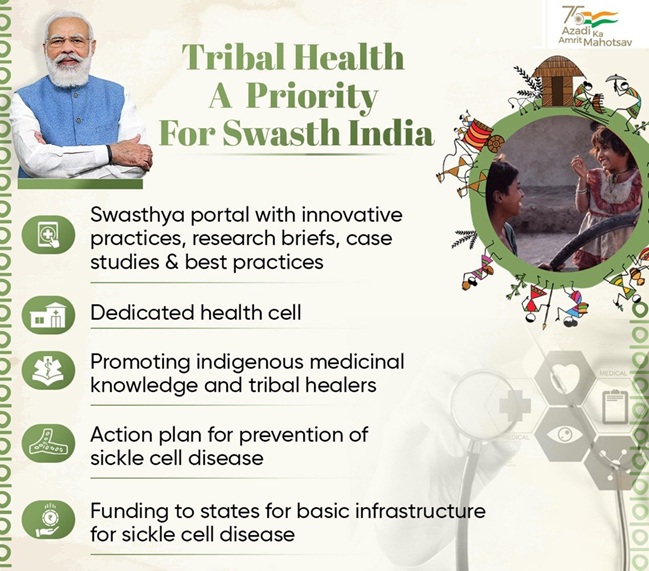
India’s tribal population (over 10.4 crore people, ~8.6% of the population) faces persistent challenges:
To address the information gap, the Ministry of Tribal Affairs launched the Swasthya Portal under the larger digital knowledge initiative TRI-ECE (Tribal Research Information, Education, Communication & Events). The portal aims to consolidate health-related data for tribal communities, serve as a research repository, and support evidence-based policy interventions.
The Swasthya Portal is a centralised digital platform providing real-time information on the health and nutrition status of India’s tribal population.
Key Functions:
1. Unified Tribal Health Dashboard
2. Knowledge Repository
3. Sickle Cell Disease (SCD) Corner
4. Partner & Collaboration Section
5. Hosted and Managed by NIC Ecosystem
1. Bridges Tribal Health Data Gaps
Reliable tribal health statistics are often unavailable — this platform centralises and standardises them.
2. Improves Policymaking
Helps ministries, state departments and district administrations plan targeted interventions.
3. Supports Sickle Cell Disease (SCD) Elimination Mission
Acts as a knowledge base to support the National SCD Elimination Programme.
4. Enhances Transparency & Governance
Digitised dashboards create accountability and encourage inter-state learning.
5. Evidence-Based Decision Making
Researchers and NGOs can design interventions based on verified data.
The government clarified that the Swasthya Portal will not be expanded to include:
This means the platform remains primarily informational, not analytical.
FAQs1. What is the primary objective of the Swasthya Portal ? To provide a comprehensive, centralised platform presenting health and nutrition data of tribal populations, aiding policymakers and researchers. 2. Does the Swasthya Portal collect real-time health data ? No. It curates data from existing national and state sources. 3. Why is Sickle Cell Disease highlighted on the portal ? Because SCD disproportionately affects tribal communities; the portal serves as an awareness and knowledge hub. 4. Will the portal integrate AI analytics ? No. The government clarified that no such expansion is planned currently. 5. Who manages the Swasthya Portal ? It is hosted by NIC and managed by the Centre of Excellence for Knowledge Management in Health and Nutrition under the Ministry of Tribal Affairs. |



Our support team will be happy to assist you!

 Contact Us
  New Batch : 9555124124/ 7428085757
  Tech Support : 9555124124/ 7428085757