
- UPSC Exam
- State PCS
- One Day Exam
- Current Affairs
- PT Quiz
- Downlaods
- About Coaching
- Blog
- Videos

The Securities and Exchange Board of India (SEBI) has recently cautioned regulated entities and listed companies against an emerging cyber fraud known as the ‘Boss Scam’, where fraudsters impersonate Chief Executive Officers (CEOs), Managing Directors (MDs), and other senior executives to trick finance teams into transferring funds to fraudulent bank accounts.
As cybercriminals increasingly leverage artificial intelligence (AI), deepfake technology, and social engineering, Boss Scam has emerged as a significant threat to corporate financial security.
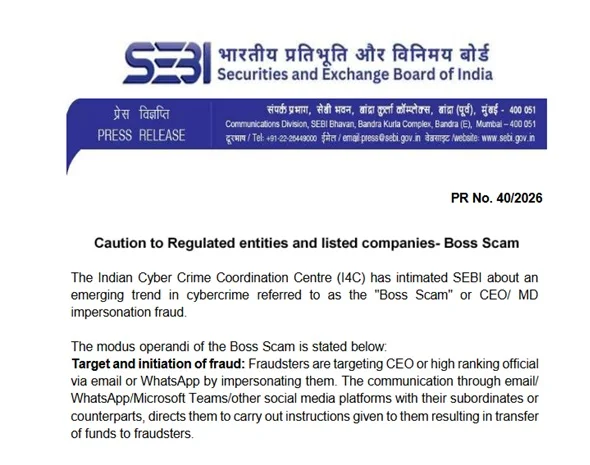
Boss Scam is an advanced form of cyber fraud in which attackers impersonate senior company executives—such as CEOs, Managing Directors (MDs), or Chief Financial Officers (CFOs)—to deceive finance and accounts personnel into making unauthorized fund transfers.
The fraud relies on creating a sense of urgency and confidentiality, convincing employees that the payment is genuine and must be executed immediately.
Cybercriminals primarily use two methods to carry out the scam.
In the first method, fraudsters exploit advanced AI-powered deepfake technology to convincingly impersonate senior executives.
They use:
The finance department is then instructed to transfer money to a specified bank account.
In several cases, employees are also told not to disclose the transaction, with fraudsters claiming that it concerns Unpublished Price Sensitive Information (UPSI) or another confidential corporate matter.
The second method involves sending compressed ZIP files containing malicious executable programs.
When the recipient opens the file:
In some instances, attackers also modify contact lists by saving their own phone numbers under the names of the CEO or MD, making fraudulent messages appear authentic.
SEBI has advised all regulated entities and listed companies to remain vigilant against Boss Scam.
According to the regulator, fraudsters are using communication platforms such as:
to impersonate senior executives and instruct employees or counterparts to execute urgent financial transactions that ultimately result in funds being transferred to criminals.
Organizations can reduce the risk of Boss Scam by adopting the following cybersecurity measures:
Q1. What is Boss Scam?Answer: Boss Scam is an emerging cyber fraud in which criminals impersonate CEOs, Managing Directors (MDs), or other senior executives to trick finance teams into transferring funds to fraudulent bank accounts. Q2. Why has SEBI issued a warning about Boss Scam?Answer: SEBI has warned regulated entities and listed companies because cybercriminals are increasingly using AI, deepfakes, and social engineering to impersonate senior officials and deceive employees into making unauthorized financial transactions. Q3. How do fraudsters carry out a Boss Scam?Answer: Fraudsters mainly use two methods:
Q4. What is the role of AI in Boss Scam?Answer: AI is used to create realistic voice clones and deepfake videos that imitate senior executives, making fraudulent instructions appear genuine. |



Our support team will be happy to assist you!

 Contact Us
  New Batch : 9555124124/ 7428085757
  Tech Support : 9555124124/ 7428085757