New
Final Result - UPSC CSE Result, 2025 GS Foundation (P+M) - Delhi : 1st April 2026, 11:30 AM GS Foundation (P+M) - Prayagraj : 3rd April 2026, 5:30PM Final Result - UPSC CSE Result, 2025 GS Foundation (P+M) - Delhi : 1st April 2026, 11:30 AM GS Foundation (P+M) - Prayagraj : 3rd April 2026, 5:30PM

Current Affairs for 06 April 2026

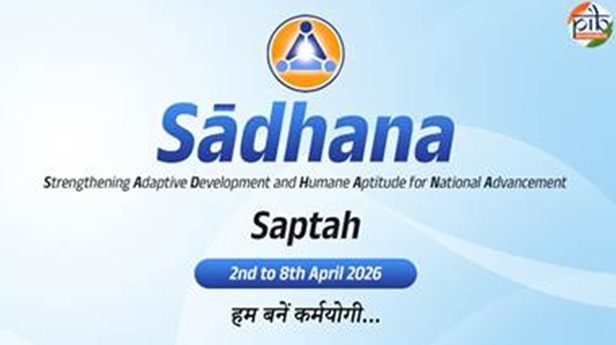
Sadhana Saptah Initiative: How is It Transforming Civil Services Capacity Building in India?

Prelims : Polity & Governance + CA
Mains : GS Paper 2 – Governance, Civil Services Reforms, Capacity Building

Why in News ?

  • The Sādhana Saptah 2026 initiative has been highlighted as a key step towards building a future-ready civil services system in India.
  • It reflects the government’s broader push under Mission Karmayogi to enhance the competency, efficiency, and citizen-centric orientation of public servants.

What is the Sādhana Saptah Initiative ?

  • Sādhana Saptah is a structured capacity-building initiative under Mission Karmayogi (National Programme for Civil Services Capacity Building).
  • The term SĀDHANA (Strengthening Adaptive Development and Humane Aptitude for National Advancement) reflects its focus on developing both technical competencies and ethical governance values.
  • The initiative aims to create a responsive, adaptive, and citizen-focused bureaucracy capable of addressing complex governance challenges.

What is the Institutional Framework Behind the Initiative ?

  • The initiative is jointly organised by :
    • Department of Personnel and Training (DoPT)
    • Capacity Building Commission (CBC)
    • Karmayogi Bharat
  • It brings together :
    • Central Ministries
    • State Governments
    • Union Territories
    • Training institutions
  • This collaborative framework ensures a whole-of-government approach to capacity building.

Key Features of Sādhana Saptah

1. Three-Sutra Approach to Capacity Building

  • The initiative is structured around three guiding principles :
    • Technology : Promoting digital governance and data-driven decision-making
    • Tradition : Integrating India’s administrative ethos and ethical values
    • Tangible Outcomes : Ensuring measurable improvements in governance delivery
  • This framework ensures a balanced approach combining modern tools with foundational values.

2. Integrated Learning Ecosystem

  • The programme provides multiple learning opportunities through :
    • Curated courses on the iGOT Karmayogi platform
    • Samuhik Charcha (group discussions) for peer learning
    • Thematic webinars and workshops
  • These platforms enable continuous learning and knowledge sharing among civil servants.

3. Focus on Core Competencies

  • The initiative emphasises development of critical skills such as :
    • Leadership and decision-making
    • Communication and stakeholder engagement
    • Data analysis and evidence-based policymaking
    • Project management and implementation efficiency
    • Digital governance capabilities
  • This competency-based approach aligns training with real-world administrative requirements.

How Does It Link with Mission Karmayogi ?

  • Mission Karmayogi aims to shift civil services from a rule-based to a role-based human resource management system.
  • Sādhana Saptah operationalises this vision by : 
    • Promoting continuous capacity building
    • Encouraging self-driven learning
    • Aligning skills with functional roles and responsibilities

Significance of the Initiative

1. Promoting Citizen-Centric Governance

  • By focusing on behavioural and functional competencies, the initiative aims to make governance more responsive, transparent, and people-oriented.

2. Building Future-Ready Bureaucracy

  • It prepares civil servants to deal with emerging challenges such as : 
    • Digital transformation
    • Complex policy environments
    • Data-driven governance

3. Supporting Vision of Viksit Bharat 2047

  • The initiative aligns with the long-term goal of transforming India into a developed nation by 2047, by strengthening institutional capacity.

4. Encouraging Collaborative Governance

  • By bringing multiple stakeholders onto a common platform, it fosters coordination across ministries and levels of government.

What are the Challenges?

1. Implementation Across Diverse Administrative Levels

  • Ensuring uniform adoption across Central, State, and local levels remains a challenge due to variations in capacity and resources.

2. Resistance to Change

  • Transitioning from traditional administrative practices to a competency-based system may face resistance within the bureaucracy.

3. Digital Divide and Accessibility

  • Effective utilisation of platforms like iGOT requires digital infrastructure and literacy, which may not be uniformly available.

Way Forward

  • Strengthen last-mile connectivity and digital infrastructure for wider participation
  • Promote a culture of continuous learning and performance evaluation
  • Ensure customised training modules based on roles and sectors
  • Enhance monitoring and impact assessment of training outcomes

Practice Questions

Prelims :

Q. Mission Karmayogi is primarily aimed at :
(a) Electoral reforms
(b) Civil services capacity building
(c) Judicial reforms
(d) Agricultural modernization

Mains :

“Discuss the role of capacity-building initiatives like Sādhana Saptah in transforming governance and civil services in India.”

FAQs

Q1. What is Sādhana Saptah ?

It is a capacity-building initiative for civil servants under Mission Karmayogi.

Q2. What does SĀDHANA stand for ?

Strengthening Adaptive Development and Humane Aptitude for National Advancement.

Q3. Which institutions are involved ?

DoPT, Capacity Building Commission, and Karmayogi Bharat.

Q4. What platform is used for training ?

The iGOT Karmayogi digital platform.

Q5. What is its main objective ?

To build a competent, citizen-centric, and future-ready civil services system.

Sacred Groves (Orans) in Rajasthan: Constitutional Protection and Legal Debate

Prelims : Environment + Culture + Current Affairs
Mains : GS Paper 2 – Fundamental Rights, Governance; GS Paper 3 – Conservation, Environmental Protection

Why in News ?

  • The Supreme Court has agreed to hear a petition seeking constitutional protection for Orans (sacred groves) in Rajasthan.
  • The plea argues that Orans are not merely land parcels but ecologically sensitive and culturally significant community spaces, requiring legal safeguards against degradation and encroachment.

About Orans (Sacred Groves)

  • Orans are community-protected forest patches traditionally preserved for religious and cultural reasons, particularly in Rajasthan.
  • They are often associated with local deities and customary practices, leading to their conservation over generations.
  • These areas function as common lands, used for : 
    • Grazing
    • Water conservation
    • Biodiversity preservation

Ecological and Cultural Significance

1. Biodiversity Conservation

  • Orans act as micro-ecosystems, supporting diverse flora and fauna in arid regions like Rajasthan.
  • They serve as natural gene banks, preserving native species that may not survive in degraded landscapes.

2. Climate and Water Security

  • These groves contribute to groundwater recharge and soil conservation, which is crucial in desert ecosystems.
  • They help in mitigating desertification and maintaining ecological balance.

3. Cultural and Religious Importance

  • Orans are deeply linked with faith-based conservation, where local communities protect them as sacred spaces.
  • This traditional system represents an indigenous model of environmental governance.

Legal and Constitutional Dimensions

1. Demand for Constitutional Protection

  • The petition seeks recognition of Orans under constitutional provisions, arguing that their protection is essential for : 
    • Environmental sustainability
    • Cultural preservation

2. Fundamental Rights Linkages

  • The issue involves balancing: 
    • Article 25 (Freedom of Religion) → Protection of sacred practices
    • Article 21 (Right to Life) → Includes right to a healthy environment

3. Directive Principles & Environmental Duties

  • Article 48A : Directs the State to protect and improve the environment
  • Article 51A(g) : Imposes a duty on citizens to protect natural resources

Issues and Challenges

1. Lack of Legal Recognition

  • Despite their importance, Orans are often classified as revenue or wasteland, leaving them vulnerable to diversion for development projects.

2. Encroachment and Land Degradation

  • Increasing pressure from : 
    • Infrastructure projects
    • Mining activities
    • Urban expansion
  • This leads to shrinking and fragmentation of these ecosystems.

3. Weak Institutional Protection

  • Absence of a clear legal framework results in poor enforcement and monitoring, despite community dependence on these lands.

Significance of the Supreme Court Intervention

1. Recognition of Community-Conserved Areas

  • The case highlights the need to formally recognise traditional conservation systems within modern legal frameworks.

2. Strengthening Environmental Jurisprudence

  • It provides an opportunity to expand the scope of environmental rights under Article 21.

3. Integrating Culture with Conservation

  • The issue reinforces the idea that cultural practices can complement ecological sustainability, offering a holistic conservation model.

Related Concepts

1. Community Forest Resources (CFR)

  • Recognised under the Forest Rights Act, 2006, empowering communities to manage forest resources.

2. Sacred Groves in India

  • Found across various states : 
    • Western Ghats
    • Northeast India
    • Rajasthan (Orans)
  • Serve as examples of community-led conservation.

Way Forward

  • Provide legal recognition to Orans under environmental or forest laws
  • Integrate Orans into biodiversity conservation policies
  • Strengthen community participation and governance
  • Develop mapping and documentation systems for protection
  • Ensure balance between development and ecological preservation

Practice Questions

Prelims :

Q. Sacred groves in India are best described as :
(a) Government-protected wildlife sanctuaries
(b) Community-conserved forest patches with religious significance
(c) Commercial plantation areas
(d) Reserved forests under the Forest Act

Mains :

“Sacred groves represent a unique model of community-based conservation in India. Examine their significance and the need for legal protection.”

FAQs

Q1. What are Orans ?

Orans are sacred community-protected forest areas in Rajasthan conserved due to religious beliefs.

Q2. Why are they important ?

They support biodiversity, water conservation, and cultural heritage.

Q3. What is the issue currently ?

They lack legal protection and face threats from encroachment and development.

Q4. Which constitutional provisions are relevant ?

Articles 21, 25, 48A, and 51A(g).

Q5. What is the role of the Supreme Court ?

It is examining whether Orans should be granted constitutional protection.

Transgender Persons (Amendment) Act 2026: Why is its Constitutional Validity Being Challenged?

Prelims : Polity + CA
Mains : GS Paper 2 – Fundamental Rights, Social Justice, Vulnerable Sections

Why is the Transgender Persons (Amendment) Act 2026 in News ?

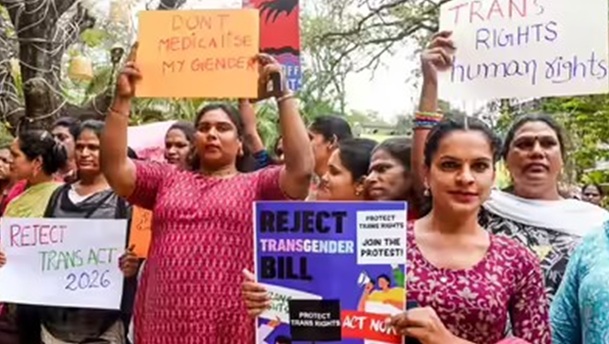
  • A petition has been filed before the Supreme Court challenging the constitutional validity of the Transgender Persons (Amendment) Act, 2026, bringing the issue of transgender rights back into national focus.
  • The petition argues that certain provisions introduced through the amendment may dilute the rights previously recognised by the judiciary, particularly those related to self-identification and personal autonomy.
  • The matter is significant as it raises broader constitutional questions regarding the balance between State regulation and individual freedoms, especially for marginalized communities.

Background of Transgender Rights in India

  • The legal recognition of transgender persons in India has evolved significantly over the past decade, with the landmark NALSA judgment (2014) marking a turning point in affirming their constitutional rights.
  • In this judgment, the Supreme Court recognised transgender persons as a “third gender” and upheld their right to self-identify their gender identity without any external validation, grounding this right in dignity, privacy, and autonomy.
  • Subsequently, the Transgender Persons (Protection of Rights) Act, 2019 was enacted to prohibit discrimination in areas such as education, employment, healthcare, and access to public services, while also mandating welfare measures for the community.
  • However, concerns were raised even at the time of its enactment regarding procedural requirements for identity certification, which many activists argued were inconsistent with the spirit of the NALSA judgment.

Key Changes Introduced 

  • The 2026 amendment reportedly introduces additional regulatory mechanisms in the process of gender identity recognition, shifting away from a purely self-identification-based approach.
  • It appears to provide for verification or certification procedures involving authorities or medical boards, thereby increasing institutional involvement in what was earlier considered a matter of personal choice.
  • These changes have raised concerns that the amendment may reintroduce barriers and bureaucratic hurdles for transgender individuals seeking legal recognition of their identity.

Provisions Being Challenged in the Supreme Court

1. Does the Amendment Undermine the Principle of Self-Identification ?

  • The petition contends that the amendment weakens the principle of self-identification of gender, which was explicitly recognised as a fundamental right in the NALSA judgment.
  • By introducing verification requirements, the law may effectively transfer the power of identity recognition from the individual to the State, thereby infringing upon personal autonomy and dignity.

2. Does the Law Introduce Excessive Institutional Control ?

  • The introduction of screening or certification mechanisms is seen as placing undue control in the hands of administrative or medical authorities, which could lead to arbitrary or inconsistent decisions.
  • Such provisions may subject transgender individuals to invasive procedures or scrutiny, which can be both discriminatory and violative of privacy.

3. Are Fundamental Rights Being Violated ?

  • The petition argues that the amendment may violate several constitutional guarantees, including : 
    • Article 14, by creating unreasonable classification and discrimination
    • Article 19, by restricting expression of gender identity
    • Article 21, by undermining dignity, privacy, and the right to live with self-determined identity
  • It highlights that any law affecting such core aspects of identity must meet strict standards of constitutional validity, which the amendment may fail to satisfy.

Constitutional and Judicial Context

1. NALSA Judgment (2014)

  • The Supreme Court, in this landmark case, established that gender identity is an integral part of personal autonomy and dignity, and that individuals must have the right to determine their own gender without external interference.

2. Expanding Scope of Article 21

  • Over time, judicial interpretation has expanded Article 21 to include : 
    • Right to privacy
    • Right to dignity
    • Right to personal autonomy
  • The present case tests whether the amendment aligns with these evolving constitutional principles.

Significance 

1. Reaffirmation of Individual Autonomy

  • The case has the potential to reaffirm that identity-related rights are intrinsic to individual autonomy, and cannot be subjected to excessive State control.

2. Impact on Social Justice Framework

  • The outcome will significantly influence the implementation of welfare schemes and legal protections for transgender persons, shaping the broader discourse on inclusion and equality.

3. Defining Limits of State Intervention

  • It raises a critical question regarding the extent to which the State can regulate identity without infringing constitutional freedoms, thereby contributing to the development of constitutional jurisprudence.

What are the Key Challenges in Ensuring Transgender Rights ?

1. Persistent Implementation Gaps

  • Despite progressive legal frameworks, there remains a significant gap between law and practice, with many transgender individuals continuing to face barriers in accessing basic rights and services.

2. Deep-Rooted Social Stigma

  • Societal attitudes and discrimination continue to limit the effectiveness of legal protections, indicating that legal reform alone is insufficient without social change.

3. Procedural and Administrative Ambiguities

  • Lack of clarity in procedures for identity recognition can lead to arbitrary implementation, further complicating access to rights for transgender individuals.

 Way Forward

  • The legal framework must be aligned with the principles laid down in the NALSA judgment, particularly the centrality of self-identification.
  • Any regulatory mechanism should be non-intrusive, transparent, and rights-based, ensuring that dignity and privacy are not compromised.
  • There is a need to strengthen institutional support systems, including access to healthcare, education, and employment opportunities.
  • Greater emphasis must be placed on awareness and sensitisation programs to address societal stigma and promote inclusivity.

Practice Questions

Prelims :

Q. The NALSA judgment (2014) is associated with :
(a) Environmental protection
(b) Electoral reforms
(c) Recognition of transgender persons
(d) Right to education

Mains :

“Critically examine the constitutional challenges associated with recent amendments to transgender rights laws in India in light of judicial precedents.”

FAQs

Q1. What is being challenged in the Supreme Court ?

The constitutional validity of the Transgender Persons (Amendment) Act, 2026.

Q2. What is the core issue ?

Whether the amendment undermines the right to self-identification of gender.

Q3. Which judgment is central to this issue ?

The NALSA judgment (2014).

Q4. Which constitutional rights are involved ?

Articles 14, 19, and 21.

Q5. Why is this case important ?

It will determine the balance between State regulation and individual rights in matters of gender identity.

BioNEST Scheme: How Does It Promote Biotechnology Startups and Innovation in India?

Prelims : Science & Technology + CA
Mains : GS Paper 3 – Science & Technology, Innovation, Startups

Why in News ?

  • The Union Minister recently inaugurated a BIRAC-BioNEST Incubation Centre at the Central Food Technology & Research Institute (CFTRI), Mysuru.
  • The development highlights the government’s continued push towards strengthening the biotechnology startup ecosystem and innovation infrastructure in India.

What is BioNEST ?

  • BioNEST (Bioincubators Nurturing Entrepreneurship for Scaling Technologies) is an initiative launched by the Biotechnology Industry Research Assistance Council (BIRAC).
  • It aims to create a robust biotech innovation ecosystem by supporting early-stage startups and entrepreneurs.
  • The programme focuses on translating research into viable commercial technologies, thereby bridging the gap between laboratory research and market-ready products.

What is the Institutional Framework Behind BioNEST ?

  • BioNEST is implemented by BIRAC, which functions under the Department of Biotechnology (DBT), Ministry of Science & Technology.
  • It operates as part of the broader government vision to promote innovation-driven entrepreneurship in biotechnology and life sciences sectors.

What Facilities and Support Do BioNEST Incubators Provide ?

  • BioNEST incubators offer state-of-the-art infrastructure, including advanced laboratories and specialized equipment, which are often inaccessible to early-stage startups due to high costs.
  • They provide business mentorship and technical guidance, enabling startups to refine their ideas into scalable business models.
  • The incubators also assist with intellectual property (IP) management, legal compliance, and regulatory approvals, which are critical in the biotech sector.
  • Additionally, they create networking platforms, connecting startups with investors, industry experts, and academic institutions, thereby fostering collaboration and growth.

Key Objectives of the BioNEST Scheme

1. Promoting Biotech Startups and Entrepreneurship

  • The scheme aims to create an enabling environment where innovative biotech ideas can be nurtured into successful enterprises, thereby contributing to economic growth and job creation.

2. Strengthening Industry–Academia Linkages

  • BioNEST facilitates collaboration between research institutions and industry, ensuring that academic research is effectively translated into practical applications and commercial products.

3. Providing Comprehensive Support Ecosystem

  • The scheme offers end-to-end support, including mentorship, funding facilitation, regulatory guidance, and validation services, which are essential for startups to scale successfully.

4. Enabling Technology Commercialisation

  • By supporting startups through incubation, BioNEST helps in bringing innovative technologies from the lab to the market, thereby enhancing India’s technological competitiveness.

How is BioNEST Funded ?

  • Funding for BioNEST centres is provided by BIRAC under the government’s umbrella scheme Biotechnology Research Innovation and Entrepreneurship Development (Bio-RIDE).
  • This integrated funding approach ensures sustained financial support for incubation infrastructure and startup development.

 Significance of BioNEST for India

1. Boosting Biotechnology Innovation

  • BioNEST plays a crucial role in strengthening India’s biotechnology sector, which is emerging as a key driver of economic growth and technological advancement.

2. Supporting Startup Ecosystem

  • By providing infrastructure and mentorship, the scheme reduces entry barriers and enables startups to innovate and scale efficiently.

3. Enhancing Global Competitiveness

  • It helps position India as a global hub for biotech innovation, particularly in areas such as healthcare, agriculture, and industrial biotechnology.

4. Promoting Atmanirbhar Bharat

  • By encouraging indigenous innovation and reducing dependence on imports, BioNEST contributes to the vision of self-reliance in critical technologies.

What are the Challenges?

1. High Cost and Complexity of Biotech Innovation

  • Biotechnology startups require significant investment, long gestation periods, and regulatory approvals, which can limit scalability.

2. Regulatory and Compliance Barriers

  • Complex regulatory frameworks may slow down product approvals and commercialization.

3. Limited Industry Linkages in Some Regions

  • Not all incubators have equal access to strong industry networks, which may affect the growth potential of startups.

Way Forward

  • Strengthen regional distribution of BioNEST centres to ensure wider accessibility
  • Simplify regulatory frameworks for faster innovation cycles
  • Enhance industry partnerships and funding support
  • Promote global collaborations in biotechnology research and development

Practice Questions

Prelims :

Q. BioNEST programme in India is associated with :
(a) Space technology incubation
(b) Biotechnology startup support
(c) Agricultural subsidies
(d) Renewable energy projects

Mains :

“Discuss the role of incubation centres like BioNEST in promoting biotechnology innovation and entrepreneurship in India.”

FAQs

Q1. What is BioNEST ?

It is a biotech incubation programme to support startups and innovation.

Q2. Which organisation implements it ?

Biotechnology Industry Research Assistance Council (BIRAC).

Q3. What support does it provide ?

Infrastructure, mentorship, funding facilitation, and regulatory guidance.

Q4. Under which scheme is it funded ?

Biotechnology Research Innovation and Entrepreneurship Development (Bio-RIDE).

Q5. Why is it important ?

It promotes innovation, startups, and self-reliance in biotechnology.

How Does the 2026 Amendment to Plastic Waste Management Rules Impact EPR Targets?

Prelims : Environment +CA
Mains : GS Paper 3 – Conservation, Environmental Pollution & Degradation, Government Policies & Interventions

Why in News ?

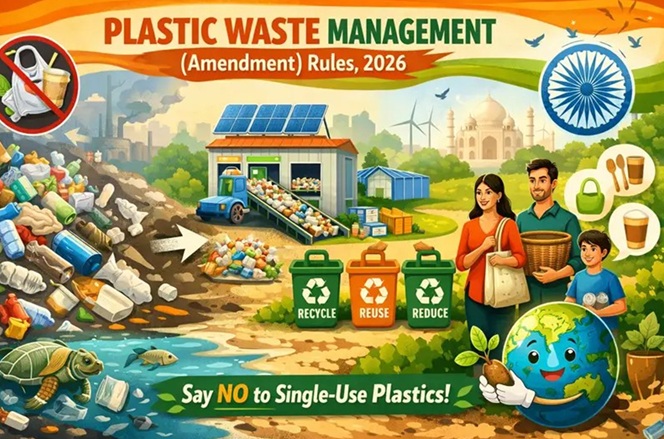
  • India has amended the Plastic Waste Management Rules, 2016 in 2026, easing compliance norms for companies.
  • The amendment allows carry-forward of recycling deficits, while retaining targets under the Extended Producer Responsibility (EPR) framework.

About Plastic Waste Management Rules, 2016 (Amended 2026)

  • These rules regulate plastic waste generation, collection, recycling, and disposal in India.
  • The 2026 amendment focuses on flexibility in compliance, while continuing long-term sustainability goals.

Key Features of the 2026 Amendment

1. Compliance Provisions

  • No immediate penalties for failing recycling targets in FY 2025–26
  • Deficits can be carried forward for 3 years (from 2026–27)
  • Condition : At least 1/3rd of the deficit must be cleared annually

2. Recycling Targets (Under EPR Framework)

  • Continues phased targets introduced in 2022 for Producers, Importers, Brand Owners (PIBOs)

Category-wise Targets :

  • Category I (Rigid Plastics) :
    • 30% (2025–26) → 60% (2028–29)
  • Category II (Flexible Plastics) :
    • 10% → 20%
  • Category III (Multi-layered Plastics) :
    • 5% → 10%

3. Reuse Targets

  • Introduced for rigid plastic packaging : 
    • Small containers (0.9–4.9 L): 10%
    • Large water packaging: 70%
    • Large non-water packaging: 10%
  • Targets to increase gradually over time

4. Tradable Certificate System

  • Companies can meet targets by buying credits from over-performing firms
  • Pros : 
    • Flexibility
    • Cost reduction
  • Concerns : 
    • Allows avoidance of actual recycling
    • Over 6 lakh fake certificates detected (2023)

5. Exemptions

  • Exemptions where use of recycled plastic is restricted, e.g.: 
    • Food packaging (regulated by FSSAI)
  • Limits applicability in food & beverage sector

6. Implementation Mechanism

  • Centralised EPR Portal for :
    • Tracking
    • Reporting
    • Compliance
  • Oversight by Central Pollution Control Board (CPCB)
  • Mandate :
    • 100% collection & processing of plastic by 2024–25

7. Ground Reality

  • Over 20.7 million tonnes recycled since 2022
  • Annual plastic waste generation: ~4.13 million tonnes (2022–23)
  • Issues : 
    • Reliance on self-reporting
    • Lack of independent verification

Plastic Categories (Based on Recyclability)

  • Category I (Rigid Plastics) :
    • Examples : HDPE, PET containers
    • Easiest to recycle
  • Category II (Flexible Plastics) :
    • Examples : Carry bags, wrappers
    • Moderately difficult
  • Category III (Multi-layered Plastics) :
    • Examples : Tetra Pak, foil wrappers
    • Hardest to recycle

Key Concepts: Extended Producer Responsibility (EPR)

  • EPR makes producers responsible for :
    • Collection
    • Recycling
    • Safe disposal of plastic
  • Ensures :
    • Polluter Pays Principle
    • Circular economy approach

Key Terms (Amendment 2026)

1. End-of-Life Disposal

  • Includes : 
    • Waste-to-energy
    • Co-processing (cement/steel)
    • Waste-to-oil
    • Road construction
  • Excludes recycling into new plastic

2. Recycling

  • Expanded definition : 
    • Conversion into new products
    • Includes energy generation

3. Plastic Waste Processors

  • Now includes : 
    • Recyclers
    • Waste-to-energy operators
    • Co-processors

4. Registered Environment Auditor

  • Defined under Environment Audit Rules, 2025
  • Role : 
    • Verify EPR compliance
    • Check recycled content

5. Reuse

  • Using plastic again without structural change

6. Seller (New Term)

  • Includes : 
    • Raw material suppliers (resins, pellets)
  • Expands accountability across entire value chain

Significance of the Amendment

1. Flexibility for Industry

  • Reduces compliance burden
  • Prevents abrupt penalties

2. Strengthening Circular Economy

  • Encourages : 
    • Recycling
    • Reuse
    • Resource efficiency

3. Improved Regulatory Coverage

  • Inclusion of : 
    • Sellers
    • Waste processors
  • Expands scope of responsibility

4. Institutional Monitoring

  • Centralised digital tracking improves : 
    • Transparency
    • Accountability

Challenges

1. Weak Enforcement

  • Heavy reliance on self-reporting
  • Lack of robust verification system

2. Misuse of Tradable Certificates

  • Fake certificates undermine system integrity

3. Exemptions Diluting Impact

  • Food packaging exemptions reduce coverage

4. Gap Between Targets and Reality

  • High plastic waste generation persists

Related Developments

  • Ban on Single-Use Plastics (2022)
  • Strengthening of EPR framework (2022 onwards)
  • Push towards Aatmanirbhar Bharat in waste management technologies

Way Forward

  • Strengthen third-party verification mechanisms
  • Regulate and audit tradable certificate system
  • Reduce exemptions and promote safe recycled materials
  • Enhance waste segregation at source
  • Invest in advanced recycling technologies

Practice Questions

Prelims :

Q. Which of the following best describes Extended Producer Responsibility (EPR) ?
(a) Government responsibility for waste management
(b) Consumer responsibility for recycling
(c) Producer responsibility for lifecycle of products
(d) Local body responsibility for waste disposal

Mains :

“Critically examine the effectiveness of the Extended Producer Responsibility (EPR) framework in managing plastic waste in India.”

FAQs

Q1. What is the key change in the 2026 amendment ?

Carry-forward of recycling deficits for 3 years with phased compliance.

Q2. What is EPR ?

A policy making producers responsible for plastic waste management.

Q3. What are plastic categories ?

Rigid, flexible, and multi-layered plastics based on recyclability.

Q4. What is the issue with tradable certificates ?

Risk of fake credits and avoidance of actual recycling.

Q5. What is India’s plastic waste scenario ?

High generation with improving but incomplete recycling coverage.

Right to Promotion Consideration: Constitutional Dimensions of Fairness in Public Employment

Prelims : Polity (Fundamental Rights, Articles 14 & 16), Current Affairs
Mains : GS 2 – Constitution, Governance, Public Administration

Why in News ?

  • The Punjab and Haryana High Court has reaffirmed that while government employees do not have a fundamental right to promotion, they do have a fundamental right to be fairly considered for promotion.
  • The judgment highlights the importance of non-arbitrary, timely, and rule-based evaluation in public employment, strengthening constitutional safeguards under Articles 14 and 16.

Background of the Case

  • The case involved Kulwant Singh, who was excluded from consideration by the Departmental Promotion Committee (DPC).
  • The government denied eligibility citing a distance-learning diploma requirement, but :
    • The court found that existing employees were exempted under amended rules
    • His exclusion was therefore based on misinterpretation of rules
  • The Court held that :
    • Non-consideration amounted to a violation of fundamental rights
    • Directed notional promotion with retrospective effect
    • Mandated regular DPC meetings (every three months)

Understanding the Right to Promotion Consideration

1. Not a Right to Promotion, but to Fair Consideration

  • The judiciary has consistently maintained a distinction :
    • No fundamental right to promotion itself
    • Yes, a fundamental right to be considered for promotion
  • This ensures :
    • Merit-based progression
    • Protection against arbitrary exclusion

2. Role of Departmental Promotion Committees (DPCs)

  • DPCs are responsible for :
    • Assessing eligibility and merit
    • Recommending promotions
  • Delays or non-convening of DPCs :
    • Lead to career stagnation
    • May amount to denial of constitutional rights

Constitutional Basis

1. Article 14 – Equality Before Law

  • Guarantees non-arbitrary state action
  • Ensures all eligible employees are treated equally in promotion consideration

2. Article 16(1) – Equality of Opportunity in Public Employment

  • Extends beyond initial recruitment to include :
    • Career progression
    • Promotion opportunities
  • Courts have interpreted “employment” broadly to include fair consideration for advancement

Judicial Interpretation and Evolution

1. Supreme Court (1991 – Lift Irrigation Case)

  • Clarified that : 
    • No employee has a fundamental right to promotion
    • But every eligible employee has a right to be considered when vacancies arise

2. Ajit Singh vs State of Punjab

  • A Constitution Bench reaffirmed that : 
    • Employees within the zone of consideration have a fundamental right to be considered
    • Denial amounts to violation of constitutional guarantees

3. Recent Judicial Trends

  • Courts have increasingly recognised :
    • Delays in DPC meetings as rights violations
    • Need for time-bound promotion processes
  • In Bihar State Electricity Board vs Dharamdeo Das :
    • Supreme Court held that : 
      • No right to backdated promotion from vacancy date
      • Administrative realities may justify delays

Key High Court News

1. Timely DPC Mandate

  • Courts have directed governments to : 
    • Conduct DPCs regularly and without delay
    • Prevent systemic denial of promotion opportunities

2. Notional Promotions

  • In cases of prolonged delay : 
    • Courts grant notional promotions
    • Recognise loss of career progression due to state inaction

3. Administrative Accountability

  • High Courts (Delhi, Himachal Pradesh, Manipur) have : 
    • Emphasised administrative responsibility
    • Linked delays to constitutional violations

Significance of the Judgment

1. Strengthening Rule of Law

  • Reinforces that state actions must be fair, transparent, and rule-based

2. Protection Against Arbitrary Decisions

  • Prevents discretionary exclusion of eligible employees

3. Ensuring Career Progression

  • Recognises promotion consideration as part of dignified public service

4. Improving Administrative Efficiency

  • Regular DPCs ensure: 
    • Better workforce planning
    • Reduced litigation

Challenges and Issues

1. Delay in DPC Meetings

  • Frequent delays lead to : 
    • Backlogs
    • Demotivation among employees

2. Misinterpretation of Rules

  • Lack of clarity or arbitrary interpretation results in : 
    • Unfair exclusions
    • Increased litigation

3. Administrative Inertia

  • Bureaucratic delays often : 
    • Undermine constitutional guarantees
    • Affect governance efficiency

Way Forward

  • Institutionalise time-bound DPC schedules
  • Ensure clarity and transparency in promotion rules
  • Strengthen judicial oversight and accountability mechanisms
  • Digitise promotion processes for efficiency and fairness

Practice Questions

Prelims :
Q. Which Articles of the Constitution are primarily associated with equality in public employment ?
(a) Articles 12 & 13
(b) Articles 14 & 16
(c) Articles 19 & 21
(d) Articles 32 & 226

Mains :
“While there is no fundamental right to promotion, the right to be considered for promotion is constitutionally protected.” Discuss.

FAQs

Q1. Is promotion a fundamental right in India ?

No, promotion itself is not a fundamental right, but fair consideration for promotion is.

Q2. Which Articles support this right ?

Articles 14 and 16(1) ensure equality and equal opportunity in public employment.

Q3. What happens if an eligible employee is not considered ?

It is treated as a violation of fundamental rights, and courts can grant relief.

Q4. What is the role of DPC ?

The Departmental Promotion Committee evaluates and recommends eligible candidates for promotion.

Q5. Can courts grant promotion directly ?

Courts usually grant notional promotion or direct reconsideration, not automatic promotion.

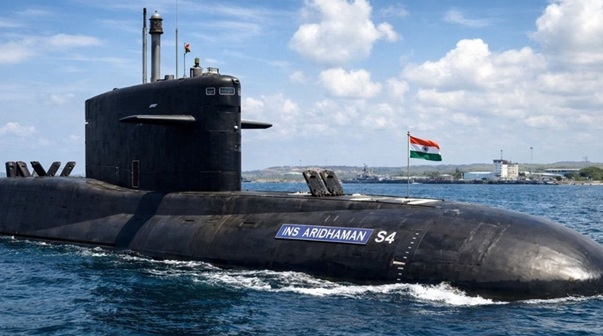
What is INS Aridaman? Features, Missiles, and Strategic Importance Explained

Prelims : Defence + CA
Mains : GS 3 – Internal Security, Defence Technology, Strategic Deterrence

Why in News ?

  • India has inducted its third nuclear-powered ballistic missile submarine, INS Aridaman, significantly enhancing its sea-based nuclear deterrence capabilities.
  • With this induction, India now has three operational SSBNs at sea simultaneously, strengthening its second-strike capability and nuclear triad.

About INS Aridaman

  • INS Aridaman is an indigenously developed nuclear-powered ballistic missile submarine (SSBN).
  • Key features include :
    • Displacement: ~7,000 tonnes, making it larger and more capable than its predecessors
    • Missile Capacity: Equipped with 8 vertical launch system (VLS) tubes, nearly double that of earlier submarines
    • Missile Capability : 
      • K-15 (range ~700 km)
      • K-4 (range ~3,500 km)
    • Advanced Nuclear Reactor: Enables long-duration submerged operations (months) without surfacing

What is an SSBN ?

  • SSBN stands for Ship Submersible Ballistic Nuclear submarine.
  • These submarines :
    • Are powered by nuclear reactors
    • Carry nuclear-tipped ballistic missiles
    • Operate stealthily underwater for extended periods
  • They form the most survivable leg of nuclear deterrence systems.

India’s Nuclear Triad Explained

  • A nuclear triad refers to the ability to launch nuclear weapons from :
    • Land (e.g., Agni missile series)
    • Air (fighter aircraft like Rafale, Su-30MKI, Mirage 2000)
    • Sea (SSBNs like INS Aridaman)
  • India is among a select group of countries possessing a nuclear triad :
    • United States
    • Russia
    • China
    • France

Significance of INS Aridaman

1. Strengthening Second-Strike Capability

  • India follows a No First Use (NFU) nuclear doctrine, meaning nuclear weapons are used only in retaliation.
  • SSBNs like INS Aridaman ensure :
    • Survivability even after a first strike
    • Ability to launch a retaliatory nuclear attack, maintaining deterrence credibility

2. Enhanced Sea-Based Deterrence

  • Compared to earlier submarines like :
    • INS Arihant
    • INS Arighaat
  • Aridaman offers :
    • Greater missile capacity
    • Longer strike range
    • Improved stealth and endurance

3. Strategic Depth and Survivability

  • Sea-based platforms are :
    • Harder to detect and target
    • Less vulnerable than land and air bases
  • This enhances credible minimum deterrence, a key pillar of India’s nuclear doctrine.

4. Boost to Indigenous Defence Capability

  • The submarine reflects India’s progress in :
    • Indigenous shipbuilding
    • Nuclear propulsion technology
    • Advanced missile integration
  • Supports Aatmanirbhar Bharat in defence manufacturing.

India’s Submarine Fleet: Current Status

  • India operates :
    • SSBNs (Nuclear ballistic submarines) : 3 (with Aridaman)
    • Conventional submarines : ~16
  • Major classes include :
    • Kalvari-class (Scorpene)
    • Kilo-class (Sindhughosh)
    • Shishumar-class
  • However :
    • Around 30% of submarines are under refit at any time, reducing operational strength

Global Comparison

  • United States : ~14 SSBNs + 50+ attack submarines
  • China : ~12 nuclear submarines
  • India is still expanding its underwater capabilities, but making steady progress

Related Developments

1. Project-75I

  • India is planning next-generation conventional submarines with Air Independent Propulsion (AIP)
  • Collaboration with Germany’s ThyssenKrupp Marine Systems

2. Nuclear Attack Submarines (SSNs)

  • India is also working on SSNs (attack submarines) to complement SSBNs

Challenges

1. Limited Fleet Size

  • India’s submarine numbers are still below authorised strength, affecting operational readiness

2. Technological Complexity

  • Nuclear submarines require : 
    • Advanced reactors
    • Stealth technology
    • High-end maintenance

3. Strategic Competition

  • Increasing naval presence of China in the Indian Ocean Region (IOR) adds pressure

Way Forward

  • Expand submarine fleet to meet strategic requirements
  • Accelerate indigenous submarine programs
  • Strengthen underwater surveillance and anti-submarine warfare
  • Enhance jointness among triad components

Practice Questions

Prelims :
Q. What is the primary role of a nuclear-powered ballistic missile submarine (SSBN) ?
(a) Air defence
(b) Anti-submarine warfare
(c) Nuclear deterrence
(d) Surveillance

Mains :
“Discuss the significance of sea-based nuclear deterrence in India’s nuclear doctrine.”

FAQs

Q1. What is INS Aridaman ?

INS Aridaman is India’s third nuclear-powered ballistic missile submarine, designed for strategic deterrence.

Q2. What is a nuclear triad ?

It is the capability to launch nuclear weapons from land, air, and sea-based platforms.

Q3. Why are SSBNs important ?

They provide second-strike capability, ensuring retaliation even after a nuclear attack.

Q4. Which missiles does INS Aridaman carry ?

It can carry K-15 and K-4 submarine-launched ballistic missiles.

Q5. What is India’s nuclear doctrine ?

India follows No First Use and maintains credible minimum deterrence.

Large Cavitation Tunnel (LCT): Boosting India’s Indigenous Naval Research & Defence

Prelims : Science & Technology + CA
Mains : GS 3 – Defence Technology, Indigenisation, Internal Security

Why in News ?

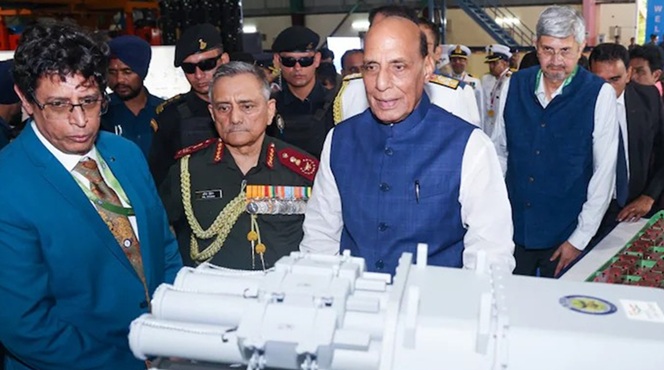
  • The Rajnath Singh laid the foundation stone of a Large Cavitation Tunnel (LCT) facility at the Naval Science & Technological Laboratory in Visakhapatnam.
  • The project is expected to significantly enhance India’s naval research, testing capabilities, and self-reliance in defence technology, reducing dependence on foreign testing facilities.

About Large Cavitation Tunnel (LCT)

  • The Large Cavitation Tunnel (LCT) is a state-of-the-art hydrodynamic testing facility being developed by the Defence Research and Development Organisation.
  • It will enable India to :
    • Design, develop, and test naval systems indigenously
    • Conduct advanced experiments on propulsion systems and underwater platforms
  • The facility is being set up at :
    • Naval Science & Technological Laboratory, Visakhapatnam

What is Cavitation ? 

  • Cavitation refers to the formation of vapour bubbles in a liquid due to pressure differences, which collapse violently and can:
    • Damage propellers and underwater systems
    • Generate noise, affecting stealth
  • Controlling cavitation is critical for :
    • Submarine stealth capabilities
    • Efficient naval propulsion systems

Key Features of the LCT Facility

1. Advanced Hydrodynamic Testing Capability

  • The facility will allow precise simulation of underwater conditions, enabling testing of naval platforms under realistic scenarios.
  • This will help in optimising design and performance of ships, submarines, and propulsion systems.

2. Indigenous Design and Testing Ecosystem

  • Earlier, India had to rely on foreign facilities for specialised testing, even after developing indigenous systems.
  • With LCT, India can now complete the entire cycle of design, development, and testing domestically, marking a major step toward self-reliance.

3. Enhancement of Stealth Capabilities

  • The facility will support research on :
    • Noise reduction technologies
    • Cavitation control mechanisms
  • This is crucial for submarine stealth and survivability in modern naval warfare.

4. Boost to Propulsion System Development

  • LCT will act as a core infrastructure for advancing propulsion technologies, improving : 
    • Efficiency
    • Durability
    • Operational performance

5. Support for Future Naval Platforms

  • The facility will serve as a foundational backbone for the design and development of next-generation submarines and ships, enabling innovation in naval engineering.

Associated Developments at NSTL

  • During the visit, several advanced technologies were showcased at the Naval Science & Technological Laboratory, including : 
    • Torpedoes
    • Naval mines
    • Decoys
    • Autonomous Underwater Vehicles (AUVs)

1. Swarm AUV Technology

  • Demonstration of man-portable swarm AUVs highlighted India’s growing capability in : 
    • Autonomous maritime operations
    • Network-centric underwater warfare

2. Spin-off Technologies

  • Innovations developed post Operation Sindoor show the dual-use potential of defence technologies, benefiting civilian sectors as well.

3. Emerging Areas of Research

  • Work is ongoing in : 
    • Lithium-ion battery systems for defence applications
    • Advanced underwater warfare systems

Significance of the Project

1. Strengthening Aatmanirbhar Bharat in Defence

  • The project aligns with India’s push for indigenisation in defence manufacturing and R&D, reducing dependence on imports.

2. Strategic Naval Capability Enhancement

  • Improved testing and design capabilities will : 
    • Strengthen India’s maritime security
    • Enhance its position as a blue-water navy

3. Technological Leadership

  • The facility positions India as a global leader in specialised naval testing infrastructure, boosting defence innovation.

4. Integration of Industry, Academia, and Research

  • The project reflects collaboration between : 
    • Government
    • MSMEs
    • Academia
    • Defence scientists

Challenges

1. High Capital and Technological Requirements

  • Such advanced facilities require significant investment and continuous technological upgrades.

2. Skill and Expertise Development

  • Effective utilisation depends on highly skilled researchers and engineers.

3. Integration with Production Ecosystem

  • Translating research outputs into mass production and deployment remains a key challenge.

Way Forward

  • Strengthen indigenous defence R&D ecosystem
  • Promote public-private partnerships in defence innovation
  • Focus on export potential of defence technologies
  • Enhance integration of AI and automation in naval systems

Practice Questions

Prelims :
Q. What is the primary purpose of a cavitation tunnel ?
(a) Missile testing
(b) Underwater hydrodynamic testing
(c) Satellite communication
(d) Radar calibration

Mains :
“Discuss the role of indigenous defence infrastructure like the Large Cavitation Tunnel in strengthening India’s maritime security.”

FAQs

Q1. What is a Large Cavitation Tunnel (LCT) ?

It is an advanced testing facility used to simulate underwater conditions and study cavitation effects on naval systems.

Q2. Which organisation is developing the LCT ?

It is being developed by the Defence Research and Development Organisation at the Naval Science & Technological Laboratory.

Q3. Why is cavitation important in naval systems ?

Cavitation affects efficiency, noise, and durability of propulsion systems, making it crucial for stealth and performance.

Q4. How will the LCT benefit India ?

It will enable indigenous testing, reduce foreign dependence, and improve naval capabilities, especially for submarines and ships.

Q5. What are AUVs?

Autonomous Underwater Vehicles are unmanned systems used for underwater operations such as surveillance and mine detection.

Multi-Hazard Early Warning Decision Support System: Transforming India’s Disaster Preparedness

Prelims : Geography + CA
Mains : GS 3 – Disaster Management, Science & Technology, Internal Security

Why in News ?

  • The Multi-Hazard Early Warning Decision Support System marks a major technological shift in India’s weather forecasting and disaster risk reduction framework, reflecting the growing integration of digital tools in governance.
  • It highlights India’s transition toward a proactive, anticipatory disaster management approach, where early warnings and real-time data guide policy and response.

About Multi-Hazard Early Warning Decision Support System

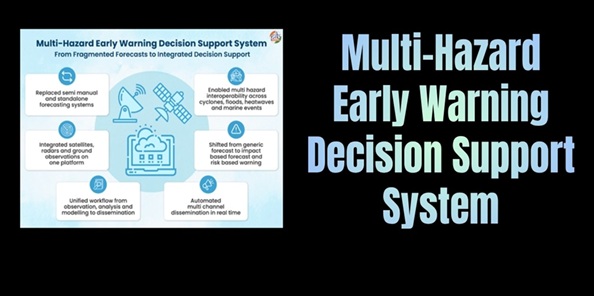
  • The Multi-Hazard Early Warning Decision Support System is an advanced digital forecasting and decision-support platform developed by the India Meteorological Department, combining open-source technology with in-house scientific expertise.
  • It functions under Mission Mausam, which aims to modernise India’s meteorological infrastructure and improve climate services delivery.
  • Launched in January 2024, the system integrates multiple datasets, forecasting models, and analytical tools into a single unified interface, enabling seamless forecasting and dissemination.
  • It operates in real time using GIS-based mapping tools, allowing forecasters and administrators to visualise risks spatially and take targeted decisions.
  • The initiative is overseen by the Ministry of Earth Sciences (MoES), which is responsible for strengthening India’s scientific and disaster preparedness ecosystem.

Key Features of the System

1. Automated Weather Data Processing

  • The system automates over 90% of weather data collection, quality control, and integration, significantly reducing human intervention and enhancing efficiency.
  • This enables faster detection of evolving weather phenomena, such as cyclones, heatwaves, and extreme rainfall events, improving early warning capabilities.

2. Enhanced Use of Forecast Models

  • More than 95% of inputs from Numerical Weather Prediction (NWP) models are utilised, ensuring forecasts are based on comprehensive, high-resolution datasets.
  • This improves the accuracy, reliability, and granularity of multi-hazard risk assessments, especially in complex weather scenarios.

3. Re-engineered Forecasting Workflow

  • The forecasting process has been completely restructured into an integrated digital workflow, ensuring seamless coordination from data input to warning dissemination.
  • This allows for real-time alerts and quicker response generation, which is critical in disaster situations.

4. Increased Forecast Lead Time

  • Forecast lead time has been extended from 5 days to 7 days, giving authorities and communities additional time to prepare and respond effectively.
  • This enhances evacuation planning, resource allocation, and disaster mitigation strategies.

5. Faster Forecast Preparation

  • The time required to generate forecasts has been reduced by approximately 3 hours, enabling quicker communication of warnings.
  • This is particularly important in rapid-onset disasters, where timely information can save lives.

6. GIS-Based Visualisation and Decision Support

  • Integration of Geographic Information System (GIS) tools allows for spatial mapping of hazards and vulnerabilities, improving situational awareness.
  • This enables location-specific, data-driven decision-making, enhancing the effectiveness of disaster response.

Significance of the System

1. Shift from Reactive to Proactive Disaster Management

  • The system enables a transition from post-disaster response to pre-disaster preparedness, aligning with global disaster risk reduction frameworks.

2. Integration of Technology in Governance

  • It showcases the effective use of digital technologies such as GIS, big data, and predictive modelling in strengthening governance mechanisms.

3. Reduction in Disaster Losses

  • Timely and accurate warnings can significantly reduce : 
    • Human casualties
    • Infrastructure damage
    • Economic losses

4. Strengthening Climate Resilience

  • With increasing climate variability, the system enhances India’s adaptive capacity and resilience to extreme weather events.

5. Improved Inter-Agency Coordination

  • A unified platform enables better coordination among : 
    • Disaster management authorities
    • State governments
    • Emergency response agencies

Challenges and Limitations

1. Last-Mile Connectivity Issues

  • Despite improved forecasting, effective dissemination to remote and vulnerable communities remains a challenge, limiting impact on the ground.

2. Digital Infrastructure Gaps

  • Uneven digital infrastructure across regions may affect the system’s accessibility and efficiency.

3. Capacity Building Needs

  • Effective utilisation requires trained personnel and institutional capacity, especially at the local level.

4. Data Integration Complexities

  • Integrating diverse datasets in real time can pose technical and coordination challenges, particularly in high-pressure scenarios.

Way Forward

  • Strengthen last-mile communication systems using mobile alerts and community networks
  • Invest in AI and advanced predictive analytics for improved accuracy
  • Enhance training and capacity building of local authorities
  • Improve data-sharing and inter-agency coordination mechanisms

Practice Questions

Prelims :
Q. Which of the following best describes the Multi-Hazard Early Warning Decision Support System ?
(a) A disaster relief fund
(b) A real-time weather forecasting and early warning platform
(c) A satellite launch programme
(d) A climate mitigation scheme

Mains :
“Discuss how digital technologies like the Multi-Hazard Early Warning Decision Support System can transform disaster management in India.”

FAQs

Q1. What is the Multi-Hazard Early Warning Decision Support System ?

It is a digital platform developed by the India Meteorological Department to provide real-time, integrated early warnings for multiple weather hazards using advanced data analytics and GIS tools.

Q2. Under which initiative has this system been developed ?

It has been developed under Mission Mausam, which focuses on modernising India’s weather forecasting infrastructure.

Q3. Which ministry oversees this system ?

The system operates under the Ministry of Earth Sciences (MoES).

Q4. How does it improve disaster management ?

It enhances preparedness through real-time alerts, longer forecast lead time (up to 7 days), and faster decision-making, reducing disaster impact.

Q5. What technologies are used in the system ?

It uses :

  • GIS for spatial mapping
  • Numerical Weather Prediction (NWP) models
  • Automation and real-time data processing
« »
  • SUN
  • MON
  • TUE
  • WED
  • THU
  • FRI
  • SAT
Have any Query?

Our support team will be happy to assist you!

OR
X