- UPSC Exam
- State PCS
- One Day Exam
- Current Affairs
- PT Quiz
- Downlaods
- About Coaching
- Blog
- Videos

| Prelims: FDI, Gross FDI vs Net FDI, Automatic Route, Government Route, RBI, DPIIT Mains: GS Paper III: Indian Economy, Investment Models, Liberalisation, Industrial Growth and External Sector |
India received $30.7 billion in gross Foreign Direct Investment (FDI) during April–June 2026, the highest quarterly gross inflow in the accessible 15-year/60-quarter data series going back to the September 2011 quarter.

|
Indicator |
Meaning |
Key Feature |
|
Gross FDI |
Total inward direct investment before relevant outflows |
Shows fresh investment entering |
|
Net FDI |
Gross inward FDI minus relevant direct-investment outflows |
Shows net direct-investment balance |
|
FDI Equity |
Equity component of FDI |
Narrower than total FDI |
|
FPI |
Foreign investment in securities |
Generally more market-sensitive |
|
Outward FDI |
Direct investment made abroad by Indian residents/firms |
Capital moves from India to foreign enterprises |
|
Facts |
Detail |
|
Gross FDI, April–June 2026 |
$30.7 billion |
|
Corresponding 2025 quarter |
$26.7 billion |
|
Growth |
14.8% YoY |
|
Net FDI, April–June 2026 |
about $7.8–7.9 billion |
|
Net FDI, April–June 2025 |
about $4.8 billion |
|
Gross FDI, June 2026 |
$9.3 billion |
|
Net FDI, June 2026 |
$1.3 billion |
|
Major source countries |
Singapore, Netherlands, US, Canada |
|
Combined share of four countries |
~74% |
|
Leading recipient sector |
Manufacturing |
|
Total FDI FY2025-26 |
$94.53 billion (provisional) |
|
FDI equity FY2025-26 |
$58.85 billion |
|
Cumulative FDI, Apr 2000–Mar 2026 |
~$1.166 trillion |
|
FDI routes in India |
Automatic & Government |
|
Financial Year |
Total FDI Inflow |
|
2021-22 |
$84.84 billion |
|
2022-23 |
$71.36 billion |
|
2023-24 |
$71.28 billion |
|
2024-25 |
$80.62 billion |
|
2025-26 (provisional) |
$94.53 billion |
|
April–June 2026 |
$30.7 billion gross FDI |
|
Basis |
FDI |
FPI |
|
Nature |
Direct investment in business |
Investment in financial securities |
|
Objective |
Long-term business interest |
Primarily financial returns |
|
Management influence |
Usually greater |
Usually limited |
|
Typical assets |
Companies, factories, subsidiaries |
Shares, bonds and other securities |
|
Stability |
Generally relatively stable |
More sensitive to market conditions |
|
Economic impact |
Capital, technology, management, jobs |
Capital-market liquidity and financing |
|
Net FDI = Gross inward FDI − relevant direct-investment outflows |
|
For April–June 2026: $30.7 billion gross inflows − about $22.8 billion outflows ≈ $7.8–7.9 billion net FDI. |
Prelims MCQQ. Which sector received the largest share of FDI inflows in the April–June 2026 period? A. Agriculture B. Mining C. Manufacturing D. Tourism Mains Practice QuestionQ. What measures are required to ensure that rising gross FDI translates into sustained net investment? |
What is FDI?FDI is cross-border investment intended to establish a lasting interest and meaningful influence in a foreign business enterprise. How much gross FDI did India receive in April–June 2026?India received $30.7 billion, compared with $26.7 billion in the same period of 2025. Why is the $30.7 billion figure important?It was the highest quarterly gross FDI inflow in the accessible 15-year series, covering 60 quarters back to September 2011. What was India's net FDI during the quarter?Net FDI was approximately $7.8–7.9 billion during April–June 2026. Which countries were the major FDI sources?Singapore, the Netherlands, the United States and Canada, together accounting for around 74% of inflows. |
| Prelims: Science & Technology → Defence Technology / Defence Systems Mains: GS Paper III → Science & Technology → Defence Technology, Indigenisation & Self-Reliance Important Keywords: DRDO | MCPS | ADRDE | Defence Indigenisation | Atmanirbhar Bharat | High-Altitude Military Capabilityb |
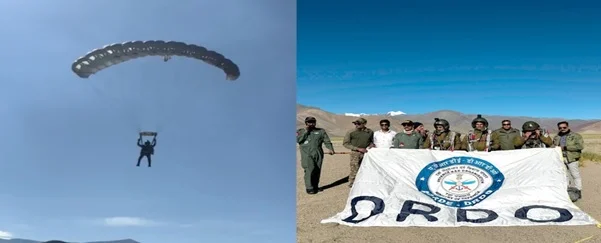
The Military Combat Parachute System (MCPS) is an indigenous parachute system developed for military airborne operations, especially high-altitude missions.
DRDO test jumpers jumped from an altitude of 22,000 feet AMSL (Above Mean Sea Level.)
Along with the MCPS, the test jumpers used several supporting systems,
including:
The use of these systems together is important for military personnel operating at extreme altitudes, where low oxygen levels and freezing temperatures create additional challenges.
The ADRDE test team included:
The team successfully completed the high-altitude jump using the MCPS and its supporting systems.
The Aerial Delivery Research and Development Establishment (ADRDE) is a specialised laboratory of DRDO.
The development of MCPS is part of India's wider effort to promote self-reliance in defence manufacturing.
Indigenous systems such as MCPS can:
The Defence Research and Development Organisation (DRDO) is India’s main defence research and development organisation.
The successful test of MCPS at 22,000 feet in Ladakh is a major step in strengthening India’s high-altitude military capabilities. It also supports India’s goal of self-reliance in defence technology by promoting indigenous and reliable military systems.
Prelims Practice QuestionMilitary Combat Parachute System (MCPS) has been developed by which organisation? Mains Practice QuestionsHow can indigenous development of specialised military systems such as MCPS contribute to India's goal of Atmanirbhar Bharat in defence? Discuss. |
1. What is MCPS?MCPS stands for Military Combat Parachute System, an indigenous parachute system developed for military airborne operations. 2. Who developed MCPS?It was designed and developed by ADRDE, a laboratory of DRDO. 3. Where was MCPS recently tested?It was tested at the Nyoma-Mudh drop zone in Ladakh. 4. At what altitude was the MCPS test jump conducted?The test jump was conducted from 22,000 feet AMSL. 5. At what altitude was the parachute deployed?The MCPS parachute was deployed at 20,000 feet. |
| Prelims: South China Sea, Paracel Islands, Yagong Island, Antelope Reef, Spratly Islands, UNCLOS, Nine-Dash Line, Exclusive Economic Zone (EEZ) Mains: GS Paper II: International Relations, India and its Neighbourhood, International Institutions GS Paper III: Security Challenges, Maritime Security, Strategic Infrastructure |
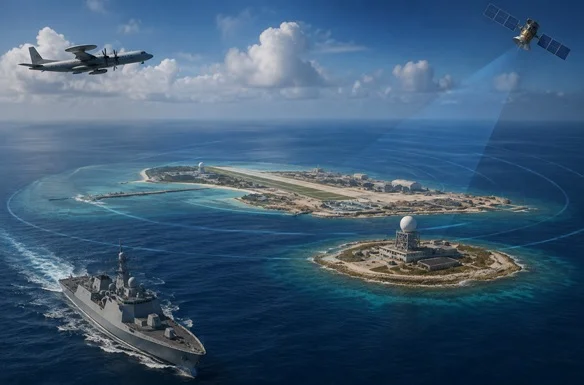
New satellite images reveal fresh construction on Yagong Islet, part of the Paracel Islands in the South China Sea, roughly 14 kilometers from Antelope Reef; a feature analysts say China is turning into its largest military outpost in the region.
|
Topic |
Key Fact |
|
Latest development |
New installations observed on Yagong Island |
|
Satellite imagery |
17 August 2026 |
|
Location |
Paracel Islands, South China Sea |
|
Nearby project |
Antelope Reef |
|
Distance from Antelope Reef |
About 14 km |
|
Possible Yagong function |
Early-warning/surveillance facility |
|
Antelope artificial island |
Approximately 6 km long |
|
Potential runway |
Around 3 km if completed as analysts expect |
|
Major maritime treaty |
UNCLOS, 1982 |
|
EEZ limit |
Up to 200 nautical miles |
|
Territorial sea |
Up to 12 nautical miles |
|
India's status |
Not a South China Sea claimant |
Antelope Reef lies roughly 162 nautical miles from Sanya in China's Hainan province and about 216 nautical miles from Da Nang, Vietnam. Its location gives it several potential strategic advantages like:
|
Country/Entity |
Major Areas of Claim/Interest |
|
China |
Claims sovereignty over multiple island groups and extensive maritime rights |
|
Vietnam |
Claims Paracel and Spratly Islands |
|
Philippines |
Claims features and maritime zones in parts of the Spratly region/West Philippine Sea |
|
Malaysia |
Claims maritime zones and some Spratly features |
|
Brunei |
Claims an EEZ overlapping part of the disputed area |
|
Taiwan |
Maintains claims broadly resembling China's historical claim |
|
Indonesia |
Not a claimant to the main island groups but rejects Chinese claims overlapping Indonesia's EEZ near the Natuna Islands |
Prelims MCQQ. Which of the following statements about artificial islands under UNCLOS is correct? A. They automatically generate a 200-nautical-mile EEZ B. They have the same status as natural islands C. They do not generate their own territorial sea or EEZ D. They automatically confer sovereignty over surrounding waters Mains Practice QuestionQ. How does China’s artificial-island strategy affect regional security and the rules-based maritime order? |
What is Yagong Island?A small feature in the Paracel Islands of the South China Sea. What is Antelope Reef?A reef in the Paracel Islands where China is carrying out major reclamation. Who controls the Paracel Islands?China currently exercises effective control. Who also claims the Paracels?Vietnam and Taiwan claim them. What is UNCLOS?The main international treaty governing maritime rights and zones. |
| Prelims: VAHAK-6, SABAL 20, ALAKH UAV, Multi-UAV Mothership, Drone Swarm, GPS-Denied Operations, ISR, Loitering Munition, Electronic Warfare, BEL Mains: GS Paper III: Defence Technology, Indigenisation of Defence, Border Security, Emerging Technologies, And Electronic Warfare |
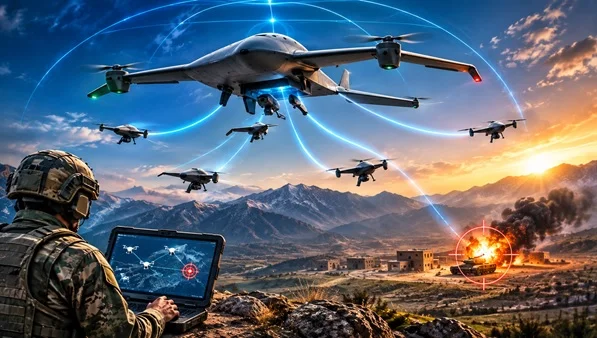
India has unveiled an indigenous multi-UAV mothership system called VAHAK-6, designed to carry and deploy multiple smaller drones in mid-air for surveillance, reconnaissance and strike missions.
|
Feature |
Details |
|
System |
VAHAK-6 |
|
Type |
Multi-UAV Mothership System |
|
Developer |
EndureAir Systems |
|
Collaboration |
Bharat Electronics Limited (BEL) |
|
Mothership |
SABAL 20 |
|
Drone Capacity |
Up to 6 ALAKH UAVs |
|
Deployment |
Mid-air |
|
ALAKH Roles |
Surveillance, reconnaissance and kamikaze/strike |
|
Operational Concept |
Search, Detect and Destroy |
|
Key Capability |
Operations in EW-challenged and GPS-denied environments |
|
Swarm Capability |
Up to six UAVs |
|
ALAKH |
Micro-UAV platform with GPS-free navigation |
|
Primary Relevance |
ISR, distributed operations and precision strike support |
It serves two important roles:
Spoofing: Feeding misleading navigation or other electronic information to a system.
Prelims MCQQ1. VAHAK-6, recently seen in the news, is best described as: A. Anti-drone missile system B. Multi-UAV mothership system C. Unmanned submarine D. Electronic warfare radar Mains Practice QuestionQ. Examine the role of indigenous unmanned aerial systems in strengthening India’s defence preparedness and technological self-reliance. |
What is VAHAK-6?An indigenous multi-UAV mothership system. Who developed VAHAK-6?EndureAir Systems, in collaboration with BEL. What drones does it carry?Specialised ALAKH micro-UAVs. What is its main operational concept?Search, Detect and Destroy (SDD). What is drone swarming?Multiple drones working together in a coordinated mission. |
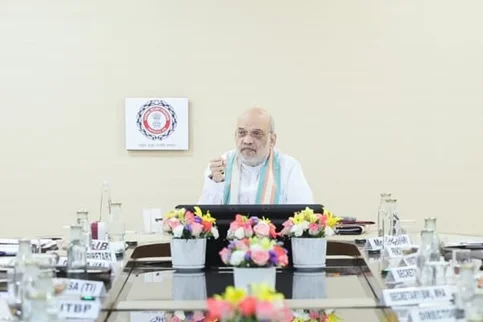
Union Home Minister Amit Shah has outlined a long-term roadmap for strengthening India’s internal security up to 2047, linking national security with the goal of Viksit Bharat 2047.
Future challenges may include:
|
Emerging Threat |
Possible Impact |
|
Cyber threats |
Attacks on digital infrastructure |
|
Online misinformation |
Social disruption |
|
Radicalisation |
Internal security concerns |
|
Narcotics trafficking |
Organised crime and social harm |
|
Energy insecurity |
Economic vulnerability |
|
Supply-chain disruption |
Economic and strategic risks |
|
Global instability |
Geopolitical uncertainty |
|
Illegal infiltration |
Border and security concerns |
Amit Shah’s 2047 Security Vision in One Line
Prelims QuestionQ. With reference to India’s internal security, consider the following as emerging challenges:
Which of the above are considered emerging internal security challenges?
Mains QuestionQ. Analyse the role of intelligence sharing, technology and Centre-State coordination in strengthening India’s internal security. |
What is Amit Shah’s 2047 security blueprint?It is a long-term approach to strengthen India's internal security by anticipating future threats and improving border management, counter-terrorism, narcotics control, intelligence sharing and technology-based policing. What is the main objective of the 2047 security strategy?The objective is to create a secure internal environment that supports India's economic development and the goal of Viksit Bharat 2047. What is the Detect, Disrupt and Destroy strategy?It is an approach to combating narcotics trafficking that focuses on identifying drug networks, disrupting their operations and dismantling them. How will AI help India’s security agencies?AI can help analyse large amounts of data, identify patterns and support intelligence agencies in detecting potential threats. |
| Prelims: Indian Coast Guard (ICG), Vietnam Coast Guard (VCG), India–Vietnam Relations, Maritime Security, Indo-Pacific Region Mains: GS Paper II (International Relations) & GS Paper III (Security), India–Vietnam Strategic Partnership, Maritime Security, Coastal Security, Indo-Pacific Cooperation, Maritime Diplomacy Keywords: Indian Coast Guard (ICG), Vietnam Coast Guard (VCG), 7th High-Level Meeting, Chennai, Maritime Security, Coastal Security, Search and Rescue, Maritime Cooperation, Indo-Pacific, India–Vietnam Relations, Operational Coordination |
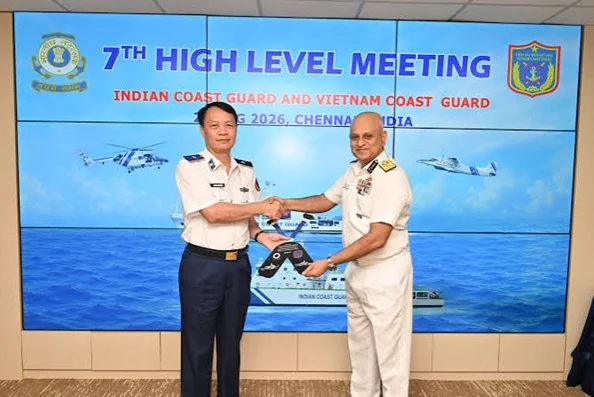
The 7th High-Level Meeting between the Indian Coast Guard (ICG) and Vietnam Coast Guard (VCG) was held in Chennai.
India and Vietnam have important maritime interests in the Indo-Pacific. Cooperation between their Coast Guards can help strengthen security and stability across the wider maritime region. Regular interaction also allows both forces to exchange experiences related to maritime surveillance and security challenges.
Protecting fishermen, merchant vessels and other people operating at sea is an important responsibility of Coast Guard organisations. Cooperation can improve coordination in emergencies and strengthen mechanisms for protecting lives in maritime areas.
Search and Rescue (SAR) cooperation is particularly important during accidents, cyclones, vessel emergencies and other maritime disasters. Professional exchanges and coordinated exercises can help both Coast Guards improve their operational preparedness.
Coastal security involves monitoring activities close to the coastline and preventing illegal or suspicious maritime activities. India has significantly strengthened its coastal security architecture, especially after the 26/11 Mumbai terror attacks, making Coast Guard cooperation an important element of maritime security.
Regular meetings, training programmes, ship visits and interaction among personnel help the two organisations learn from each other's operational experience. Such exchanges also improve interoperability and build institutional trust between the two Coast Guards.
The ICG also works with the Indian Navy, coastal police, customs authorities and other agencies as part of India's wider maritime security architecture.
Maritime cooperation is not limited to naval forces. Coast Guards increasingly play an important role in what can be described as maritime diplomacy.
Unlike conventional military engagement, Coast Guard cooperation often focuses on non-traditional security challenges such as:
These areas provide countries with opportunities to build trust while addressing practical security challenges.
UPSC Prelims MCQQ. Consider the following statements regarding the Indian Coast Guard (ICG):
Which of the statements given above are correct? (a) 1 and 2 only Mains QuestionIndia–Vietnam maritime cooperation has emerged as an important component of India's Indo-Pacific engagement. Discuss the significance of Coast Guard cooperation between the two countries in addressing traditional and non-traditional maritime security challenges. |
Where was the 7th India–Vietnam Coast Guard High-Level Meeting held?It was held in Chennai, Tamil Nadu. Which organisations participated in the meeting?The Indian Coast Guard (ICG) and Vietnam Coast Guard (VCG) participated. What was the main focus of the meeting?The meeting focused on professional cooperation, maritime engagement and operational coordination. Under which ministry does the Indian Coast Guard function?The Indian Coast Guard functions under the Ministry of Defence. When was the Indian Coast Guard established?The Indian Coast Guard was formally established on 1 February 1977. |
| Mains: GS Paper I & II – Indian Culture, Tribal Communities, Linguistic Diversity, Welfare of Vulnerable Sections, Digital Inclusion and Preservation of Cultural Heritage Keywords: National Conclave on Tribal Languages & Museums, Mysuru, Ministry of Tribal Affairs, Adi Vaani, Jago AI Bot, CIIL, KSTRI, Tribal Languages, Tribal Freedom Fighter Museums, PVTGs, PM-JANMAN, Mysuru Declaration, Viksit Bharat@2047 |
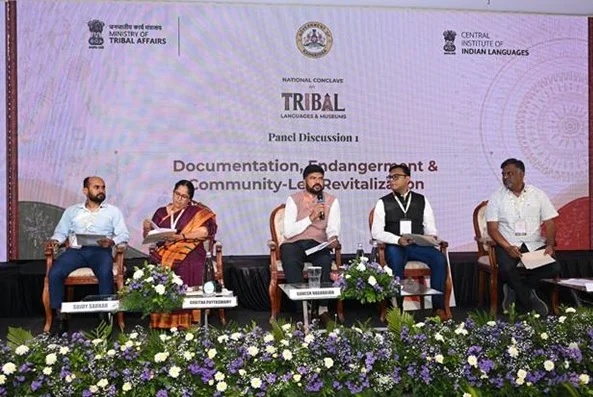
The Ministry of Tribal Affairs (MoTA) began the three-day National Conclave on Tribal Languages & Museums in Mysuru, Karnataka. It brought together policymakers, linguists, researchers, technologists and tribal community representatives.
Tribal communities should be active partners in deciding what linguistic and cultural knowledge should be documented.
Oral histories, folk songs, stories, vocabulary and traditional knowledge should be systematically recorded and preserved.
Tribal youth can be trained in language documentation, recording, translation and digital content creation.
More primers, dictionaries, teacher handbooks and digital educational resources should be developed in tribal languages.
AI-based language technologies should follow principles of consent, privacy, community ownership and responsible data use.Technology should support tribal communities rather than separate linguistic knowledge from the people who created and preserved it.
Prelims MCQQ. With reference to ‘Jago’, recently seen in the news, which of the following is correct? A. It is a scholarship portal for tribal students. Mains Practice Question“The preservation of tribal languages is not merely a question of linguistic diversity but also of protecting cultural identity and traditional knowledge.” Discuss the role of technology in the preservation and revitalisation of tribal languages in India. |
Q1. Where was the National Conclave on Tribal Languages & Museums held?Mysuru, Karnataka. Q2. Which ministry organised the Conclave?The Ministry of Tribal Affairs. Q3. What is Jago?It is the official AI conversational assistant of the Ministry of Tribal Affairs. Q4. What new features were added to Adi Vaani?An iOS application, five new languages and other upgraded features were introduced. Q5. MoTA signed an MoU with which institution?The Central Institute of Indian Languages (CIIL). |

Our support team will be happy to assist you!

 Contact Us
  New Batch : 9555124124/ 7428085757
  Tech Support : 9555124124/ 7428085757