
- UPSC Exam
- State PCS
- One Day Exam
- Current Affairs
- PT Quiz
- Downlaods
- About Coaching
- Blog
- Videos

| Prelims: UNESCO World Heritage Sites, Tentative List, Gupta Period, Buddhist Rock-Cut Architecture, Gandhi and Satyagraha. Mains: GS Paper I – Indian Art and Culture; GS Paper II – International Relations and India’s cultural diplomacy; GS Paper III – Conservation of heritage and tourism. Keywords: UNESCO Tentative List, World Heritage Convention, Udaigiri Caves, Bagh Cave Paintings, Ginnorgarh Fort, Chambal Valley Temples, Satyagraha, Mahatma Gandhi, Cultural Heritage Conservation. |
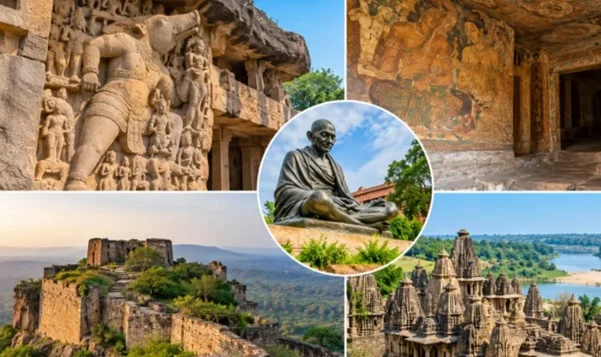
The Udaigiri Caves represent an important example of India’s early historic rock-cut religious architecture. Developed mainly during the Gupta period, particularly in the late fourth and early fifth centuries CE, the site reflects the relationship between religious traditions, royal patronage and artistic expression.
The complex comprises 20 excavated caves, sculptural panels, inscriptions and pathways integrated into the surrounding rocky landscape. Its famous sculptures, including the depiction of Vishnu as Varaha, provide insights into the development of Hindu iconography during the Gupta period.
The Bagh Caves are a group of nine rock-cut Buddhist caves situated on the southern slopes of the Vindhyan range, near the Baghni River in western Madhya Pradesh. They are known for their Buddhist associations, architectural features and mural paintings.
The paintings provide evidence of ancient Indian artistic traditions, religious life and the use of colour and narrative in mural art. The caves’ sandstone geological setting also influenced their architecture and the preservation of their paintings.
Ginnorgarh Fort is a historic fortified site associated with the Gond rulers of central India. Its strategic location and defensive character reflect the importance of hill forts in regional political and military history.
The fort offers opportunities to study the relationship between terrain, defence, regional kingdoms and the historical development of tribal polities in central India.
This proposed heritage entry includes three temple complexes: Bateshwar, Padavali and Kakarmath. Together, they represent the region’s architectural and religious heritage.
The Bateshwar complex is known for its cluster of historic temples, while Padavali is noted for its richly carved temple architecture and fortification. The Kakarmath temple complex at Amrol adds to the evidence of medieval temple-building traditions in the region.
These sites help explain the evolution of temple architecture, stone carving, religious patronage and regional artistic traditions in central India.
The proposed Sites of Satyagraha property is a serial transnational nomination linking nine locations across India and South Africa. It traces the development of Gandhi’s philosophy of Satyagraha, based on truth and non-violent resistance.
The proposal connects places associated with the beginnings of Gandhi’s political experiments in South Africa with locations where the philosophy was further developed, organised and applied in India’s freedom struggle.
The additions can strengthen India’s cultural diplomacy by presenting its heritage as part of a wider human history. The proposed Satyagraha property is particularly relevant because it connects India’s freedom movement with the experiences that shaped Gandhi’s philosophy in South Africa.
For Madhya Pradesh, the four entries draw attention to the state’s diverse heritage, ranging from ancient religious art to historic forts and temple complexes. Their long-term value will depend on conservation, scientific documentation, responsible tourism and community participation.
The five additions to India’s reported UNESCO Tentative List highlight the country’s diverse cultural heritage and the international significance of its historical connections. The four Madhya Pradesh entries reflect the region’s architectural and artistic traditions, while the proposed Sites of Satyagraha property connects India and South Africa through the history of non-violent resistance.
Prelims MCQQ. With reference to UNESCO’s Tentative List, consider the following statements:
Which of the statements given above is/are correct? (a) 1 only Mains Practice Question“India’s cultural heritage contributes to both national identity and international cultural diplomacy.” Discuss with reference to the latest additions to India’s UNESCO Tentative List. |
Q1. What is UNESCO’s Tentative List?It is a list of properties a country may nominate for future inclusion on the World Heritage List. Q2. How many new entries have been reported?Five new entries have been reported, taking the stated total to 78. Q3. Which state accounts for four of the new entries?Madhya Pradesh. Q4. What is the Sites of Satyagraha proposal?It is a proposed transnational heritage property linking nine locations in India and South Africa associated with the development of Gandhi’s philosophy of Satyagraha. Q5. Does Tentative List inclusion mean a site is already a UNESCO World Heritage Site?No. A separate nomination and evaluation process is required before inscription on the World Heritage List. |
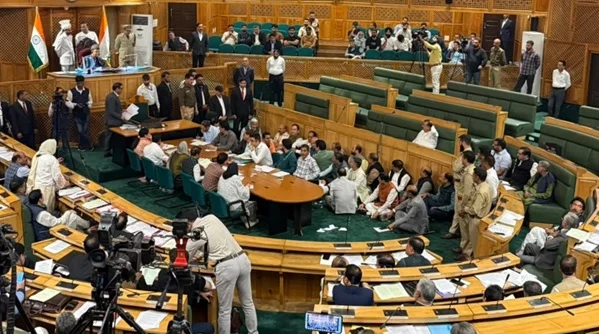
This special constitutional arrangement subsequently formed the background for the creation of Article 370.
Article 370 provided a special constitutional arrangement for Jammu and Kashmir under the Indian Constitution.
Under this arrangement:
Negotiations between the Union Government and Jammu and Kashmir continued over the constitutional relationship. The Delhi Agreement was concluded in 1952.
Its major provisions included:
Article 35A empowered the Jammu and Kashmir Legislature to define “Permanent Residents” and provide them with special rights and privileges.
These included:
The reorganisation came into effect on October 31, 2019, fundamentally changing the administrative and constitutional status of the region.
Therefore, the two demands should be understood as distinct constitutional issues.
Q1. What was Article 370?Answer - Article 370 provided a special constitutional arrangement for Jammu and Kashmir, under which the application of the Indian Constitution and the legislative powers of Parliament were subject to special provisions. Q2. When was Article 370 adopted?Answer - Article 370 was adopted by the Constituent Assembly on October 17, 1949. Q3. What was the Instrument of Accession?Answer - The Instrument of Accession was the legal document through which Maharaja Hari Singh acceded Jammu and Kashmir to India on October 26, 1947. Initially, it covered subjects such as defence, foreign affairs and communications. Q4. What was the Delhi Agreement of 1952?Answer - The Delhi Agreement was an understanding between the Union Government and Jammu and Kashmir that further defined their constitutional relationship. It included matters such as the jurisdiction of the Supreme Court and the position of the Indian national flag. Q5. What was Article 35A?Answer - Article 35A was introduced through the 1954 Presidential Order under Article 370. It empowered the Jammu and Kashmir Legislature to define permanent residents and provide them with certain special rights and privileges. Q6. What happened to Article 370 on August 5, 2019?Answer - On August 5, 2019, constitutional changes were introduced that rendered the special operation of Article 370 ineffective and enabled the wider application of the Indian Constitution to Jammu and Kashmir. |
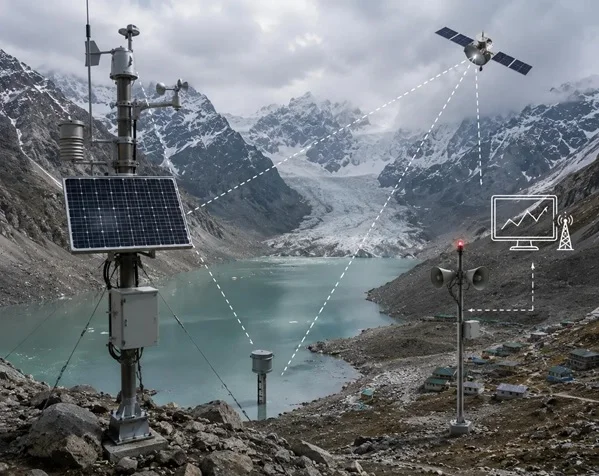
The system being installed at Vasundhara Tal will monitor various environmental and hydrological parameters.
Abnormal changes in water level, weather and water flow can be detected at an early stage.
Early warnings can help authorities alert people living in downstream areas and prepare for evacuation.
Roads, bridges, hydropower projects and other critical infrastructure can receive advance information about potential risks.
Real-time data can enable more scientific assessment and management of disaster risks.
Over the long term, the system can help understand changes in temperature, snow cover, water levels and glacial lakes.
Extreme altitude, difficult terrain and harsh weather conditions in the high Himalayas make the installation and maintenance of equipment challenging.
The absence of mobile networks creates a strong dependence on satellite-based communication systems.
Detecting changes in a glacial lake is not enough. The biggest challenge is ensuring that the information reaches people living in downstream areas in time.
The Himalayas face multiple hazards, including GLOFs, landslides, avalanches, extreme rainfall and flash floods. Therefore, an integrated disaster monitoring system is essential.
MCQQ1. Consider the following statements regarding GLOF:
Which of the statements given above are correct? A. Only 1 and 2 B. Only 2 and 3 C. Only 1 and 3 D. 1, 2 and 3 |
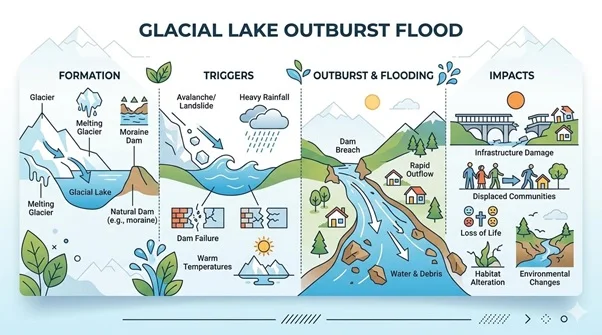
1. What is a Glacial Lake Outburst Flood (GLOF)?Answer: GLOF (Glacial Lake Outburst Flood) refers to a sudden flood caused by the outburst of a glacial lake. When the natural dam holding back a glacial lake suddenly breaks, a large volume of water rapidly flows downstream, potentially causing flash flooding. 2. Where is Uttarakhand’s first Glacial Lake Early Warning System being installed?Answer: The system is being installed at Vasundhara Tal in Chamoli district. 3. What is the main objective of the Glacial Lake Early Warning System?Answer: The main objective is to conduct real-time monitoring of the lake’s water level, weather conditions, snow, water flow and surrounding activities, and generate timely alerts when abnormal changes are detected. |
| Prelims: Advertising Standards Council of India (ASCI), Artificial Intelligence (AI) Deep fakes, Consumer Protection, Self-Regulation in Advertising. Mains: GS Paper II: Governance and Consumer Protection; GS Paper III: Science & Technology, Artificial Intelligence, Digital Technologies and their societal implicationsGS Paper IV: Ethics in Technology and Responsible Advertising. |
The ASCI released the Guidelines for Responsible Labelling of Synthetically Generated Content in Advertising on 29 September 2026.

|
Particular |
Details |
|
Guidelines issued by |
Advertising Standards Council of India (ASCI) |
|
Released |
29 September 2026 |
|
Subject |
Responsible labelling of Synthetically Generated Content in advertising |
|
Effective from |
Three months from publication |
|
Core approach |
Consumer-impact based |
|
Main objective |
Transparency and protection against misleading synthetic advertising |
|
Main principle |
AI disclosure is required where synthetic content can materially influence consumer understanding or decisions |
|
Governing standard |
ASCI Code for Self-Regulation in Advertising |
Prelims MCQQ. With reference to ASCI, consider the following statements:
Which of the statements given above is/are correct? (a) 1 only (b) 2 only (c) Both 1 and 2 (d) Neither 1 nor 2 Mains Practice QuestionQ. Examine the need for transparency in AI-generated advertising in India. |
What are ASCI’s AI advertising guidelines?They set disclosure rules for AI-generated content in advertisements. Is AI labelling mandatory for all ads?No. It is mainly required when synthetic content can materially influence consumers. Are AI-generated influencers allowed in ads?Yes, but appropriate disclosure may be required. Are AI deepfake ads allowed in India?Unauthorised or misleading deepfake advertisements are not acceptable under the guidelines. Is ASCI a government body?No. ASCI is an independent advertising self-regulatory organisation. |
The International Day of Older Persons is observed every year on 1 October to raise awareness about the opportunities and challenges associated with population ageing.

|
Particular |
Details |
|
Observed on |
1 October |
|
Established by |
United Nations General Assembly |
|
Established in |
1990 |
|
UN Resolution |
45/106 |
|
First Observed |
1 October 1991 |
|
2026 Theme |
The Age of Longevity: Rethinking Systems for Longer Lives |
|
Major focus |
Rights, dignity, health and well-being of older persons |
|
Important global framework |
Madrid International Plan of Action on Ageing |
|
Related initiative |
UN Decade of Healthy Ageing (2021–2030) |
Prelims MCQQ. International Day of Older Persons is observed on: (a) 15 June (b) 1 October (c) 10 October (d) 14 December Mains Practice QuestionQ. What challenges does population ageing pose for India? Discuss. |
When is International Day of Older Persons observed?1 October. What is the theme of International Day of Older Persons 2026?The Age of Longevity: Rethinking Systems for Longer Lives Who started International Day of Older Persons?The UN General Assembly established it in 1990. What is AVYAY?It is an umbrella welfare scheme for senior citizens in India. What is India's senior citizen helpline number?The Elderline helpline number is 14567. |
| Prelims: UNICORN, Unified Complex Radio Antenna, India–Japan defence cooperation, FOIP, Quad, Malabar Exercise, Veer Guardian, naval modernisation, unmanned systems. Mains: GS Paper II – India–Japan strategic partnership and Indo-Pacific; GS Paper III – defence technology, naval modernisation, AI and unmanned warfare. Keywords: UNICORN, Unified Complex Radio Antenna, Technology Transfer, India–Japan Defence Cooperation, FOIP, Quad, Malabar, Naval Modernisation, Counter-Drone Systems. |

India occupies a strategically important position in the Indian Ocean Region, making maritime surveillance, communication and naval preparedness important components of national security. Advanced naval technologies can enhance India's ability to monitor and respond to emerging maritime challenges.
Technology-transfer agreements can contribute to India's defence-industrial ecosystem when accompanied by domestic manufacturing, research and development and technology absorption. The key challenge is to ensure that technology cooperation develops sustainable indigenous capabilities rather than creating long-term dependence.
India's cooperation with Japan complements its engagement with other like-minded partners through mechanisms such as the Quad and exercises such as Malabar. Such cooperation can contribute to greater interoperability and maritime coordination without being limited to traditional military alliances.
Prelims MCQQ. With reference to the India–Japan UNICORN agreement, consider the following statements:
Which of the statements given above is/are correct? A. 1 and 2 only Mains Practice Question“Defence technology cooperation is emerging as an important pillar of the India–Japan strategic partnership.” Discuss with reference to the UNICORN agreement and the changing nature of maritime security in the Indo-Pacific. |
1. What is UNICORN?UNICORN stands for Unified Complex Radio Antenna, a naval antenna system involving integrated antenna functions. 2. What is the India–Japan UNICORN agreement about?It concerns the transfer of technology related to the UNICORN system from Japan to India. 3. When was the agreement signed?The agreement was signed during Japanese Prime Minister Sanae Takaichi’s visit to India in July 2026. 4. What is FOIP?FOIP stands for Free and Open Indo-Pacific, a framework emphasising a free, open and rules-based Indo-Pacific region. 5. What is Malabar?Malabar is a multilateral naval exercise involving India, Japan, the United States and Australia. |
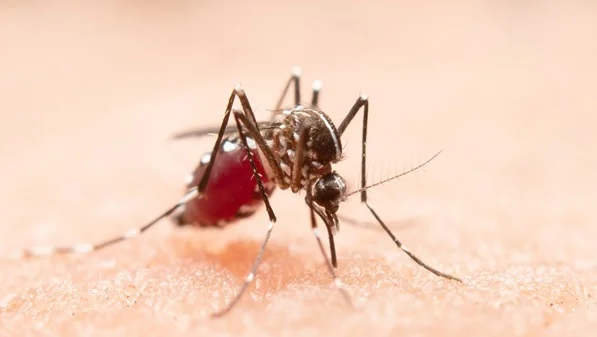
The system then generates a district-wise forecast of the expected dengue burden.
Dengue is mainly transmitted by Aedes mosquitoes, whose growth and survival are strongly influenced by environmental conditions.
Dengue outbreaks can put significant pressure on public health systems. Early forecasting can help authorities prepare in advance instead of responding only after cases rise.
The system can potentially help in:
Forecasting dengue is difficult because its transmission depends on several factors beyond weather.
The Dengue Early Warning System developed by IAV represents an effort to shift dengue management from a reactive approach to a preventive and predictive approach. By combining epidemiological information with weather and district-level environmental data, the system can provide early indications of dengue risk and help health authorities prepare for potential increases in cases.
Prelims Practice Question1. The Dengue Early Warning System (DEWS), recently in the news, has been developed by which of the following? (a) Indian Council of Medical Research (ICMR) (b) Institute of Advanced Virology (IAV), Kerala (c)National Centre for Disease Control (NCDC) (d) National Institute of Virology (NIV), Pune Mains Practice QuestionQ. How can machine-learning-based disease forecasting systems strengthen India's preparedness against vector-borne diseases? Discuss the challenges associated with their use. |
1. What is the Dengue Early Warning System (DEWS)?DEWS is a machine-learning-based system that uses epidemiological and climatic data to forecast dengue trends in advance. 2. Who developed DEWS?It was developed by scientists at the Institute of Advanced Virology (IAV), Kerala. 3. What factors does DEWS analyse?The system analyses temperature, rainfall, humidity and epidemiological data related to dengue. 4. What is the main vector of dengue?Dengue is primarily transmitted by Aedes mosquitoes. 5. What is the main objective of DEWS?Its main objective is to provide early forecasts of dengue trends, helping health authorities plan resources and preventive measures in advance. |

Our support team will be happy to assist you!

 Contact Us
  New Batch : 9555124124/ 7428085757
  Tech Support : 9555124124/ 7428085757

