
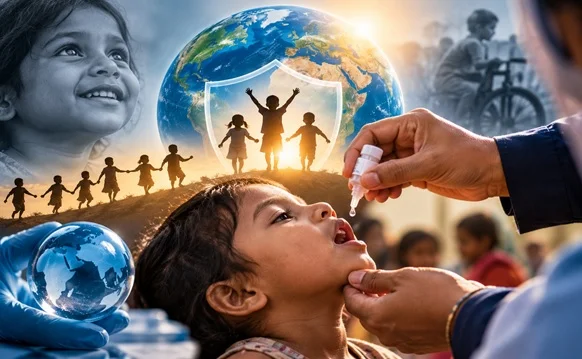
World Polio Day is observed every year on 24 October to raise awareness about polio prevention and highlight global efforts to eradicate the disease.
|
Particular |
Details |
|
Observed on |
24 October |
|
Disease |
Poliomyelitis (Polio) |
|
First observed |
2014 |
|
Main objective |
To eradicate polio worldwide |
|
Major organisation |
World Health Organization (WHO) |
|
Global initiative |
Global Polio Eradication Initiative (GPEI) |
|
India’s status |
Certified polio-free in 2014 |
|
2026 campaign theme |
Together, We End Polio |
Prelims Practice QuestionQ. Consider the following statements about polio:
Which of the statements given above are correct? (a) 1 only (b) 1 and 2 only (c) 2 and 3 only (d) 1, 2 and 3 Mains Practice QuestionQ. Explain the importance of vaccination in preventing polio and discuss India’s efforts to eradicate the disease. |
When is World Polio Day observed?24 October. What is polio?Polio is a viral disease that can damage the nervous system and cause permanent paralysis. When was India declared polio-free?In 2014. Which two countries still have endemic wild poliovirus?Afghanistan and Pakistan. What is the theme of World Polio Day 2026?Together, We End Polio. |
| Prelims: Indian Army, Land Warfare Doctrine, Army Commanders’ Conference, Operation Sindoor, multi-domain operations Mains: GS Paper III – Security Challenges; Defence Modernisation; Technology in Warfare Keywords: Land Warfare Doctrine 2026, Indian Army, Rajnath Singh, drones, artificial intelligence, multi-domain operations, Atmanirbharta, Operation Sindoor |
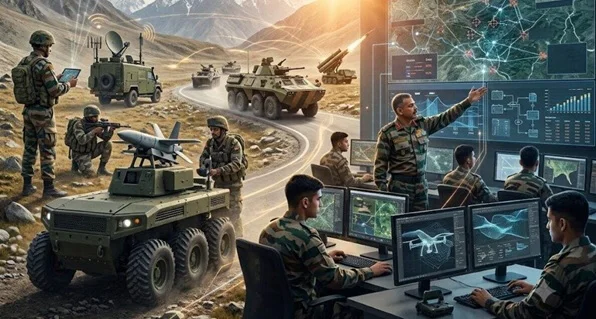
The doctrine responds to a battlefield increasingly shaped by drones, artificial intelligence, precision weapons, persistent surveillance and networked operations. These technologies can change how forces gather information, identify targets and coordinate action.
The framework emphasises coordination among the armed forces and integration of capabilities across multiple domains. Land power remains central, while operations increasingly connect with activity in areas such as cyber, space and the electromagnetic spectrum.
The doctrine highlights the role of soldiers and commanders alongside unmanned systems. Man–unmanned teaming can combine human judgment with the reach and persistence of robotic or remotely operated platforms. The reporting also highlights human leadership and the need to operate in technologically contested environments.
Commanders are expected to adapt operational approaches to the threat, terrain and mission. Resilient logistics and the ability to sustain operations when communications or technology are disrupted are also identified as important themes.
The doctrine places emphasis on Atmanirbharta in defence and a broader national effort. This recognises that future military preparedness depends not only on the armed forces, but also on indigenous defence capabilities, infrastructure and coordination with institutions beyond the military.
The doctrine is reported as aligned with Defence Forces Vision 2047, linking the Army’s future preparedness to long-term defence transformation and integration.
The Land Warfare Doctrine 2026 gives the Indian Army a refreshed framework for preparing for future conflict. Its focus on technology, jointness, adaptable leadership, resilient logistics and self-reliance reflects the changing battlefield. Its effectiveness will ultimately depend on how consistently these principles shape training, procurement and operational readiness.
Prelims MCQWith reference to India’s Land Warfare Doctrine 2026, consider the following statements:
Which of the statements given above is/are correct? A. 1 and 2 only Mains QuestionHow does the Land Warfare Doctrine 2026 address the changing character of warfare? Discuss the challenges involved in translating its principles into operational capability. |
1. What is the Land Warfare Doctrine 2026?It is a high-level framework guiding how the Indian Army prepares for and approaches future land conflicts. 2. Who released the doctrine?Defence Minister Rajnath Singh released it on 23 October 2026. 3. When was the previous Land Warfare Doctrine issued?The previous doctrine was released in December 2018. 4. What major changes in warfare does the new doctrine address?It addresses the growing role of drones, AI, precision warfare, surveillance, information warfare and operations across multiple domains. 5. Why is the doctrine significant for India?It provides a framework for adapting Army preparedness to evolving threats, integrating capabilities and strengthening self-reliance in defence. |
| Prelims: Carbon allotropes; covalent bonding; hybridisation; crystal structures Mains: GS Paper III – Science and Technology, materials science and emerging technologies Keywords: Diamondiyne, carbon allotrope, sp and sp³ hybridisation, diyne linkage, diamond topology, liquid–liquid interface |
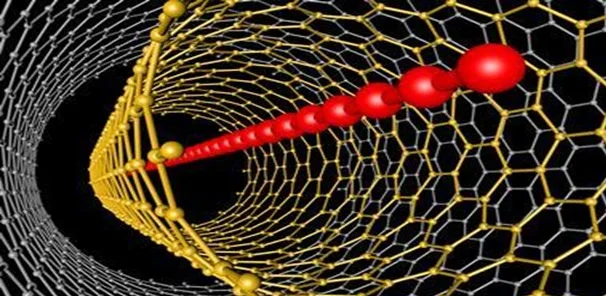
Diamondiyne is a newly synthesised carbon allotrope that combines a diamond-like three-dimensional network with triple-bonded diyne units. Its synthesis marks a significant step in carbon-materials research, while its practical value will depend on improving production and establishing its properties through further testing.
Prelims MCQWith reference to diamondiyne, consider the following statements:
Which of the statements given above is/are correct? A. 1 and 2 only Mains QuestionExplain how diamondiyne differs structurally from diamond. What challenges must be addressed before it can be considered for practical applications? |
1. What is diamondiyne?Diamondiyne is a newly synthesised, three-dimensional carbon allotrope with an expanded diamond-like network. 2. What does “diyne” mean in its name?A diyne group contains two carbon–carbon triple bonds. These groups help expand the diamond-topology network. 3. How does its structure differ from diamond?Diamond has a network of sp³-hybridised carbon atoms. Diamondiyne’s ideal model combines sp and sp³ carbon, with diyne units making the network more open. 4. How was diamondiyne made?Researchers formed it through a cascade reaction at the interface between two liquids, producing thin carbon films containing diamondiyne crystallites. 5. Does diamondiyne already have a confirmed industrial use?No. The study reports its synthesis and structural evidence; practical applications have not yet been demonstrated. |
| Prelims: Orthobunyavirus, vector-borne diseases, zoonoses, One Health Mains: GS Paper II – Health; GS Paper III – Science and Technology, Biosecurity, Disaster Management Keywords: Shamonda virus, Orthobunyavirus, Culicoides midges, One Health, zoonotic disease, vector surveillance |
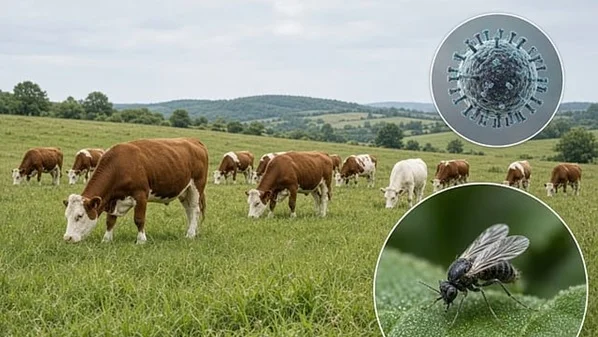
Prelims MCQConsider the following statements about Shamonda virus:
Which of the statements given above are correct? A. 1 and 2 only Mains QuestionDiscuss how the One Health approach can help countries detect and respond to emerging infections at the human–animal–environment interface. |
1. What is Shamonda virus?It is an Orthobunyavirus primarily associated with livestock, particularly cattle. 2. Why is the French case significant?It is the first known detection of Shamonda virus in a human. 3. Did Shamonda virus cause the patient’s death?That has not been established. The patient died after the infection was detected, but the virus’s role remains under investigation. 4. How is Shamonda virus believed to spread?Biting midges are associated with transmission among animals. A midge bite is suspected in the French case, but the route has not been confirmed. 5. Is there a confirmed risk to the general public?French authorities have said that no risk to the general population has been identified based on current knowledge. There is no reported evidence of human-to-human transmission. |

National Geographic’s Best of the World list highlights destinations offering distinctive cultural experiences, historic milestones and important events.
Jaipur’s inclusion is associated with the following factors:
Jaipur was founded in 1727 by Maharaja Sawai Jai Singh II, the ruler of the Kachwaha Rajput kingdom of Amber. The establishment of Jaipur marked an important development in the history of urban planning in India.
The main historical features of the city include:
Unlike cities that developed gradually without a unified plan, Jaipur was designed with considerable attention to its street network, commercial activities and urban organisation.
Jaipur is popularly known as the Pink City because of the distinctive pink colour associated with many buildings in its historic centre.
The tradition is commonly linked to the 1876 visit of the Prince of Wales, later King Edward VII, when the city was painted pink as a gesture of hospitality. The colour subsequently became an important part of Jaipur’s identity.
The pink facades, historic streets and traditional architecture contribute to the city’s distinctive visual character and tourism appeal.
Jaipur represents an important example of planned urban development in pre-modern India. Its architecture reflects Rajput traditions alongside influences from Mughal and other architectural styles.
Important examples include:
These monuments collectively demonstrate the historical importance of Jaipur as a centre of architecture, astronomy, governance and cultural development.
Jaipur’s cultural calendar is an important reason for its recognition as a tourism destination.
These events contribute to cultural exchange, local employment, tourism revenue and the preservation of traditional knowledge.
Jaipur’s inclusion in the list has implications beyond tourism.
Despite its cultural significance, Jaipur faces several challenges.
Addressing these challenges requires cooperation among the state government, local authorities, conservation experts, tourism operators, businesses and residents.
Jaipur’s growing international visibility should be accompanied by a long-term strategy for heritage protection and sustainable tourism.
These measures can help Jaipur protect its historic character while generating economic and social benefits from tourism.
Jaipur’s inclusion in National Geographic’s Best of the World 2027 list highlights the global appeal of India’s cultural and architectural heritage. As the city approaches its 300th foundation anniversary, its planned urban layout, historic monuments, literary events and traditional crafts offer valuable opportunities for tourism and cultural exchange.
However, international recognition must be supported by effective conservation, sustainable tourism and inclusive urban development. Jaipur’s experience demonstrates that heritage cities can contribute to economic growth while preserving their historical identity for future generations.
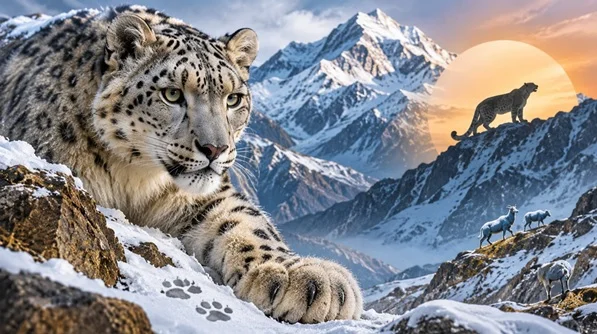
The United Nations General Assembly proclaimed 23 October as the International Day of the Snow Leopard in 2024 through Resolution A/RES/79/143.
|
Particular |
Details |
|
Observed on |
23 October |
|
First Observance |
2014, as an established conservation observance |
|
UN General Assembly proclamation |
2024 |
|
Scientific name |
Panthera uncia |
|
Common nickname |
Ghost of the Mountains |
|
IUCN Red List status |
Vulnerable |
|
Global conservation initiative |
Global Snow Leopard and Ecosystem Protection Program (GSLEP) |
|
Countries where it occurs |
12 Asian countries |
Prelims MCQQ. Consider the following statements about the snow leopard:
Which of the statements given above are correct? (a) 1 only (b) 1 and 2 only (c) 2 and 3 only (d) 1, 2 and 3 Mains Practice QuestionQ. Why is snow leopard conservation important in India? What are the main threats to its survival? |
When is International Snow Leopard Day celebrated?It is celebrated every year on 23 October. What is the scientific name of the snow leopard?Its scientific name is Panthera uncia. Why the snow leopard is called the “Ghost of the Mountains”?Because it is difficult to spot in the mountains and blends easily with its surroundings. What is the conservation status of the snow leopard?It is classified as Vulnerable on the IUCN Red List. How many snow leopards were estimated in India?India’s first nationwide assessment estimated 718 snow leopards. |
| Prelims: BrahMos Missile, BrahMos-NG, DRDO, India-Russia Defence Cooperation, Supersonic Cruise Missile, Defence Indigenisation, Defence Exports, Operation Sindoor. Mains: GS Paper III: Science and Technology, Defence Technology, Indigenisation, Defence Manufacturing, National Security, Defence Exports. |

|
Feature |
Details |
|
Missile type |
Supersonic cruise missile |
|
Joint venture |
India-Russia |
|
Indian partner |
DRDO |
|
Russian partner |
NPO Mashinostroyeniya |
|
Developer |
BrahMos Aerospace |
|
Initial reported strike range |
290 km |
|
Launch platforms |
Land, Sea and Air |
|
Speed |
Around Mach 2.8 |
|
Main role |
Precision strike against designated targets |
|
Feature |
Existing BrahMos |
BrahMos-NG |
|
Generation |
Existing system |
Next-generation variant |
|
Design |
Larger missile system |
Smaller and lighter design |
|
Indigenous content |
Existing level of indigenisation |
Higher indigenous content planned |
|
Technology |
Established system |
New technologies and advanced materials |
|
First planned configuration |
Multiple platforms |
Air-launched |
|
Development status |
Existing missile system |
Under development |
|
Prototype timeline |
— |
2027-28 target |
|
Location |
Importance |
|
Hyderabad |
BrahMos production activities |
|
Nagpur |
Missile manufacturing |
|
Pilani |
Production and industrial support |
|
Lucknow |
Newer production facility |
Prelims MCQQ. BrahMos missile is jointly developed by which of the following? A. India and France B. India and Russia C. India and Israel D. India and the United States Mains Practice QuestionQ. What challenges must be addressed for the development of next-generation missile systems? |
What is BrahMos-NG?It is the next-generation, smaller and lighter version of the BrahMos missile. When is its first prototype expected?By 2027 or 2028. What is the proposed range of the future missile?A 1,500-km range is part of the future roadmap, currently at the conceptual stage. Which aircraft is planned for BrahMos-NG integration?The Su-30MKI is an initial planned platform. Adaptation to Tejas is also envisaged. Is the 1,500-km BrahMos operational?The reported project is at the conceptual stage. |