

World Psoriasis Day is observed on 29 October every year to raise awareness about psoriasis and psoriatic arthritis.

|
Particular |
Details |
|
Observance |
World Psoriasis Day |
|
Date |
29 October |
|
First observed |
2004 |
|
Organising body |
International Federation of Psoriasis Associations (IFPA) |
|
2026 theme |
Look Beyond My Skin |
|
Main objective |
Awareness, inclusion and better access to care |
|
Nature of disease |
Chronic inflammatory, non-communicable disease |
Prelims MCQQ. Consider the following statements about psoriasis:
Which of the following statements are correct? (a) 1 only Mains Practice QuestionQ. Discuss the health and social challenges associated with psoriasis. |
When is World Psoriasis Day observed?29 October every year. What is the 2026 theme?Look Beyond My Skin Is psoriasis contagious?No. It cannot spread through ordinary physical contact. Can psoriasis be cured permanently?There is no permanent cure currently, but treatments can control symptoms. What is psoriatic arthritis?An inflammatory condition that can cause joint pain, swelling and stiffness. |

|
Particular |
Details |
|
Observance |
International Internet Day |
|
Date |
29 October |
|
Historical milestone |
First message sent over ARPANET |
|
Year of first message |
1969 |
|
First message received |
“LO” |
|
Network |
ARPANET |
|
Key significance |
Development of computer networking and the modern internet |
|
Related UN observance |
World Telecommunication and Information Society Day-17 May |
|
1969 |
ARPANET carried the first message between computers at UCLA and the Stanford Research Institute |
|
First message |
The attempt was to send “LOGIN”, but the system crashed after transmitting “LO”. The complete message was sent later |
|
1989 |
Tim Berners-Lee proposed the World Wide Web at CERN. |
|
1991 |
The first website became publicly accessible |
|
Today |
The internet supports global communication, digital economies, scientific research and public services. |
|
Initiative |
Purpose |
|
Digital India |
Promotes digital infrastructure, services and literacy |
|
BharatNet |
Expands broadband connectivity to rural areas |
|
Common Services Centres |
Provides assisted access to digital and government services |
|
UMANG |
Offers access to multiple government services through a digital platform |
|
PM-WANI |
Framework for expanding public Wi-Fi access |
|
Digital Personal Data Protection Act, 2023 |
Establishes a legal framework for processing digital personal data |
Prelims MCQQ. Consider the following statements:
Which of the following statements are correct? (a) 1 only Mains Practice QuestionQ. Discuss the role of the internet in inclusive development and the challenges associated with its use in India. |
When is International Internet Day observed?29 October every year. Why is 29 October significant?It marks the first message transmitted over ARPANET in 1969. What was the first ARPANET message?The initial attempt to send “LOGIN” transmitted “LO” before the system crashed. How is the internet different from the World Wide Web?The internet is the global network; the Web is a service that operates over it. What is the digital divide?The gap between people who can effectively access and use digital technologies and those who cannot. |
| Prelims: Defence Acquisition Council, DAC, Acceptance of Necessity, AoN, VSHORADS, Counter-UAS, Active Offboard Decoy System, Defence Acquisition Procedure. Mains: GS paper III: Defence indigenisation, national security, military modernisation, strategic autonomy, defence manufacturing, indigenous technology. |
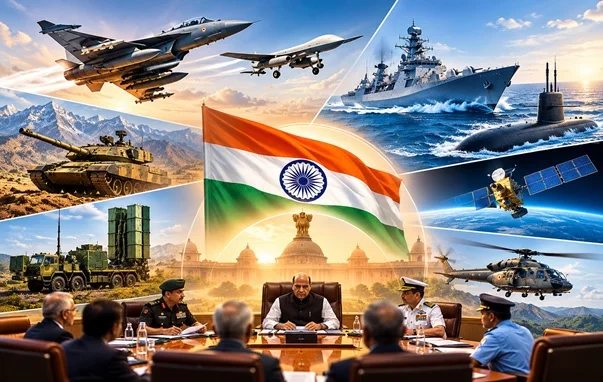
The Defence Acquisition Council approved capital acquisition proposals worth approximately ₹2.12 lakh crore on 26 October 2026.
|
Particular |
Details |
|
Decision-making body |
Defence Acquisition Council (DAC) |
|
Date of approval |
26 October 2026 |
|
Chairperson |
Defence Minister Rajnath Singh |
|
Total estimated value |
Approximately ₹2.12 lakh crore |
|
Nature of approval |
Acceptance of Necessity (AoN) |
|
Domestic sourcing |
Approximately 82% from Indian industry |
|
Beneficiaries |
Indian Army, Indian Navy and Indian Air Force |
|
Nodal ministry |
Ministry of Defence |
|
UPSC relevance |
GS Paper III: Security, Defence Technology and Indigenisation |
|
Initiative |
Relevance |
|
Make in India |
Encourages domestic manufacturing, including defence production. |
|
Atmanirbhar Bharat Abhiyan |
Promotes self-reliance in strategic sectors and domestic industrial capacity. |
|
Defence Acquisition Procedure (DAP), 2020 |
Provides the framework for defence capital acquisition with emphasis on indigenisation and domestic procurement. |
|
Positive Indigenisation Lists |
Identify specified defence items for which procurement restrictions on imports apply |
|
Defence Industrial Corridors |
Support defence manufacturing ecosystems in Uttar Pradesh and Tamil Nadu. |
|
Innovations for Defence Excellence (iDEX) |
Supports innovation and the development of defence solutions by start-ups, MSMEs and innovators. |
Prelims MCQQ. Acceptance of Necessity (AoN) generally represents: A. Final delivery of equipment B. An in-principle administrative approval C. Completion of all contract payments D. Operational induction of a weapon Mains Practice QuestionQ. The modernisation of India's armed forces requires both advanced military capabilities and a strong indigenous defence industrial base. Discuss. |
What is the latest DAC approval worth?Approximately ₹2.12 lakh crore What percentage will be sourced from Indian industry?Approximately 82% of the proposed procurement. Does AoN mean that the contracts have been signed?No. It is an in-principle administrative approval, and subsequent procurement steps remain necessary. Which services are covered?The Indian Army, Indian Navy and Indian Air Force. What is the Active Offboard Decoy System (AODS)?A naval defence system designed to help protect warships against incoming anti-ship missiles. |
| Prelims: Coral Reefs, IUCN Red List of Ecosystems, Coral Bleaching, Ocean Acidification, Marine Biodiversity, INCOIS, Global Coral Reef Monitoring Network (GCRMN), International Coral Reef Initiative (ICRI). Mains: GS Paper III: Environment and Ecology, Climate Change, Biodiversity Conservation, Environmental Governance, Coastal Ecosystems and Sustainable Development. |
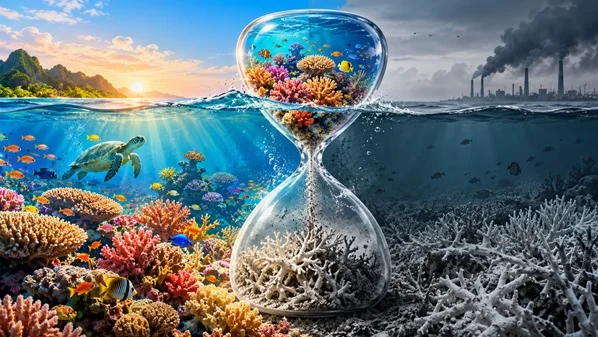
On 22 October 2026, the International Union for Conservation of Nature (IUCN) released a global assessment warning that virtually all assessed shallow-water coral reef ecosystems face a high risk of collapse over the coming decades.
|
Particular |
Details |
|
Assessment organisation |
International Union for Conservation of Nature (IUCN) |
|
Release date |
22 October 2026 |
|
Assessment framework |
IUCN Red List of Ecosystems |
|
Ecosystems assessed |
Shallow-water coral reef ecosystems |
|
Geographic coverage |
127 tropical and subtropical marine ecoregions |
|
Reef area covered |
Approximately 188,362 km² |
|
Critically Endangered under projected climate impacts |
96% of assessed ecosystems |
|
Classification based on observed historical changes alone |
24% of assessed ecosystems |
|
Major threat |
Climate change-induced heat stress |
|
Climate scenario cited |
Approximately 2.7°C warming by the end of the century under the assessment’s middle-of-the-road scenario |
|
Major concern |
Loss of coral reef structure, biodiversity and ecological functions |
Prelims MCQQ. Consider the following statements about coral reefs:
Which are correct? (a) 1 only (b) 2 and 3 only (c) 1 and 3 only (d) 1, 2 and 3 Mains Practice QuestionQ. How does climate change threaten coral reefs? Suggest. |
What did the IUCN report warn?96% of assessed coral reef ecosystems face a Critically Endangered risk under projected climate impacts. What is coral bleaching?The loss of symbiotic algae that causes corals to turn white. Which are India’s major coral reef regions?Gulf of Mannar, Gulf of Kachchh, Lakshadweep, and Andaman and Nicobar Islands. What is the main threat to coral reefs?Climate change, particularly rising ocean temperatures. Can bleached corals recover?If conditions improve; repeated bleaching can prevent recovery. |
| GS Paper I: Indian Culture – Art Forms, Literature and Architecture from Ancient to Modern Times GS Paper III: Tourism Development and Conservation of Cultural Heritage Keywords: Nelakondapalli Buddhist Stupa, Telangana Buddhist Heritage, Mahastupa, Buddhist Viharas, Ikshvaku Dynasty, Vishnukundin Dynasty, Buddhist Tourism, Archaeological Conservation. |
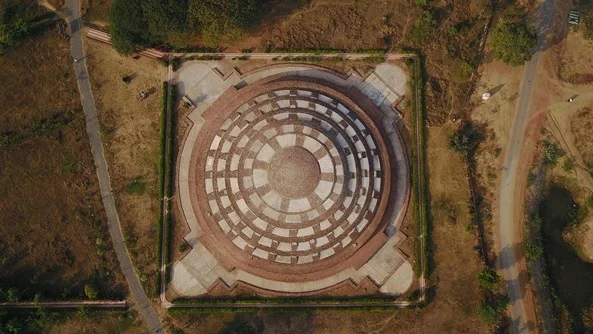
Nelakondapalli is an important archaeological site associated with the spread and development of Buddhism in the Deccan region. The site contains the remains of a large Buddhist Mahastupa, monastic establishments and several ancient structures.
|
Feature |
Details |
|
Location |
Nelakondapalli, Khammam district, Telangana |
|
Assembly constituency |
Palair |
|
Distance from Khammam |
Approximately 21 km |
|
Religious association |
Buddhism |
|
Major monument |
Brick-built Buddhist Mahastupa |
|
Historical period |
Early centuries CE, with remains particularly associated with the 3rd–4th centuries CE |
|
Associated dynasties |
Satavahana, Ikshvaku and Vishnukundin |
|
Important discoveries |
Buddhist sculptures, coins, pottery, terracotta figurines and monastic remains |
|
Archaeological importance |
Evidence of Buddhist religious and monastic activity in ancient Telangana |
The Khammam district administration records that the historic settlement is surrounded by an earthen fortification covering nearly 100 acres.
The archaeological remains of Nelakondapalli reflect the influence of different ruling dynasties that shaped the cultural and religious history of the Deccan.
|
Dynasty |
Approximate period |
Historical connection |
|
Satavahana |
c. 1st century BCE–3rd century CE |
Early Buddhist patronage in the Deccan; Satavahana-period coins are associated with the site |
|
Ikshvaku |
c. 3rd–4th century CE |
Important phase of Buddhist architectural and religious activity |
|
Vishnukundin |
c. 5th–7th century CE |
Archaeological evidence of later settlement and cultural activity |
Excavated coins and archaeological layers particularly establish connections with the Ikshvaku and Vishnukundin periods.
|
Archaeological discovery |
Historical significance |
|
Buddhist Mahastupa |
Indicates Buddhist worship and religious activity |
|
Brick-built viharas |
Provide evidence of organised monastic communities |
|
Bronze Buddha image |
Reflects Buddhist artistic and religious traditions |
|
Limestone miniature stupa |
Demonstrates Buddhist religious symbolism and sculptural craftsmanship |
|
Terracotta figurines |
Offer insights into material culture and artistic practices |
|
Ikshvaku and Vishnukundin coins |
Help identify chronological phases and economic activities |
|
Wells and water-storage structures |
Indicate organised settlement and water-management practices |
|
Pottery and beads |
Provide evidence of everyday life, craftsmanship and material culture |
The Mahastupa is the principal archaeological attraction of Nelakondapalli. Its design reflects the development of Buddhist religious architecture in ancient South India.
The Telangana government aims to develop the site into an internationally recognised Buddhist tourism destination while maintaining its archaeological authenticity.
|
Proposed initiative |
Objective |
|
Restoration and conservation |
Protect the historic Mahastupa and other structures |
|
Tourist amenities |
Improve facilities for domestic and international visitors |
|
Interpretation facilities |
Communicate the site's history and archaeological importance |
|
Walking tracks and landscaping |
Improve accessibility and the visitor experience |
|
Scientific archaeological surveys |
Identify and preserve buried historical remains |
|
Stakeholder consultations |
Include Buddhist monks, heritage experts and local communities |
|
Tourism promotion |
Position Nelakondapalli within Buddhist tourism networks |
|
Buddhist site |
District |
Major historical significance |
|
Nelakondapalli |
Khammam |
Large brick-built Mahastupa, Buddhist monasteries and ancient sculptures |
|
Phanigiri |
Suryapet |
Important Buddhist monastic complex with stupas and sculptural remains |
|
Dhulikatta |
Peddapalli |
Early Buddhist stupa and Satavahana-period archaeological remains |
|
Kotilingala |
Jagtial |
Early historic settlement associated with Satavahana history |
|
Buddhavanam |
Nalgonda |
Modern Buddhist heritage and interpretation project near Nagarjuna Sagar |
Prelims Practice QuestionQ. With reference to the Nelakondapalli Buddhist site, consider the following statements:
Which of the statements given above are correct? (A) 1 and 2 only (B) 2 and 3 only (C) 1 and 3 only (D) 1, 2 and 3 Mains Practice QuestionQ. Discuss the archaeological and cultural significance of Buddhist heritage sites in the Deccan region. How can heritage conservation and sustainable tourism development be balanced in India? |
1. Where is Nelakondapalli Buddhist Stupa located?It is located in Nelakondapalli village, approximately 21 km from Khammam in Telangana. 2. Why is Nelakondapalli historically important?It contains remains of a large Buddhist Mahastupa, monasteries, sculptures, ancient coins and other archaeological evidence of Buddhist activity in the Deccan. 3. Which ancient dynasties are associated with Nelakondapalli?The Satavahana, Ikshvaku and Vishnukundin dynasties are associated with different historical and archaeological phases of the site. 4. What important objects were discovered during excavations?Discoveries include Buddhist sculptures, a bronze Buddha image, terracotta figurines, pottery, coins, brick-built viharas and a miniature limestone stupa. 5. Is Nelakondapalli a UNESCO World Heritage Site?No. |
| Keywords: India's Green Cover, Climate Trends Report 2026, Green Cover Loss, Rising Summer Temperatures, MODIS, ERA5-Land, Climate Adaptation, Urban Heat Island Effect, Vegetation Conservation, UPSC Environment |
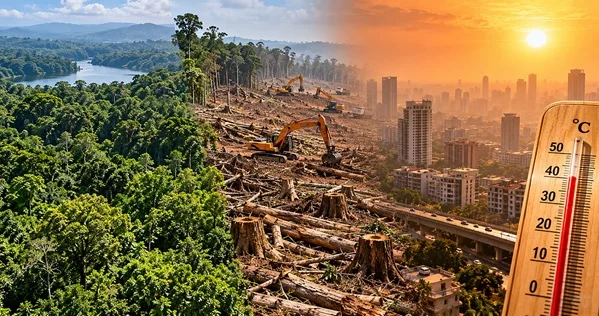
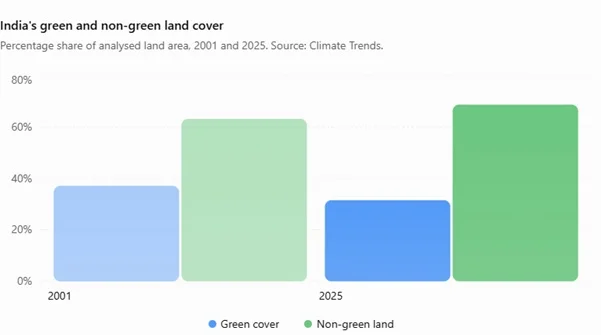
|
Regions |
Major Observations |
|
Western India |
Significant green-cover loss |
|
Indo-Gangetic Plain |
Decline in vegetation coverage |
|
Central and Peninsular India |
Green-cover reduction in several areas |
|
Northeastern India |
Localised gains in green cover |
|
Himalayan Foothills |
Vegetation gains in some areas |
|
Southern and Eastern India |
Mixed changes, including localised improvements |
Summer warming was particularly prominent in northern and northwestern India. Some parts of central and southern India experienced localised cooling.
Vegetation moderates temperatures through several natural processes.
|
Technology |
Purpose |
|
MODIS (Moderate Resolution Imaging Spectroradiometer) |
Satellite-based observation of land cover and vegetation |
|
ERA5-Land Reanalysis Data |
Provides historical information about land-surface and climate conditions |
|
Remote Sensing |
Helps identify changes in vegetation and land use over time |
|
Geospatial Analysis |
Supports the comparison of land-cover changes with temperature patterns |
MODIS instruments operate aboard NASA's Terra and Aqua satellites. ERA5-Land is a land-focused reanalysis dataset produced through the Copernicus Climate Change Service.
|
Initiative |
Objective |
|
Green India Mission |
Protect, restore and enhance forest cover and ecosystem services |
|
National Afforestation Programme |
Support afforestation and ecological restoration |
|
CAMPA |
Utilise compensatory afforestation funds for forest-related activities |
|
Nagar Van Yojana |
Develop and improve urban forests and green spaces |
|
National Action Plan on Climate Change |
Strengthen India's response to climate change through various missions |
|
MISHTI |
Restore and promote mangrove ecosystems along coastal regions |
UPSC Prelims Practice QuestionsQ. Which of the following processes directly contributes to the cooling effect of vegetation? A. Thermal inversion B. Evapotranspiration C. Ozone depletion D. Radioactive decay UPSC Mains Practice Question"Declining green cover can intensify local heat stress and increase India's vulnerability to climate change." Discuss the relationship between vegetation loss and rising temperatures. |
Q1. What is the Climate Trends Report 2026?It is a study examining changes in India's green cover and their relationship with summer temperatures between 2001 and 2025. Q2. How much green cover did India lose between 2001 and 2025?According to the study, green cover declined from 36.95% to 31.35% of the analysed land area, a reduction of 5.6 percentage points. Q3. How does vegetation help reduce rising temperatures?Vegetation reduces heat through evapotranspiration, shade and soil moisture retention, keeping green-covered landscapes relatively cooler. Q4. Which regions experienced significant green-cover loss?The study identified western India, the Indo-Gangetic Plain, parts of central India and several peninsular regions as major areas of vegetation loss. Q5. Can increasing green cover stop global warming?No. |
|
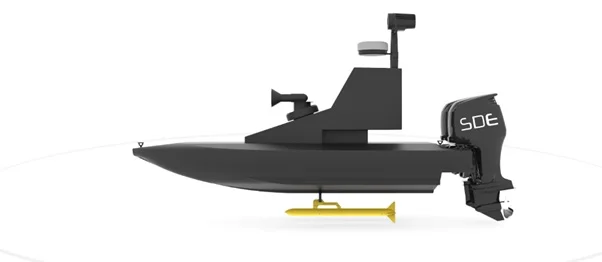
Question 1. With reference to Unmanned Surface Vessels (USVs), consider the following statements:
Which of the statements given above is/are correct? (A) 1 and 2 only (B) 2 and 3 only (C) 1 and 3 only (D) 1, 2 and 3 |
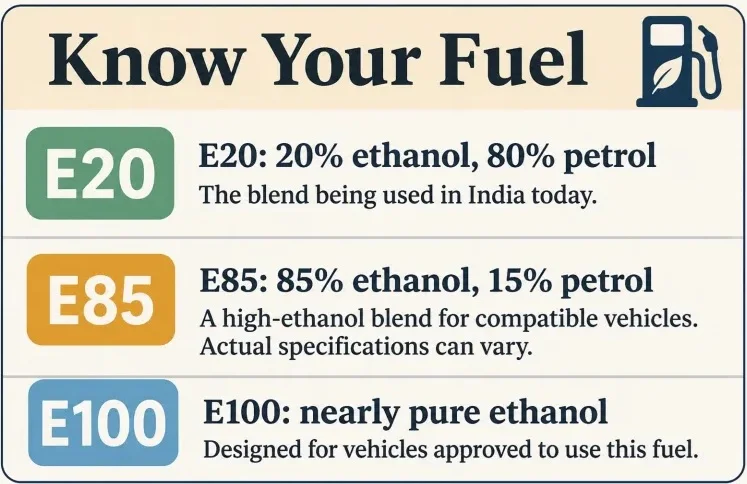
Preliminary Examination QuestionQuestion. What is the major advantage of ethanol's high octane rating? (a) It necessarily increases the energy content of the fuel. (b) It helps reduce engine knocking. (c) It completely eliminates fuel consumption. (d) It reduces carbon dioxide emissions from vehicles to zero. Main Examination QuestionQuestion: Discuss the significance of the amendments to the Central Motor Vehicles Rules for E100 fuel. Also, analyse the technological and economic challenges associated with the expansion of flex-fuel vehicles. |
Question 1. What is E100 fuel?E100 is a fuel consisting of approximately pure ethanol. To use it, a vehicle must be specifically designed and certified for compatibility with this fuel. Question 2. Does the amendment to the E100 rules mean that all petrol vehicles can run on E100?No. The amendment relates to the certification of flex-fuel vehicles. E100 should be used in a conventional petrol or E20 vehicle only if the vehicle manufacturer explicitly confirms that the vehicle is compatible with it. Question 3. What is the main difference between E20, E85 and E100?The three fuels differ in their ethanol content. E20 contains approximately 20% ethanol, E85 contains approximately 85% ethanol, and E100 contains approximately 100% ethanol. Question 4. Why may a vehicle deliver lower mileage on E100?Ethanol contains less energy per litre than petrol. Therefore, a vehicle may require more fuel to cover the same distance. Question 5. Why is ethanol blended with petrol?The main objectives are to reduce dependence on crude oil imports, promote the domestic ethanol industry, and create additional markets for farmers and agriculture-based industries. |
| Prelims: Ebola virus, Bundibugyo virus, WHO, vaccine technology and clinical trials. Mains: GS Paper II: Health, global health cooperation and international organisations. GS Paper III: Biotechnology, vaccine development and disease outbreak management. |
On 23 October 2026, the first participant was vaccinated in the TUMAINI Phase 2/3 clinical trial in Bunia, in the Democratic Republic of the Congo.

|
Particular |
Details |
|
Country |
Democratic Republic of the Congo (DR Congo) |
|
Location of trial launch |
Bunia, Ituri Province |
|
Trial name |
TUMAINI, meaning “hope” in Swahili |
|
Trial phase |
Phase 2/3 |
|
First participant vaccinated |
23 October 2026 |
|
Disease under investigation |
Bundibugyo virus disease (BVD) |
|
First vaccine candidate |
Ervebo |
|
Trial approach |
Adaptive platform trial using ring vaccination |
|
National leadership |
DR Congo Ministry of Health |
|
International support |
WHO, Africa CDC, CEPI and research partners |
|
Ebola virus (EBOV) |
Causes Ebola virus disease |
|
Bundibugyo virus (BDBV) |
Causes Bundibugyo virus disease |
|
Sudan virus (SUDV) |
Causes Sudan virus disease |
|
Taï Forest virus (TAFV) |
Causes Taï Forest virus disease |
Health teams identify confirmed cases and trace people who may have been exposed to the virus.
Ring vaccination targets contacts of confirmed cases and other eligible high-risk contacts, according to the approved trial protocol.
Researchers assess safety, immune responses and the ability of vaccines to prevent disease.
Findings can guide future decisions on vaccine effectiveness, safety and public-health policy.
Prelims MCQQ. The TUMAINI clinical trial is related to which disease? (a) Malaria (b) Ebola (c) Dengue (d) Tuberculosis Mains Practice QuestionQ. Discuss the significance of Ebola vaccine trials in controlling disease outbreaks. |
What is the TUMAINI trial?A clinical trial testing vaccines against Bundibugyo virus. Where did the trial begin?Bunia, DR Congo. When did the trial begin?23 October 2026. What is Bundibugyo virus?A virus that causes a form of Ebola disease. Which organisation supports the trial?The World Health Organization (WHO), along with other partners. |
| Prelims: Biofortification, Kufri Jamunia, ICAR-CPRI, Anthocyanins, Micronutrients, Hidden Hunger, Late Blight Disease. Mains: General Studies Paper II (Health, Nutrition and Government Interventions); General Studies Paper III (Agriculture, Science and Technology, Food Security). Keywords: Kufri Jamunia, Purple Potato, Biofortified Crops, Hidden Hunger in India, Nutritional Security, Vitamin C, Iron, Zinc, Sustainable Agriculture, ICAR. |
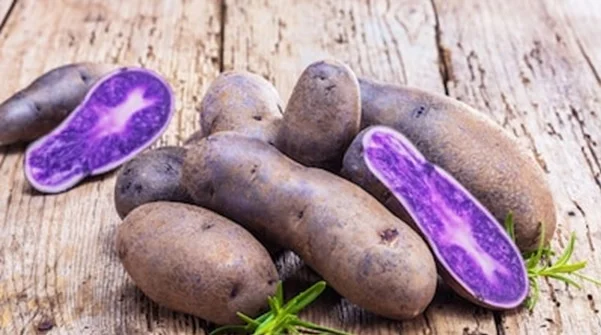
Hidden hunger is a form of malnutrition in which a person consumes sufficient calories but does not receive adequate essential vitamins and minerals.
Kufri Jamunia is a biofortified potato variety developed by ICAR-CPRI, Shimla, to improve the nutritional quality of potatoes through conventional plant breeding.
|
Feature |
Details |
|
Variety |
Kufri Jamunia |
|
Scientific name of potato |
Solanum tuberosum |
|
Developing institute |
ICAR–Central Potato Research Institute, Shimla |
|
Breeding code |
MSP/16-307 |
|
Year of release |
2024 |
|
Skin and flesh colour |
Dark purple |
|
Maturity |
Approximately 90–100 days |
|
Tubers per plant |
Around 10–12 |
|
Recommended yield |
32–35 tonnes per hectare |
|
Major nutrients |
Vitamin C, iron, zinc, anthocyanins and carotenoids |
|
Primary use |
Table consumption and food preparations |
This variety was developed through conventional cross-breeding, not genetic engineering.
|
Basis |
Biofortification |
Food Fortification |
|
Process |
Nutritional improvement of crops |
Addition of nutrients to food |
|
Stage |
During crop development and growth |
During or after food processing |
|
Methods |
Plant breeding and other crop improvement techniques |
Addition of vitamins and minerals |
|
Examples |
Kufri Jamunia, iron-rich pearl millet |
Iodised salt, fortified rice |
|
Objective |
Improve nutrient content in harvested crops |
Improve nutrient content in consumed foods |
According to the Press Information Bureau, Kufri Jamunia contains higher concentrations of several nutrients compared with conventional yellow-skinned potatoes.
|
Nutrient (per 100 g) |
Kufri Jamunia |
Conventional Potato |
|
Vitamin C |
42.75 mg |
23.15 mg |
|
Iron |
3.22 mg |
0.57 mg |
|
Zinc |
2.28 mg |
0.28 mg |
|
Anthocyanins (flesh) |
42.05 mg |
Not specified |
|
Carotenoids (flesh) |
161 µg |
Not specified |
Source: PIB, October 18, 2026. Figures represent reported nutrient concentrations, not the amount absorbed by the human body.
Kufri Jamunia has been evaluated under different agro-climatic conditions to assess its productivity, adaptability and suitability for cultivation.
|
Region |
Average Yield (tonnes/hectare) |
|
Northern Plains |
36.77 |
|
Central Plains |
33.79 |
|
Eastern Plains |
25.91 |
|
Overall Average |
31.96 |
ICAR-CPRI has developed several coloured potato varieties to improve nutritional quality and promote crop diversification.
|
Feature |
Kufri Jamunia |
Kufri Manik |
Kufri Neelkanth |
|
Year of release |
2024 |
2021 |
2018 |
|
Appearance |
Purple skin and flesh |
Red skin, yellow flesh |
Purple skin |
|
Key feature |
High vitamin C and anthocyanins |
Nutrient-rich coloured potato |
High antioxidant content |
|
Average total yield |
31.96 t/ha |
31.52 t/ha |
36.61 t/ha |
|
Marketable yield |
29.19 t/ha |
28.91 t/ha |
33.48 t/ha |
Yield figures are averages from the reported multi-location trials, not guaranteed farm-level yields.
Despite its nutritional potential, several scientific, agricultural and economic challenges could limit its contribution to combating hidden hunger.
|
Initiative |
Objective |
|
POSHAN Abhiyaan |
Improve nutritional outcomes for children, pregnant women and lactating mothers |
|
Saksham Anganwadi and POSHAN 2.0 |
Strengthen nutritional services and Anganwadi infrastructure |
|
Anaemia Mukt Bharat |
Reduce anaemia through prevention, testing and treatment |
|
PM POSHAN |
Improve schoolchildren's nutrition through meals |
|
Food Fortification Initiatives |
Improve the micronutrient content of selected food products |
|
ICAR Biofortified Crop Development |
Develop crop varieties with improved nutritional characteristics |
These initiatives focus on improving access to essential nutrients, dietary quality and nutritional outcomes among vulnerable populations.
Prelims Practice QuestionQ. With reference to Kufri Jamunia, consider the following statements:
Which of the statements given above are correct? (a) 1 and 2 only (b) 2 and 3 only (c) 1 and 3 only (d) 1, 2 and 3 Mains Practice QuestionQ. Biofortified crops can play an important role in addressing micronutrient deficiencies in India. Discuss the potential and limitations of biofortification with special reference to the Kufri Jamunia potato variety. |
Which institution developed Kufri Jamunia?It was developed by the ICAR-Central Potato Research Institute (CPRI), headquartered in Shimla, Himachal Pradesh. Why is Kufri Jamunia purple?Its purple colour comes from anthocyanins, natural plant pigments with antioxidant properties. What is hidden hunger?Hidden hunger is a condition in which people receive sufficient calories but lack essential vitamins and minerals required for healthy growth and development. Is Kufri Jamunia a genetically modified potato?No. Kufri Jamunia was developed through conventional cross-breeding of selected potato lines. When was Kufri Jamunia released?Kufri Jamunia was officially released in 2024. |




