New
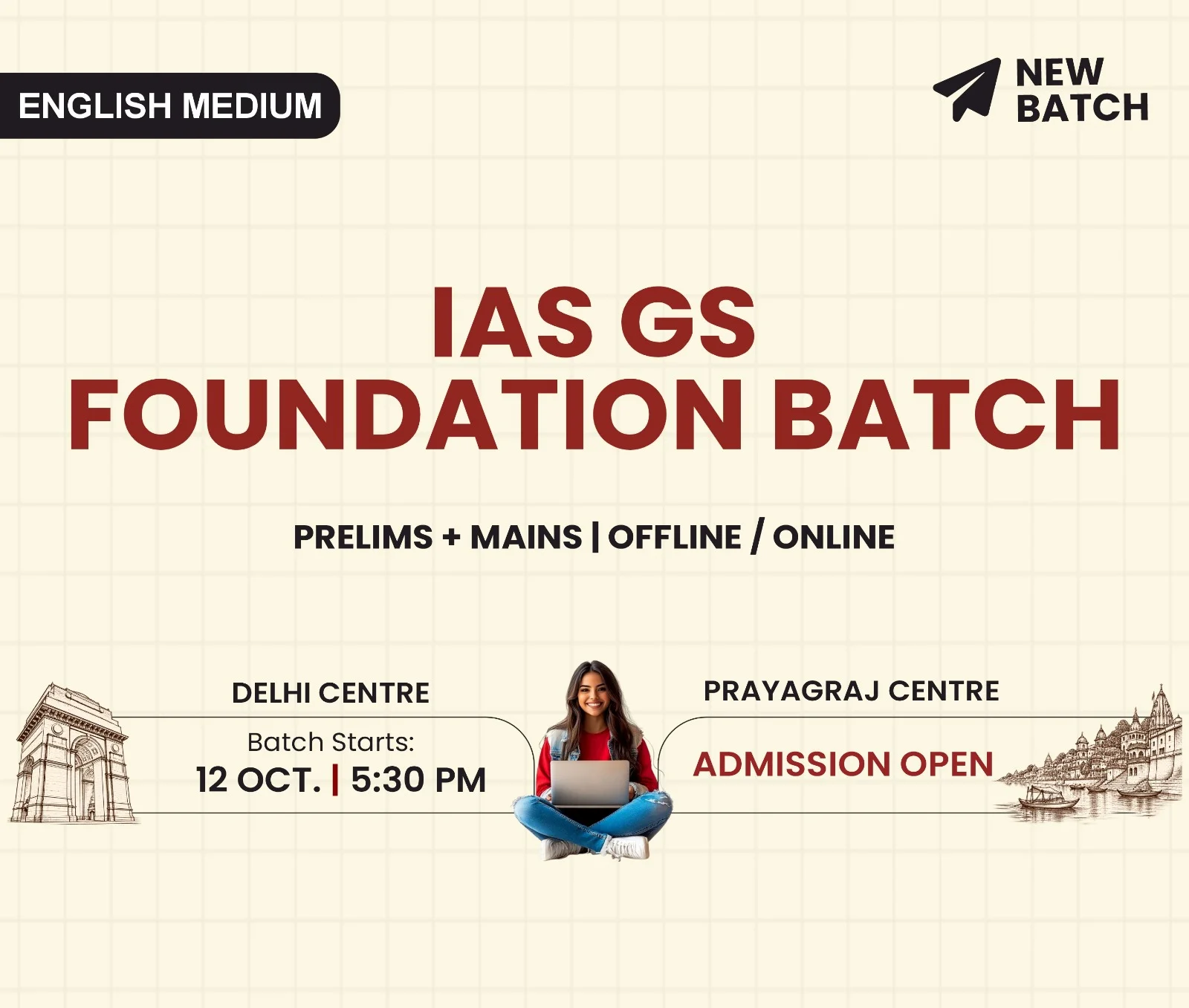
Hindi Medium: (Delhi) - GS Foundation (P+M) : 21st Sept. 2026, 11:30 AM Hindi Medium: (Prayagraj) - GS Foundation (P+M) : 22nd Sept. 2026, 8:00 AM English Medium: (Delhi) - GS Foundation (P+M) : 6th Aug 2026 English Medium: (Prayagraj) - GS Foundation (P+M) : 19th Aug 2026, 11:00 AM Hindi Medium: (Delhi) - GS Foundation (P+M) : 21st Sept. 2026, 11:30 AM Hindi Medium: (Prayagraj) - GS Foundation (P+M) : 22nd Sept. 2026, 8:00 AM English Medium: (Delhi) - GS Foundation (P+M) : 6th Aug 2026 English Medium: (Prayagraj) - GS Foundation (P+M) : 19th Aug 2026, 11:00 AM

CURRENT AFFAIRS

How to Prepare Current Affairs for UPSC Civil Services Examination?

Current Affairs is one of the most important segment of UPSC Civil Services Examination preparation. Questions in the UPSC Prelims Examination and Mains Examination are often connected with recent national and international developments. However, preparing current affairs does not mean reading every news article. The key is to identify exam-relevant issues, understand their background and revise them systematically.

Why Are Current Affairs Important for UPSC? 

The UPSC Civil Services Examination tests an aspirant’s ability to connect current events with concepts from subjects such as Indian Polity, Economy, Geography, Environment, Science and Technology, International Relations, History and Social Issues.

For example, a recent development may be linked to:

  • A government scheme or policy
  • A constitutional or legal issue
  • An economic indicator or government report
  • Climate change and environmental conventions
  • Scientific and technological developments
  • India’s relations with other countries
  • International organisations and global events
  • Social-sector initiatives and welfare programmes

Therefore, current affairs should not be studied as isolated news items. Aspirants should focus on why an issue is important, its background, key facts, implications and its connection with the UPSC syllabus. 

How to Prepare Current Affairs for UPSC?

A structured approach can make current affairs preparation more manageable and effective.

1. Follow Limited and Reliable Sources

Aspirants can refer to reliable sources such as:

  • Press Information Bureau (PIB)
  • The Hindu
  • The Indian Express
  • Down To Earth
  • Business Standard
  • Yojana and Kurukshetra
  • Government reports and official websites
  • Reports published by reputed national and international institutions
  • Sanskriti IAS Website

However, it is not necessary to read every source in detail every day. Following too many sources can lead to information overload and consume valuable preparation time.

The focus should be on selecting a few reliable sources and extracting only the information relevant to the UPSC syllabus.

2. Connect Current Affairs with the UPSC Syllabus

One of the most effective ways to prepare current affairs is to classify news according to the UPSC syllabus.

Current Development

Possible UPSC Area

New Government Scheme

Polity & Governance

RBI Policy Decision

Indian Economy

Climate Conference

Environment

New Space Mission

Science & Technology

India’s Bilateral Agreement

International Relations

Supreme Court Judgment

Indian Polity

Census or Survey

Social Issues & Governance

This approach helps aspirants understand where a particular current affair fits in the examination syllabus.

3. Focus on Concepts, Not Just Facts

UPSC questions often require conceptual understanding rather than simple recall.

Instead of merely memorising that a particular organisation has launched a programme, understand:

  • What is the programme?
  • Who launched it?
  • What is its objective?
  • Who are the beneficiaries?
  • What problem does it address?
  • What is its significance?
  • What are the associated challenges?
  • Which government ministry or organisation is involved?

This approach is particularly useful for both Prelims and Mains preparation.

4. Make Short and Revision-Friendly Notes

Current affairs notes should be short, organised and easy to revise.

A useful format is:

Topic → Background → Key Facts → Significance → Challenges → Way Forward → UPSC Relevance

Avoid copying entire newspaper articles into your notes. Instead, extract only the information that can help answer a Prelims or Mains question.

5. Revise Current Affairs Regularly

Reading current affairs once is not enough. Regular revision is essential because the volume of information can become difficult to retain.

A practical revision cycle can include:

  • Daily: Read and understand important developments.
  • Weekly: Revise major issues and update notes.
  • Monthly: Consolidate important current affairs topic-wise.
  • Before Prelims: Revise facts, reports, indices, schemes, organisations, places and important developments.
  • Before Mains: Revise issues from an analytical perspective, including causes, impacts, challenges and solutions.

6. Practise Current Affairs-Based Questions

For Prelims, aspirants should regularly solve current-affairs-based MCQs. This helps develop the ability to identify important facts and eliminate incorrect options.

For Mains, practise questions that require you to:

  • Analyse an issue
  • Explain its significance
  • Discuss challenges
  • Examine government initiatives
  • Suggest solutions
  • Connect current events with static concepts

This creates a bridge between current affairs and answer writing.

Daily Current Affairs for UPSC: All Important Updates in One Place

Sanskriti IAS Coaching regularly updates Daily Current Affairs on its website to help UPSC aspirants stay informed about important national and international developments. The content is carefully compiled from reliable and leading sources, covering key areas such as Polity, Economy, Environment, Science and Technology, International Relations, Government Schemes, and other important issues relevant to the UPSC syllabus. The information is presented in a simple, concise, and exam-oriented manner, enabling aspirants to save time by accessing important current affairs from multiple sources in one place and preparing effectively for both UPSC Prelims and Mains.

How Much Time Should You Spend on Current Affairs?

There is no fixed number of hours that every aspirant must spend on current affairs. The objective should be efficient coverage rather than maximum reading.

For most aspirants, a focused daily session of around 1–2 hours, combined with regular revision, can be more productive than spending several hours reading multiple newspapers and websites.

The exact time can vary depending on the candidate’s preparation stage, source selection and existing knowledge.

What Should You Avoid While Preparing Current Affairs?

Aspirants should avoid:

  • Reading too many newspapers and websites
  • Making excessively long notes
  • Memorising every news item
  • Ignoring the static syllabus
  • Collecting information without revision
  • Relying entirely on current affairs compilations
  • Spending too much time on irrelevant or entertainment-oriented news

The goal is not to read more current affairs; it is to retain and understand the right current affairs. 

FAQS

Why is UPSC current affairs important for Civil Services preparation?

Current affairs connect static subjects with real-world events. UPSC can ask questions related to recent developments in areas such as polity, economy, environment, science, and international relations.

How much time should I spend on current affairs for UPSC?

The exact time depends on your preparation stage and study plan. A regular daily routine can keep current affairs manageable and leave enough time for static subjects and revision.

Which newspapers are useful for UPSC current affairs?

The Hindu and The Indian Express are commonly used for UPSC preparation. You can also refer to reliable sources such as PIB and Down To Earth for specific topics.

Do I need to read multiple newspapers for UPSC?

No. Reading several newspapers every day can consume valuable preparation time. One reliable newspaper, along with selected official and subject-specific sources, can be sufficient when you study them properly.

How can I avoid missing important current affairs for UPSC?

Follow a structured current affairs source that filters important news according to the UPSC syllabus. Regular revision can also reduce the chances of missing important topics.

Are current affairs questions asked directly in the UPSC exam?

UPSC may frame questions around recent events, but questions do not always come directly from a particular news article. Candidates need to understand the issue and connect it with relevant concepts from the syllabus.

Which current affairs topics are important for UPSC?

Focus on developments related to the Constitution, government policies, economy, environment, science and technology, international relations, social issues, and other areas linked to the UPSC syllabus.

Should I make separate current affairs notes for UPSC?

Yes. Short and well-organised notes can make revision easier. Focus on important facts, concepts, government initiatives, reports, and their connection with the UPSC syllabus.

How often should I revise UPSC current affairs?

Regular revision is important because the volume of current affairs can become difficult to manage later. Weekly and monthly revision can help you retain important information for Prelims and Mains.

Can a current affairs compilation reduce my UPSC preparation time?

Yes. A well-curated compilation can reduce the need to search through multiple sources every day. It can bring relevant developments together and allow you to focus more time on understanding and revision.

GRSE Launches Indigenous Ocean Research Vessel ‘Sagar Manthan’

Science and Technology 10-Sep-2026

Kolkata-based Garden Reach Shipbuilders and Engineers (GRSE) launched ‘Sagar Manthan’ on September 9, 2026. The indigenous ocean research vessel is being built for the National Centre for Polar and Ocean Research (NCPOR) under the Ministry of Earth Sciences.

Tata Advanced Systems Emerges as Lowest Bidder for Zorawar Light Tank Project

Science and Technology 10-Sep-2026

Tata Advanced Systems Limited (TASL), a Tata Group company, has reportedly emerged as the lowest bidder (L1) in the competition to develop the next-generation Zorawar light battle tank for the Indian Army.

First International Space Summit 2026: Key facts, 51 announcements, Ariane 6, PAM-6, Haven-1, European ISS Crew, Importance for India and Significance

Science and Technology 10-Sep-2026

The first International Space Summit opened at the Grand Palais in Paris, France, on 9 September 2026, bringing together delegations from around 120 countries and roughly 2,000 participants.

Australia and India Strengthen Space Cooperation with Five New Partnerships

Science and Technology 09-Sep-2026

Australia and India expanded cooperation in the space sector on 8 September 2026 with five new industry partnerships announced at the 9th Bengaluru Space Expo in Bengaluru.

Army Launches AASHVAST Lab to Identify Chinese Components in Drones

Science and Technology 08-Sep-2026

The Indian Army has established the AASHVAST facility in New Delhi to examine the electronic hardware, firmware and software used in military drones.

India’s Su-30MKI to Integrate Russian RVV-BD Missile: Key Facts, Range Missile, Importance of Radar, Strategic Significance and Challenges

Science and Technology 08-Sep-2026

The Defence Ministry is taking up a proposal to modify the Su-30MKI so it can employ the RVV-BD, a Russian very-long-range air-to-air missile. 

GPT-6 Astra: OpenAI’s New Frontier AI Model

Science and Technology 05-Sep-2026

Recently, OpenAI released GPT-6 Astra, its newest frontier artificial intelligence model. OpenAI describes Astra as its most capable model for complex end-to-end work, with major advances in computer use, software engineering, scientific research and cybersecurity.

FDA Approves New Breast Cancer Drug Etcamah: Key Facts, ESR1 Mutation, Liquid Biopsy, ctDNA-Guided Treatment, Significance and Limitations

Science and Technology 05-Sep-2026

The U.S. Food and Drug Administration (FDA) granted accelerated approval on 4 September 2026 to camizestrant, marketed under the brand name Etcamah by AstraZeneca.

India’s R&D Ecosystem: Challenges, Industry–Academia Gap and the Path to a Knowledge-Based Economy

Science and Technology 04-Sep-2026

The NITI Aayog report ‘Ease of Doing R&D in India’ highlights several structural challenges in India’s Research and Development (R&D) ecosystem. 

India’s First Geosynchronous Earth Imaging Satellite: Key Facts, ISRO EOS-05 Mission, GSLV-F17 Launch, Applications and Strategic Importance

Science and Technology 04-Sep-2026

ISRO has scheduled the GSLV-F17/EOS-05 mission for September 4, 2026. The launch is scheduled for 2:55 AM IST from Sriharikota.

upsc english
« »
  • SUN
  • MON
  • TUE
  • WED
  • THU
  • FRI
  • SAT
Have any Query?

Our support team will be happy to assist you!

OR